





- Data Utilization
Improving Data Quality: Essential for B2B Data Utilization

Use Cases by Objective
New Approach List
Group Strategy

Digital
Marketing

Client Information Registration

Data Deduplication
Corporate Attribute Analysis

SFA/MA Activation

Business Card Data Integration

Credit & Client Check

Use Cases by Department
Sales Department

Inside Sales
Department

Marketing &
Corporate Planning Department

Information Systems Department

Management Department

Use Cases by Tool
Meeting Sonar
Last Updated: April 15, 2021
Click Here to Learn More About Data Utilization ▶
What Is the Reality of Data Utilization
in Market Development?
As digital transformation (DX) becomes the key to corporate growth and competitiveness, the importance of data utilization continues to rise.
This article explains how data integration contributes to the advancement of DX, through key points on data preparation and success stories that promote efficiency across the entire organization.
For companies to achieve sustainable growth, it is essential to integrate online and offline data and make rapid decisions based on accurate information. We hope this article provides insights for your company's DX initiatives. *This article is the final installment of a four-part series.
Table of Contents
1How the Pandemic Changed B2B Marketing
2Online Initiatives to Promote the Visualization of Purchasing Behavior
3Data Preparation Contributes to Improving Overall Corporate Efficiency
5Case Study 2: Success of Online Initiatives at a Major Insurance Company
Recommended Articles
B2B marketing is entering an era of transformation due to the diversification of customer touchpoints driven by the spread of the internet and the rise of social media. In particular, following the COVID-19 pandemic, remote work became commonplace, offline activities such as face-to-face sales and exhibitions were restricted, and the digitization of the purchasing process accelerated rapidly.
According to a McKinsey & Company survey, 57% of U.S. B2B companies reduced their marketing budgets due to the impact of COVID-19. While face-to-face sales dropped from 63% to 20%, online sales increased from 63% to 73%. This trend is now being observed in Japan as well, making it essential to expand online sales and marketing activities.
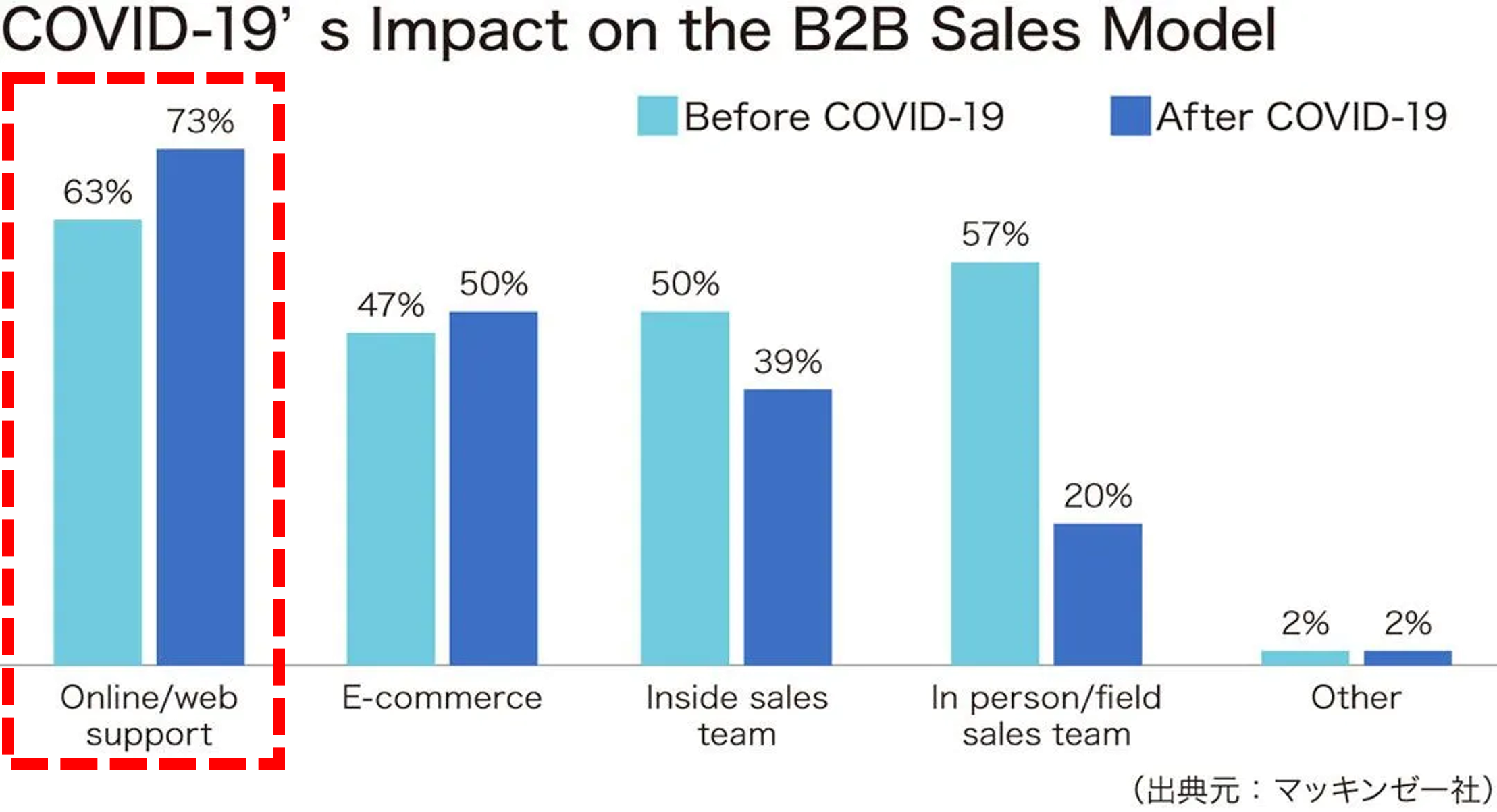
Online initiatives encompass a diverse range of methods, including webinars, website content management, and approaches leveraging email and social media. As these are non-face-to-face activities, they reduce the man-hours required to gather people in physical locations, allowing customers to collect information efficiently.
A significant advantage of online initiatives lies in data collection. According to research by CEB, B2B purchasing decision-makers complete 57% of the purchasing process before contacting a sales representative. Online initiatives play a role in visualizing these invisible customer behaviors. By visualizing customer behavior, companies can redefine their purchasing processes and optimize resource allocation.
However, if data is scattered throughout the company, the effectiveness of online initiatives will be halved. It is crucial to integrate and manage information by categorizing customer behavior into phases and enabling cross-departmental utilization. This allows for the development of initiatives targeting appropriate customer segments.
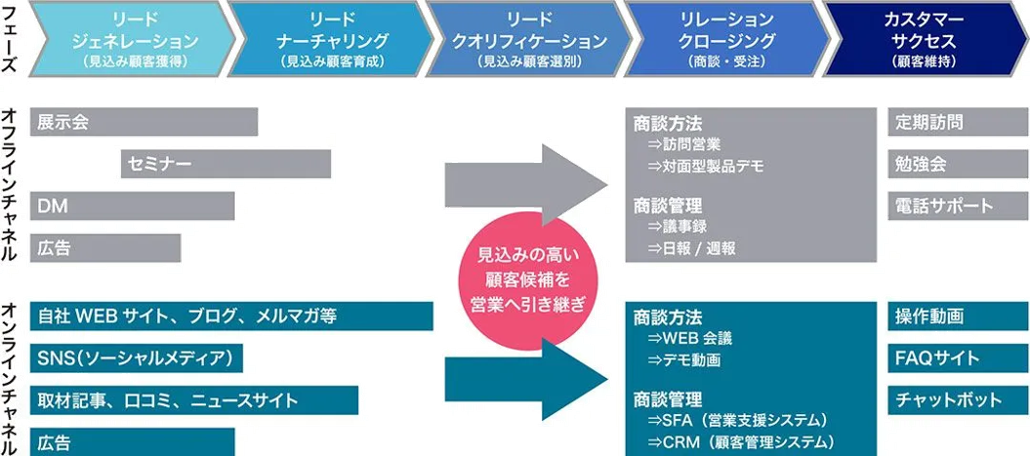
Data maintenance not only enhances the effectiveness of online initiatives but also leads to the efficiency of the entire company. Accurate and up-to-date data is consistently utilized across sales, marketing, and after-sales services, promoting company-wide efficiency.
In the sales department, organized data can be leveraged to create prospect lists, enabling effective approaches. This improves the efficiency of the sales process and enhances conversion rates. The marketing department can also use maintained data to quickly measure campaign effectiveness and conduct customer analysis, which can be applied to future strategies. Sharing data strengthens the collaboration between sales and marketing, thereby improving customer engagement.
Furthermore, in after-sales service, data maintenance enables rapid responses, leading to higher customer satisfaction. Improvements to products and services can also be realized based on customer feedback, enhancing the quality of overall corporate activities. Data maintenance is a factor that realizes seamless information sharing across the organization and increases the speed and accuracy of operations. This leads to the acceleration of initiatives and the optimization of resources, ultimately resulting in the strengthening of corporate competitiveness and sustainable growth.
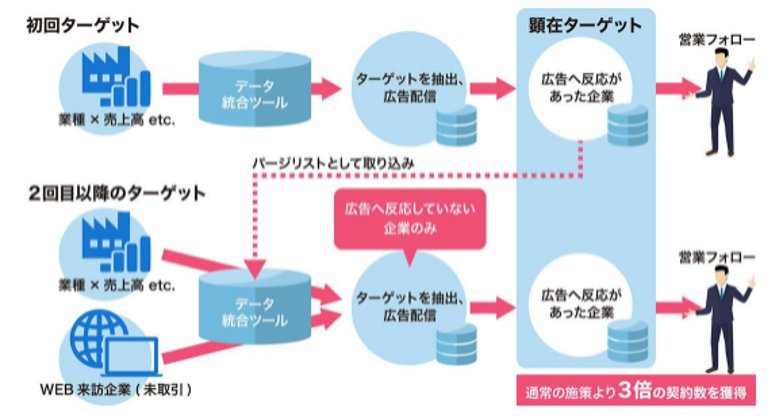
uSonar Co., Ltd. developed a predictive engine to improve the accuracy of its own sales activities and ad delivery by using corporate attributes such as revenue scale and industry for online advertising targeting. This made it possible to integrate online behavioral history with offline data to identify the needs of potential customers.
For example, we utilized uSonar to integrate data sources and applied Account-Based Marketing (ABM) methodologies to our advertising campaigns. As a result, targeting precision improved by 1.6 times, contributing to a higher conversion rate. This also reduced the operational burden of targeting tasks and increased the efficiency of the sales process.
A major insurance company faced challenges in their corporate web content strategy, specifically due to insufficient attribute analysis of visiting companies, which made it difficult to determine the appropriate approach. By implementing a data integration tool and utilizing features to identify visiting companies, they enabled detailed analysis of viewed content and corporate attributes, allowing them to provide optimal content.
Furthermore, by integrating offline client data with web data and executing efficient outreach to non-client companies, the number of contracts increased to three times the previous level. Thus, the integration of online and offline data contributes significantly to the promotion of digital transformation (DX).
As seen in the cases above, the integration of online and offline data is essential for realizing DX. According to research by uSonar, many companies that feel challenged in managing customer information view the fragmentation of data as a primary issue. By utilizing accurate and up-to-date information through data integration, companies can improve the precision and speed of their initiatives, thereby promoting efficiency across the entire organization.
To succeed in DX, the key is to thoroughly organize data and integrate online and offline information for active use. This enables companies to respond quickly to changes and maintain sustainable growth and competitiveness.
Data organization and utilization are essential for the success of DX. By organizing data collected through online initiatives and utilizing it across the entire organization, companies can achieve greater efficiency and respond rapidly to customer needs.
Furthermore, by integrating online and offline data, companies can implement more precise initiatives and strengthen their competitiveness. By recognizing the importance of data organization and utilizing it strategically, companies can achieve sustainable growth and realize the true value of DX.
The Essence of DX is a four-part series.
You can view the previous articles here.
The Essence of DX Vol. 1: The Surprising Blind Spot of Data in Companies That Cannot Achieve DX ▶
The Essence of DX Vol. 2: Organizing Customer Data from the Entry Point Is the Shortcut to DX ▶
The Essence of DX Vol. 3: Organizing Dark Data Promotes DX ▶
About the Author

uSonar Editorial Department
MX Group, Editor-in-Chief
We are the uSonar Editorial Department.
We provide information on data utilization and digital technologies useful for considering future business operations, primarily for companies engaged in B2B business.
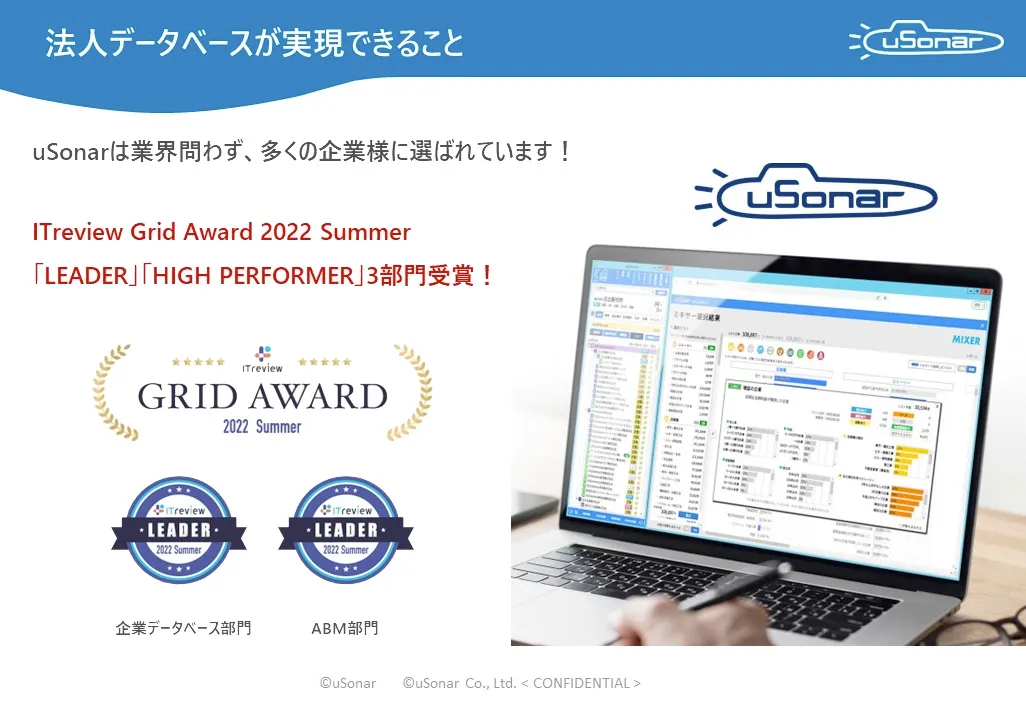
uSonar is utilized by
various companies across all industries and sectors.
ITreview Grid Award 2026 Summer
Leader in 6 Categories

With uSonar,
we can guide your company toward solving its challenges!
Case Studies and Sample Reports
Download