- Intent Data
- Digital Marketing
What Is Intent Marketing? Explaining the Reasons and Challenges for B2B Companies
Last Updated: December 23, 2024
Click Here to Learn More About Digital Marketing ▶
Download the "Free" E-book on
Intent Data
In recent years, "intent data" has been gaining significant attention in the marketing world. However, many marketers may still lack a clear understanding of its precise definition and how to effectively utilize it. This article provides a detailed explanation of what intent data is, its relationship with behavioral data, and how it can be acquired and applied.
If you are interested in learning effective marketing strategies using intent data, please read this article to the end.
Table of Contents
3The Relationship Between Intent Data and Behavioral Data
4The Importance of Intent Data and Its Background
4-1Digital Evolution and Adoption
4-2Personalization of Marketing
4-4Data-Driven Decision Making
5-2Lead Scoring
5-4New Product and Service Development
5-5Customer Lifecycle Management
6Methods for Acquiring Intent Data
7Management Strategy Platform PLANSonar
7-1Types of Intent Data Integrated into PLANSonar
8Utilization Methods for the Management Strategy Platform PLANSonar
9Points to Consider When Acquiring Intent Data
9-1Data Integration and Coordination
9-3Data Updates
10Summary
Recommended Articles

Intent data refers to information that indicates the current intentions and interests of a user.
Intent data is used as a clue to determine whether a user is interested in a specific product or service, or is considering a purchase. For marketers, it serves as a valuable source of information for understanding market needs and trends, and for planning strategies tailored to target audiences.
Behavioral data is information regarding the specific actions and activities a user has taken in the past.
This includes past purchase history, time spent on a website, number of pages viewed, and clicked advertisements or content. By leveraging behavioral data, it becomes possible to perform segmentation and targeting based on a user's past preferences and actions.
Intent data and behavioral data are closely related. While intent data provides information on what a user's current intentions and interests are, behavioral data indicates the actions and activities a user has taken in the past.
By combining these two types of data, you can build more precise user profiles.
For example, if intent data detects that a user is currently showing interest in a specific product, analyzing that user's past purchase history and behavioral data allows you to determine whether that interest is recent or a continuous one.
Furthermore, by creating customer segments based on past behavioral data and then analyzing the intent data (current intentions) shown by users in those segments, you can gain a deeper understanding of the specific needs and interests of your target users.
In recent years, the importance of intent data has been increasing in the field of digital marketing. This is because user purchasing behavior has become more diversified, making it difficult to achieve effective results using only traditional marketing methods.
The fact that intent data has become "purchasable" is also a contributing factor. With the development of digital technology, many methods for collecting intent data have emerged, and companies that sell this data have been established.
In summary, the sequence is: "Development of digital technology" → "Diversification of user behavior" → "Creation of a market" → "Increased importance."
By leveraging intent data, companies can accurately capture the true needs and interests of users, thereby improving the precision of their targeting.
There are several factors behind the rapidly increasing importance of intent data.
Due to the evolution and widespread adoption of digital technology, consumers now frequently engage in online searches, shopping, and information gathering. By aggregating data on such online consumer behavior, it has become possible to infer their intentions and interests.
There is a shift from uniform mass marketing to personalized marketing tailored to individual consumers. Intent data provides the information necessary for this personalization.
As competition intensifies across many markets and industries, accurately capturing and responding quickly to the true needs and interests of consumers has become essential for maintaining and strengthening corporate competitiveness.
With technological advancements in big data and AI, many companies have come to prioritize data-based decision-making. Intent data serves as a critical information source for reflecting consumer intentions within such data-driven decision-making processes.
☆-☆-☆ Body End ☆-☆-☆Intent data can be utilized in various marketing and sales activities.
Based on intent data, marketing activities can be personalized to align with user interests and concerns.
For example, by providing relevant content or offers to users who show interest in specific products, companies can enhance marketing effectiveness and improve conversion rates.
Intent data is also useful in the "scoring" process to evaluate the quality and enthusiasm of leads. By assigning points based on the degree of intent and interest shown by users, and prioritizing high-scoring leads for the sales team, companies can support more efficient sales activities.
Through intent data, companies can analyze how much interest consumers have in their competitors. This provides a strategic perspective for understanding the company's market positioning and clarifying points of differentiation from competitors.
By analyzing user search queries and online behavior identified through intent data, companies can pinpoint potential needs and challenges existing in the market. Based on this information, they can generate ideas for new products and services and proceed with development.
By leveraging intent data, companies can identify which stage of the customer lifecycle a user is in.
The necessary approach differs between a user considering their first purchase and a highly loyal repeat customer. By understanding the user's stage based on intent data, it becomes possible to provide communication and services tailored to their specific needs and interests.
☆-☆-☆ Body End ☆-☆-☆Intent data is classified into "First-Party Data" and "Third-Party Data," with different acquisition methods and tools for each.
This is intent data collected directly by a company, representing user behavior and intentions on channels owned by that company (e.g., their own website, applications, CRM systems, etc.).
Because it is direct data collected in-house, it offers high accuracy and reliability. Furthermore, since it is not shared with other companies, it possesses a high degree of uniqueness.
The data originates from sources such as website visitor page view history, lead information from form submissions or downloads, and click-through rates on email direct marketing.
This is intent data that can be acquired through web analytics tools like Google Analytics and CRM tools like Salesforce or HubSpot, and it has been collected in traditional web marketing as well.
This is intent data collected by other companies and organizations, primarily provided by external data vendors and providers.
Data is provided through each vendor's unique channels and methods, such as industry-specific website and forum visit data, social media trend discussions, and research findings or reports.
Because it allows for comprehensive acquisition of information from multiple sources and platforms, it is useful for grasping broad market and industry trends.
If you can identify users who have an interest or purchase intent for your products or services despite having no prior contact with your company, you can approach them beyond the scope of your existing marketing and sales targets.
Therefore, the utilization of third-party data is receiving significant attention.
By effectively combining First-Party Data and Third-Party Data, you can achieve more precise targeting, segmentation, and personalized marketing strategies.
PLANSonar is a management strategy platform equipped with features to identify and list prospective customers by leveraging intent data. Using this tool allows you to significantly improve the efficiency of your sales and marketing activities.
By using this tool, AI determines high-intent, uncontacted companies and automatically creates lists. This enables the streamlining of sales processes and the maximization of marketing effectiveness.
PLANSonar comes with the following standard intent data features. Each data set analyzes corporate intent from different perspectives to support high-precision targeting.
1. Live Access (First-Party Intent Data)
Live Access is a feature that identifies companies visiting your website in real time. By analyzing visitor IP addresses, you can instantly obtain information such as company names, industries, and employee counts.
• Analyze website visit history to create sales lists.
• Verify the effectiveness of advertisements and landing pages.
• Enable real-time approaches to target companies.
2. Interest Sign (Third-Party Intent Data)
Interest Sign utilizes data from partner companies to generate corporate lists based on specified keywords. By leveraging external data sources, it enables the discovery of new target companies.
• Extract comprehensive corporate lists based on keywords.
• Refine attribute information by integrating with LBC, one of Japan's largest corporate databases.
• Accurately identify the optimal timing for sales negotiations.
3. Interest Sign (Extended Intent Data)
Interest Sign is a service that uses AI to expand interest signals, enabling the generation of highly precise target lists.
• AI-Powered Corporate Estimation: Automatically extracts companies with high similarity based on interest signal lists.
• Analysis Independent of Fixed IP: Covers over one million companies, including small and medium-sized enterprises.
• Refinement Based on Region and Employee Size: Further improves the precision of your target audience.
Other: Standard integration of second-party intent data from B2B media.
Interest Signals and Interest Sign are integrated into the PLANSonar business strategy platform, which can be used in conjunction with Live Access to identify companies visiting your website, delivering the following benefits:
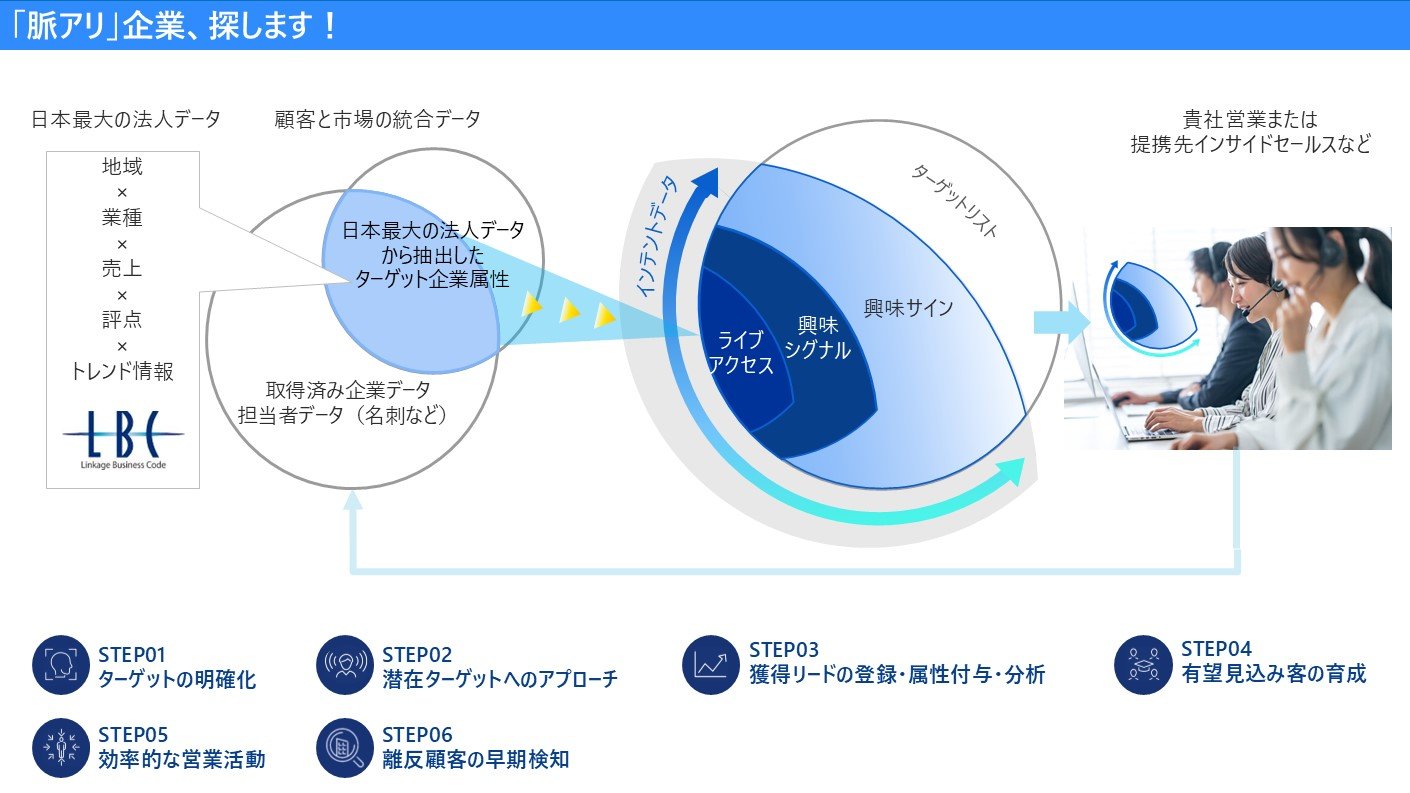
Dynamically generate lists of high-intent target companies detected by Interest Signals and Interest Signs within PLANSonar. Streamline sales activities by instantly sharing high-priority companies with sales representatives.
Leverage Interest Signal and Interest Sign data to visualize target company behavior and needs in real time. Provide this information on the PLANSonar dashboard in a format that facilitates easy management of outreach to potential customers.
Enrich lead information acquired through trade shows or document requests with needs detected by Interest Signals and Interest Signs, and analyze them alongside attribute data. This allows for the identification of optimal timing for priority outreach.
Utilize various corporate attribute data, including Interest Signals and Interest Signs, within PLANSonar to achieve seamless data integration with Marketing Automation (MA) tools and CRM systems. We provide an environment that enables efficient and smooth identification of promising prospects, campaign design, and nurturing activities.
By linking company needs identified through Interest Signals and Interest Signs with business card information, sales representatives can develop concrete outreach strategies. This enables streamlined sales activities and increases the probability of converting leads into business negotiations.
By leveraging "Interest Signals" and "Interest Sign," you can identify potential churn risks that show interest in competitor products or services—insights often missed when relying solely on CS activities or your own Web site visit history. This enables the identification of hidden needs and supports early risk mitigation.
Leveraging intent data allows you to secure a competitive advantage in today's increasingly intense market. "PLANSonar" is an ABM tool that supports both sales and marketing through data, accelerating corporate growth. For more details, please visit our official website:
Integrate the acquired intent data with the data your company already holds in systems such as MA or CRM for centralized management and analysis. When using third-party data vendors, ensure you verify the compatibility with the tools your company currently utilizes.
Verify that the data sources and collection methods are highly reliable. In particular, when purchasing or using third-party data, it is essential to carefully evaluate issues regarding data quality, reliability, and privacy.
Intent data fluctuates moment by moment. It is necessary to ensure you always possess the latest data and avoid making decisions based on outdated information.
☆-☆-☆ Body End ☆-☆-☆Intent data is information that indicates the current intentions and interests of users. While the importance of intent data is increasing, there are still not many companies that are utilizing it correctly.
Start utilizing intent data as soon as possible to enhance the precision of your marketing and sales activities and differentiate your company from competitors.
About the Author
uSonar Editorial Department
MX Group, Editor-in-Chief
We are the uSonar Editorial Department.
We provide information on data utilization and digital technologies useful for rethinking future business operations, primarily for companies engaged in B2B business.
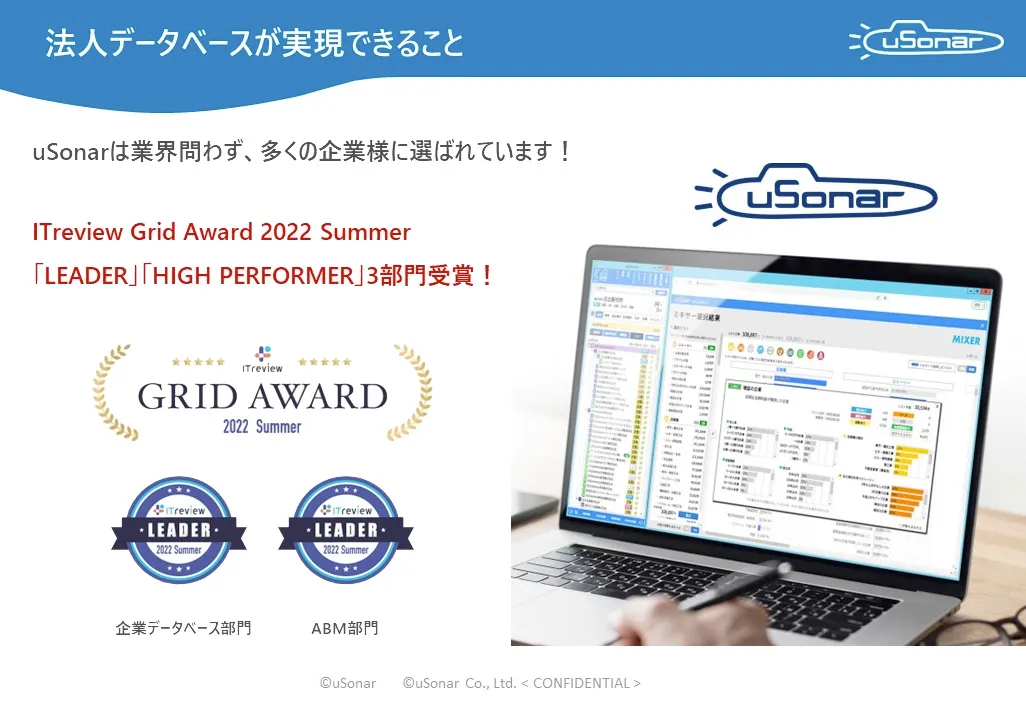
uSonar is utilized by various companies
across all industries and sectors.
ITreview Grid Award 2026 Summer
Leader in 6 Categories

With uSonar,
we can help solve your company's challenges!
Case Studies and Sample Reports
Available for Download