






- Data Cleansing and Consolidation
[Explained by a Database Company] What Is Data Consolidation? A Comprehensive Guide to Organizing and Managing Customer Data!

Use Cases by Objective
New Approach Lists

Group Strategy

Digital
Marketing

Client Information Registration

Data Cleansing
Corporate Attribute Analysis

SFA/MA Optimization

Business Card Data Integration

Credit and Client Screening

Use Cases by Department
Sales Department

Inside Sales
Department

Marketing &
Corporate Planning Department

IT Department

Administrative Department

Use Cases by Tool
Meeting Sonar
Last Updated: February 20, 2026

Recently, discussions regarding "SaaS is Dead" and "SaaS is Weak" have become active among IT industry professionals and investors.
These topics have gained attention following the rapid adoption of generative AI, which triggered a temporary, significant decline in the stock prices of SaaS companies.
In this blog, we will explain how to interpret these discussions and discuss their relationship with uSonar's own SaaS business model.
Table of Contents
1Introduction: A Review of Previous Discussions
2Main Discussion: Defining SaaS and Identifying Sustainable SaaS Solutions
2-1Key Definitions and Characteristics of SaaS
2-2Major Advantages and Disadvantages
2-3Representative Service Domains
3Conclusion: As a Data Infrastructure, uSonar Is Positioned to Leverage Both AI and SaaS
Recommended Articles
The prevailing theory regarding the origin of this discussion is that it began in late 2024, when Microsoft CEO Satya Nadella stated that business tools such as SaaS would be transformed by the arrival of the AI era.
Since then, various opinions have been exchanged, primarily within parts of the SaaS industry. While there were some actual moves to adapt businesses to this trend, the discussion subsequently quieted down.
However, entering 2026, on January 30, the U.S. generative AI venture Anthropic announced an innovative implementation of the business AI "Claude Cowork." This attracted attention for its potential to drastically increase the efficiency of various office tasks, leading to a sudden decline in SaaS stocks in both Japan and the U.S.
The sentiment spread that "full-scale business AI has finally arrived" and "the SaaS market might be replaced by AI." However, a more detailed and objective analysis suggests there is a distinction between "SaaS that will be phased out" and "SaaS that will survive" in the AI era. What exactly is that difference?
Here, we define SaaS (Software as a Service) companies as follows.
- Internet-Based Access: No installation or physical package purchase required.
- Subscription Model: Pay-as-you-go or monthly/annual contract-based billing.
- Vendor-Managed Updates: Maintenance, management, and the latest updates are handled by the service provider.
- Multi-Tenant Architecture: A system structure where a single instance is shared among multiple customers.
- Cloud-Based: Data is stored in the cloud via the internet and is accessible from outside the office.
- Advantages: Low implementation costs, no maintenance required, simultaneous multi-user access, and rapid deployment.
- Disadvantages: Limited customization, internet connectivity required, and potential security risks.
- Operational Efficiency, Communication, Customer Management & Sales Support, HR & Back Office
So, which of these characteristics are being viewed as "Dead" or "Weak"?
A careful examination of the ongoing discussion suggests that three specific characteristics are likely to be impacted by AI: "ID-based billing," "UI touchpoints," and "in-house system development."
The traditional model was that the more users a client company had, the more they paid to the SaaS provider. However, the emergence of generative AI is disrupting this structure. As AI begins to take over human tasks, the required "number of humans" decreases, leading to a reduction in the number of contracted IDs. The argument is that as efficiency improves, SaaS businesses may face declining revenue.
Providing various functions through an easy-to-use UI (User Interface) is another core value of SaaS. The argument here is that this value is rapidly becoming obsolete due to the evolution of AI.
Regardless of whether the UI is designed for humans, any LLM (Large Language Model) can generate the necessary business output simply by inputting data. This implies that the reason to maintain a contract based solely on a superior UI is beginning to disappear.
This point concerns whether the services and systems provided by SaaS vendors will be replaced because they can now be developed in-house using convenient AI. With AI tools now capable of coding faster than software engineers and allowing for flexible, custom-tailored solutions, the incentive to continue paying fixed costs to SaaS companies is diminishing.
Looking at it this way, the reality of the debate is that several of the strengths held by SaaS companies are being neutralized by AI. This does not mean that all characteristics of SaaS have weakened. It becomes clear that the "Death of SaaS" debate refers to the "relative decline of function-providing SaaS."
uSonar provides value to corporate clients via a cloud-based model. While it shares some characteristics with SaaS, the core value we deliver is our proprietary data. Consequently, our market position differs from that of other SaaS providers.
Our core strength lies in providing our corporate database, "LBC (Linkage Business Code)," to our clients. LBC is a master corporate database covering 12.5 million business locations. It is composed of irreplaceable and difficult-to-replicate data assets that we have independently built over more than 35 years since our establishment in 1990, in addition to the collection and classification of corporate information from the internet.
Below, we outline three strengths of uSonar that are becoming increasingly significant in the AI era.
Building a database of our scale today would require a significant investment of time and capital. While the emergence of AI has lowered the barrier to functional development, the value of accumulating original data remains unchanged.
In an era where generative AI and AI agents are fully entering the realm of corporate decision support, companies that possess high-precision corporate data are positioned at the starting point and foundation of the AI supply chain. This is because no AI can maximize its potential without concrete, high-quality data.
Corporate databases integrated into core systems involve high switching costs once implemented. In fact, our churn rate is exceptionally low, at 0.21%.
What are your thoughts?
As with uSonar, we hope you understand that business models that maintain data occupy a robust position relative to both AI companies and SaaS companies, allowing them to leverage the strengths of both.
While we continue to monitor the discourse surrounding "SaaS is Dead/Weak," uSonar remains committed to providing value to our corporate clients by focusing on the comprehensiveness, freshness, and accuracy of our corporate data.
About the Author

uSonar Editorial Department
MX Group Editor-in-Chief
We are the uSonar Editorial Department.
We provide information on data utilization and digital technologies useful for considering future business operations, primarily for companies engaged in B2B business.
uSonar is utilized by
various companies across all industries and sectors.
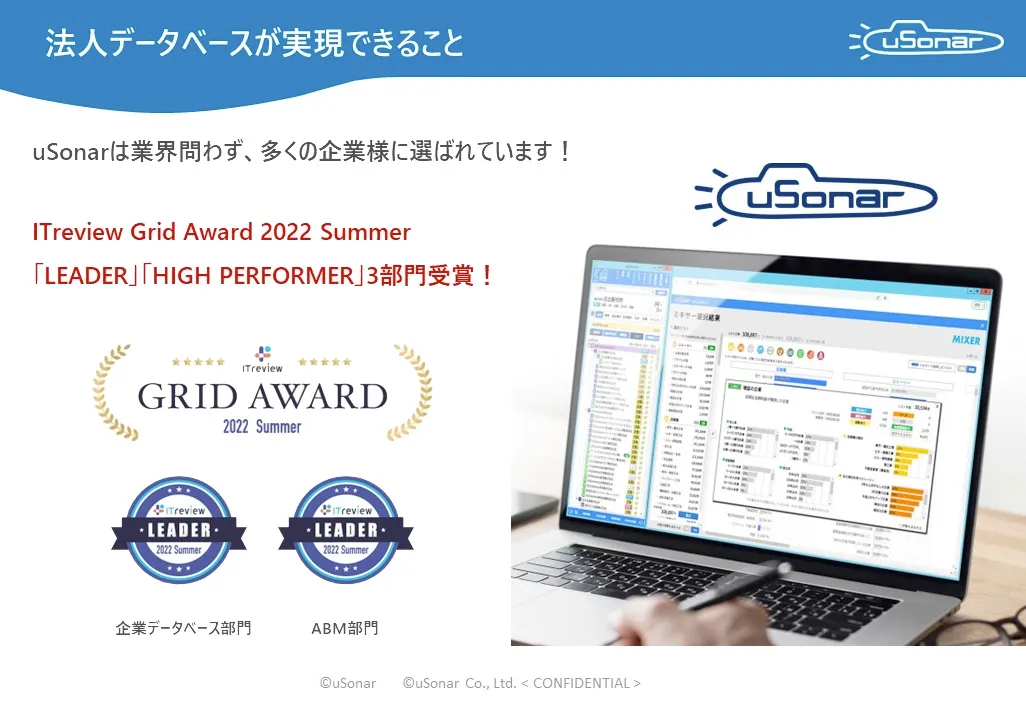
ITreview Grid Award 2026 Summer
Leader in 6 Categories
With uSonar,
we can guide your company toward solving its challenges!
Case Studies and Sample Reports
Download