- Data Utilization
- Corporate Data
- Customer Management and Analysis
Differences Between MDM and CDP: Comparing the Two Major Foundations Supporting Customer Data Utilization
Last Updated: April 2, 2024
Click Here to Learn More About Corporate Data ▶
Click Here for an Overview of the LBC Corporate Database and
uSonar
LBC is a corporate information database independently collected and built by uSonar. It covers data at the location level, including business offices and retail stores, with one of the largest volumes in Japan, totaling 12.5 million records.
Boasting the most comprehensive coverage in Japan, LBC serves as a vital tool for supporting corporate growth by streamlining sales and marketing activities and maintaining accurate customer information.
In this article, we introduce the features of LBC and the benefits of leveraging it.
Table of Contents
1What Is the LBC Corporate Information Database?
2LBC: Japan's Largest Corporate Information Database with 12.5 Million Records
3Background of the LBC Corporate Information Database Development
4A Database Specialized for Customer Data Management and Marketing
5LBC Corporate Information Database Feature (1): Data Cleansing Expertise
61. Textbooks and Dictionaries for Data Management
83. Dictionary 1: Historical Information
94. Dictionary 2: Corporate Name Knowledge
11Corporate Information Database LBC Features (2): Code System
12Rule 1: A Unique Identification Number Is Assigned to Every Business Location
13Rule 2: The Headquarters of Any Business Location Is Represented by the Headquarters LBC
14Rule 3: The Parent Company of Any Business Location Is Represented by the Parent Company LBC
15Rule 4: The Top of the Capital Hierarchy Is Represented by Its Own Code
16Rule 5: In Case of Affiliation, Only the Grouping Information Is Updated
17Corporate Information Database LBC Features (3): Maintaining Freshness and Accuracy
18Summary
Recommended Articles
The Corporate Information Database LBC (Linkage Business Code) is a database of 12.5 million corporate records maintained by uSonar. By utilizing a comprehensive, deduplicated marketing database as a foundation for sales and marketing activities, companies can streamline internal resources. Furthermore, by effectively leveraging external resources for the construction and maintenance of this foundational database, companies can reduce their operational burden.
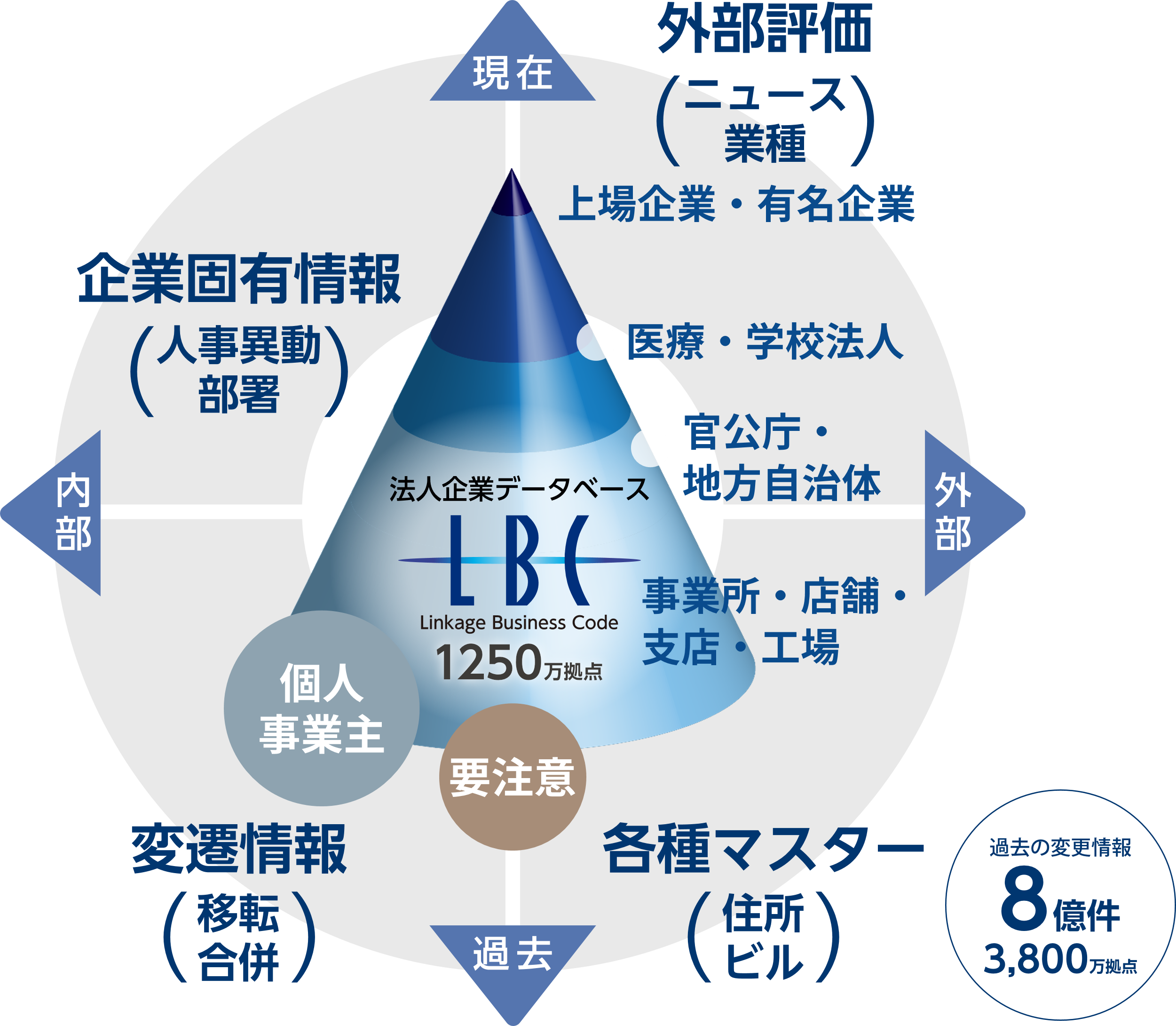
The Corporate Information Database LBC is a corporate database covering 12.5 million business locations, independently collected and built by uSonar. Based on the philosophy of "organizing information for every company in Japan," the database has been constructed to include over 38 million location records when historical data is included.
In recent years, the pace of environmental change has been accelerating, and companies are required to redesign their business processes to adapt to these rapidly shifting conditions. Nevertheless, it can be said that many companies have managed to avoid addressing the challenge of business process redesign until now.
On the other hand, there are companies that have faced these challenges head-on, viewing them as "opportunities to build mechanisms for next-generation growth." We understand that such companies did not start from scratch with new initiatives; rather, they built the foundation for growth by optimizing internal resources and effectively leveraging external resources based on existing frameworks.
At uSonar, we have built and provided the Corporate Information Database LBC to assist in this process by organizing and utilizing the database that serves as the foundation for sales and marketing activities. A foundational database must be built to be "Mutually Exclusive and Collectively Exhaustive." Databases with duplicates lead to the waste of redundant approaches, while databases with gaps result in missed opportunities, which remains a challenge for many companies.
By using this Corporate Information Database LBC,
is achieved.
The most prominent feature of the LBC corporate database is its volume of 12.5 million records, which stems from the fact that LBC is specifically designed for customer data management and marketing purposes.
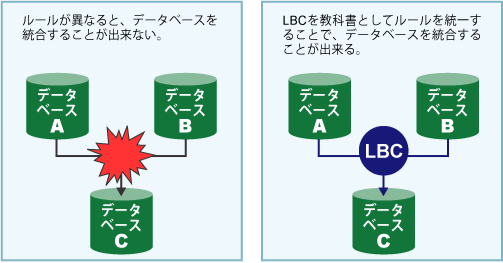
For instance, when managing customer data, LBC serves as a reference guide, as detailed below. If the reference guide (LBC) itself lacks sufficient data, it becomes impossible to clean or organize your records effectively, preventing the achievement of high-precision customer data management.
Furthermore, when planning marketing strategies or executing outreach, it is essential to first view the entire market to identify untapped markets and prospective clients. This requires a database that provides a comprehensive overview of the entire market.
For these reasons, we have constructed a database containing 12.5 million records. Additionally, the LBC corporate database includes a vast amount of data beyond private enterprises, such as central government agencies, local municipalities, schools, hospitals, public interest corporations, social welfare corporations, and religious organizations. While corporate credit research firms are well-known for their business databases, data on non-private entities is often of secondary importance when the primary goal is credit assessment. In contrast, because LBC is primarily intended for customer data management and marketing rather than credit assessment, we actively collect and maintain this diverse range of data.
By utilizing our accumulated knowledge (cleansing expertise) during the matching process between your customer database and the LBC corporate database, we achieve a high matching rate. This allows for the effective management and organization of a larger volume of data.
Furthermore, leveraging our long-standing data cleansing technology, we assist in visualizing identical or affiliated companies by assigning common keys* and latitude/longitude information to the registry data (over 10 million records) used in statistical surveys conducted by the Ministry of Economy, Trade and Industry. (Ministry of Economy, Trade and Industry Begins Using the LBC Corporate Database)
*: Common Key
A unique identifier used to specify a headquarters or business location (including sole proprietorships that do not possess a corporate number).
To manage customer data effectively, rules for data maintenance must be established in advance. Without consistent management rules, data integrity cannot be ensured. In reality, however, database management rules are rarely consistent; they often vary not only across multiple databases but even within a single database. Under such conditions, data cannot be properly managed. Therefore, a set of rules is essential. Please consider the LBC corporate database as the reference guide for these rules. By organizing your customer database according to the rules defined in this guide, you can achieve data consistency.
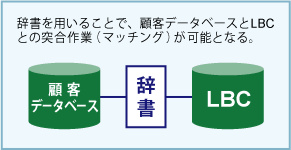
To apply textbook rules to a customer database, matching (reconciliation) between the customer database and the textbook is required. However, since the customer database and the textbook operate on different rules, they cannot be matched directly. Therefore, a dictionary (Knowledge Master) is necessary to bridge the customer database and the textbook. By entrusting your customer data to uSonar, we convert the rules according to this dictionary, enabling successful matching between the disparate rules of your customer database and the textbook.
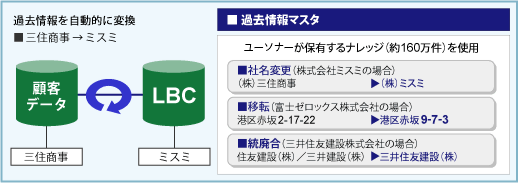
A common cause of failure when matching databases is data freshness, such as when one set of data is outdated. For example, if customer data contains an old company name or address, it cannot be matched with the LBC corporate information database as is. To address this, the LBC corporate information database utilizes historical information as a dictionary. Specifically, by using a master (dictionary) that accumulates past events such as company name changes, address relocations, and mergers and acquisitions, we can automatically convert and match customer data even if it contains old company names or addresses.
Similar to historical information, matching failures can occur due to the input of abbreviations or commonly misspelled company names. For example, writing "NEC" instead of "Nippon Electric Company" or "All Nippon Airways" as "ANA." At uSonar, we have accumulated these "data entry habits" as knowledge gained through past matching operations. Even if your customer data is entered using abbreviations or common misspellings, this knowledge allows us to automatically convert them to the official company names, enabling accurate matching.
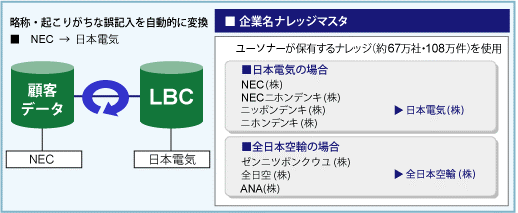
While this may seem minor compared to the previous points, data matching can also fail due to subtle variations in notation. uSonar employs data cleansing technology to standardize address formats (e.g., converting common address notations to official ones). Furthermore, we can process the conversion of old addresses to new ones resulting from municipal mergers.
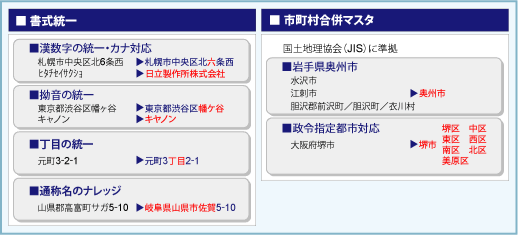
As demonstrated, even if customer data contains typos, omissions, old company names, old addresses, or pre-merger information, we utilize our proprietary dictionaries (various knowledge bases) to perform matching with the LBC corporate information database, thereby achieving high matching accuracy.
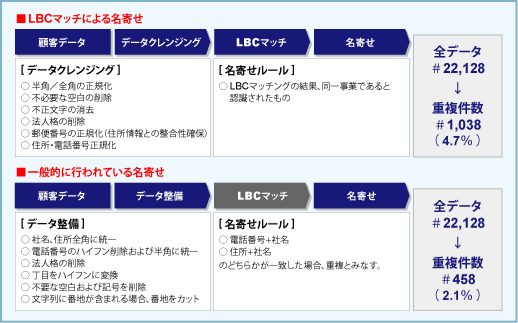
By utilizing the "dictionaries" of the LBC corporate information database in this manner, the duplicate identification rate is improved. So, what level of improvement can be expected? While this is for reference only, let us compare the results of deduplicating the business card information entered by uSonar sales representatives, as used in our previous examples, with and without the use of the LBC corporate information database.
When using the LBC corporate information database, 1,038 out of 22,128 records (4.7%) can be identified as duplicates, whereas only 458 records (2.1%) can be identified without it. This difference is due to the dictionaries that enhance cleansing accuracy.
The Corporate Information Database LBC groups business locations that share relationships such as headquarters-branch or parent-subsidiary. This enables data management at the group level, allowing you to consolidate sales information by group to determine gross transaction volume, or identify non-trading locations within a group for cross-selling opportunities.
When organizing customer information, linking data related to headquarters-branch or parent-subsidiary relationships is critical. Without this linkage, it is impossible to grasp transaction amounts at the group level or identify non-trading locations of existing customers to plan outreach strategies.
Generally, a method is adopted where a parent number such as 0001 is assigned to the headquarters, and branch numbers such as 0001-001 are assigned to business locations to represent the group. However, with this type of management, the code structure gradually collapses due to mergers, acquisitions, or business closures, eventually becoming unmanageable.
To avoid such situations, the Corporate Information Database LBC assigns a unique, immutable code to all business location data and adopts a code structure that links relationships such as headquarters-branch or parent-subsidiary. This linkage is the reason for the name Linkage Business Code (LBC).
Specifically, the rules are as follows.
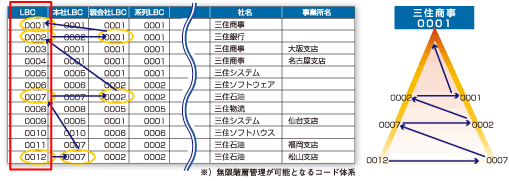
First, an individual code (identification number) is assigned to every business location. This code is also referred to as "LBC." LBC is both the name of the corporate information database and the name of the management code. To avoid confusion, we will distinguish between the two: when referring to the master data itself, we will use "Corporate Information Database LBC," and when referring to the management code, we will use "Corporate Management Code LBC." Since the Corporate Management Code LBC is assigned individually to each business location, the same number will never exist for multiple locations, and the number is permanent and immutable.
*1 The actual code consists of 11 digits.
*2 Because the 12.5 million records are based on business locations rather than companies, separate codes are assigned to different sites of the same company, such as a headquarters and a factory (The Corporate Information Database LBC is recorded with data consolidated at the location, company, and corporate group levels).
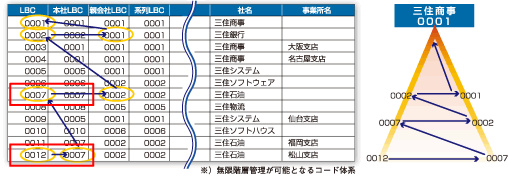
For example, regarding the LS Oil Matsuyama Branch (0012), looking at the Headquarters LBC column shows 0007, indicating that it is a business location of LS Oil (0007). Similarly, for LS Oil (0007), the Headquarters LBC is its own code (0007), which indicates that LS Oil (0007) is the headquarters.
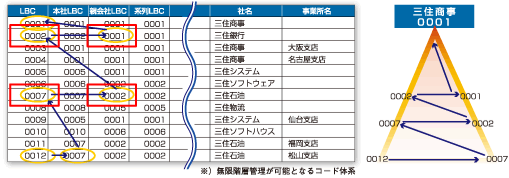
Regarding LS Petroleum (0007), the Parent Company LBC field shows 0002, indicating it is a subsidiary of LS Bank (0002). Similarly, the Parent Company LBC field for LS Bank (0002) is 0001, indicating it is a subsidiary of LS Trading (0001).
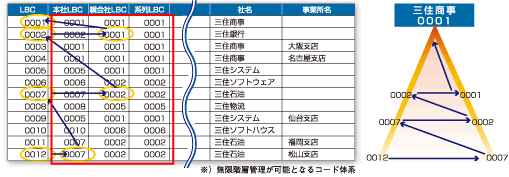
For LS Trading (0001), the Headquarters LBC, Parent Company LBC, and Group LBC fields are all 0001, which identifies it as the top of the corporate group.
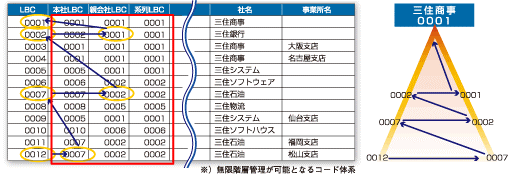
Even if changes occur in group relationships due to mergers or acquisitions, only the grouping information is updated, while the Corporate Management Code LBC remains unchanged (the Corporate Management Code LBC is immutable). By keeping the assigned identification number (Corporate Management Code LBC) constant and updating the attribute information, we maintain the consistency of the code system.
By utilizing this code system, we can group the client data provided by our customers, enabling data consolidation at both the individual company and corporate group levels.
Maintaining a massive dataset of 12.5 million records is no simple task. How, then, is this data maintenance performed?
Fundamentally, it follows the same process as the initial data construction. We reflect updates in the Corporate Information Database LBC as soon as the data sources are updated. For example, when a securities report is disclosed, we update the data based on that information. The same applies to corporate telephone directories and websites, which are updated as soon as the source data is refreshed. (Reference: URL showing monthly data update counts by category: https://usonar.co.jp/service/lbc-realtime/)
By leveraging the information in the constantly updated Corporate Information Database LBC, you can keep your customer data current at all times. By obtaining relocation information from the Corporate Information Database LBC, you can reduce approach loss, avoid potential brand damage caused by contacting outdated information, and enable accurate sales trend management through precise linking with past performance records.
We maintain the LBC corporate information database using a variety of methods. Please contact us for further details.
By leveraging the LBC corporate information database, you can streamline internal resources through sales and marketing activities based on a comprehensive, deduplicated marketing database. Furthermore, you can reduce the operational burden of building and maintaining your foundational database by effectively utilizing external resources.
About the Author

uSonar Editorial Department
MX Group, Editor-in-Chief
We are the uSonar Editorial Department.
We provide information on data utilization and digital technologies useful for rethinking future business operations, primarily for companies engaged in B2B business.
uSonar is utilized by various companies
across all industries and sectors.
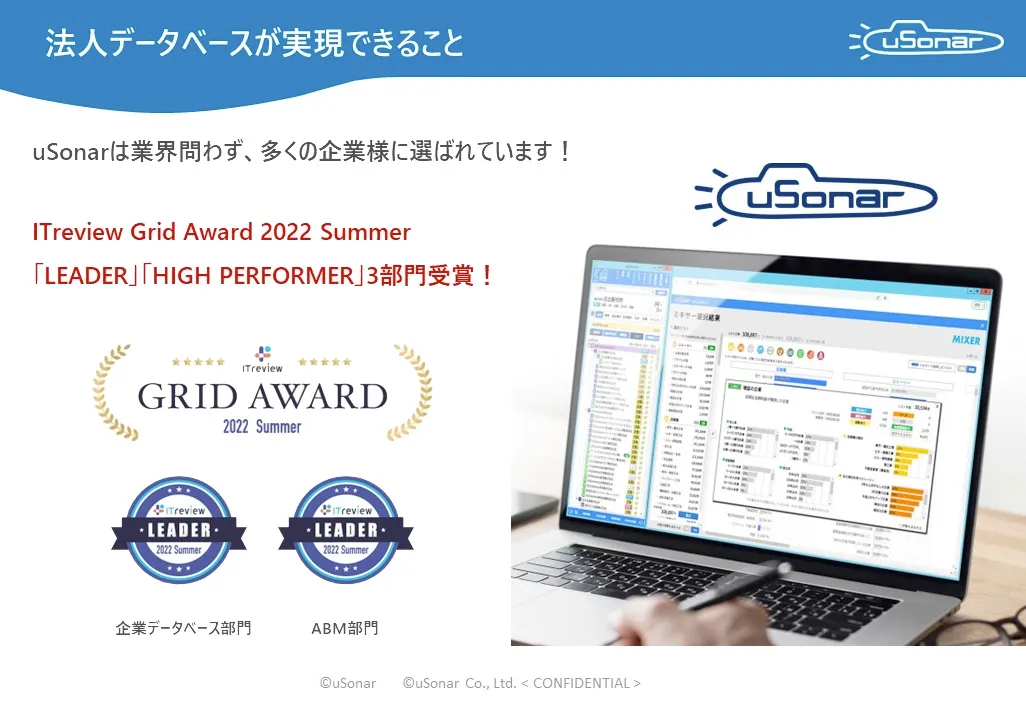
ITreview Grid Award 2026 Summer
Leader in 6 Categories

With uSonar,
we can help solve your business challenges!
Case Studies and Sample Reports
Available for Download