- Intent Data
- Digital Marketing
What Is Intent Data? Visualizing Customer Interests Through Behavioral Data
Last Updated: October 15, 2024
Click Here to Learn More About Digital Marketing ▶
Download the Free
Intent Data E-Book
In B2B marketing activities, difficulty in discovering potential customers or understanding the needs of existing clients can prevent effective engagement, leading to issues such as "lost sales opportunities" and "customer churn."
This is where "Intent Marketing" becomes a critical focus.
Intent Marketing is a strategy that leverages data indicating customer intent and interests to develop more effective marketing approaches.
This enables communication that is more closely aligned with customer needs.
This article provides a detailed explanation of how Intent Marketing contributes to B2B operations, as well as the challenges involved in its implementation and how to resolve them.
Table of Contents
2Contributions of Intent Marketing to the B2B Buying Funnel
2-1Dark Funnel Before Awareness: Visualizing Potential Targets
2-2Interest and Consideration Stage: Identifying Needs Within Customer Data
2-3Retention and Loyalty Stage: Preventing Churn and Improving Customer Success Quality
3Challenges in Implementing Intent Marketing for B2B Companies
3-2Lack of Established Data Management Frameworks
3-3Insufficient Consideration for Privacy
4Solutions for Challenges in Intent Marketing Implementation
4-1Selecting High-Quality Data Sources
4-2Leveraging an Integrated Data Platform
Recommended Articles

Intent Marketing is a methodology that leverages data indicating customer intent and interests to develop more effective marketing strategies.
By analyzing real-time customer behavioral data in addition to traditional demographic information and past purchase history, businesses can achieve communication that is more closely aligned with customer needs.
The core of Intent Marketing is focusing on the customer's "now."
By collecting and analyzing data such as website browsing history, search keywords, and content consumption patterns, businesses can accurately grasp the challenges and interests customers are currently facing.
This enables an approach optimized in terms of both timing and content.
Intent Marketing is gaining particular attention in the B2B sector, as it can streamline complex and long-term sales processes while providing a higher-quality customer experience.
* "Intent Marketing" is a trademark of Sales Marker, Inc.
Intent data is primarily classified into the following three categories:
Combining these three types of data enables a more comprehensive understanding of customers.
First-party data is information obtained from direct touchpoints with your company, but its scope is limited.
By leveraging second-party data, you can grasp broader customer behavior through collaboration with partner companies.
Furthermore, by adding third-party data, it is possible to capture wider market trends and the behavior of potential customers beyond the scope of your company and partners.
While it is not necessary to utilize all data at all times, it is important to understand the characteristics of each data type and combine them appropriately according to your business goals.
What Is Intent Data? Visualizing Customer Interests Through Behavioral Data ▶︎
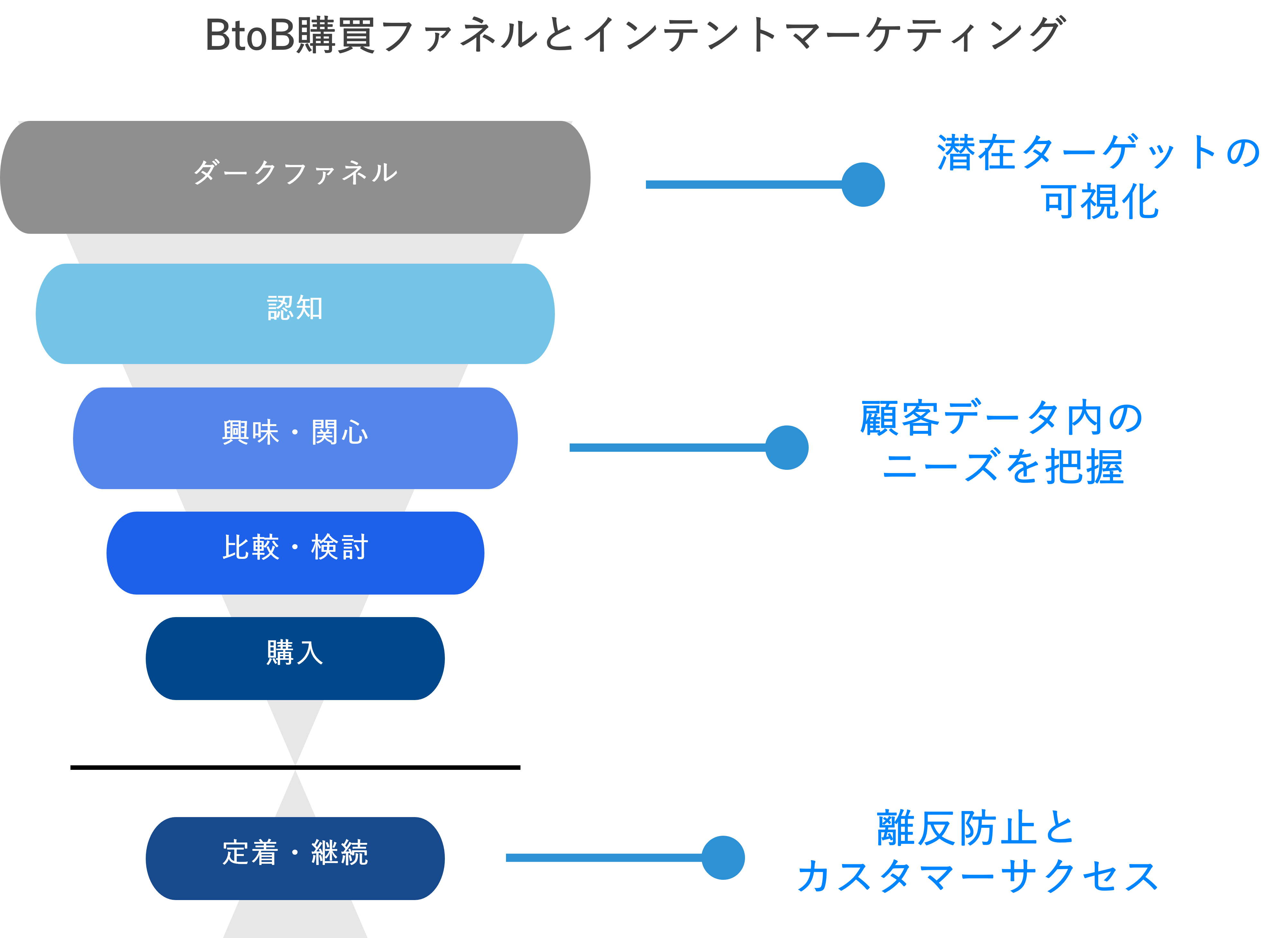
The B2B purchasing funnel is a model that represents the process from when a potential customer becomes aware of a product or service until they ultimately make a purchase.
In addition to traditional funnel models, the "Dark Funnel"—a stage of customer behavior that companies cannot directly track—has gained significant importance in recent years.
Intent marketing plays a crucial role throughout this entire funnel.
Intent marketing is superior to traditional sales and marketing methods in the following ways:
These benefits contribute significantly throughout the entire B2B purchasing funnel, particularly in the following areas:
Let us examine each of these individually.
The Dark Funnel refers to the stage before potential customers become aware of your products or services.
At this stage, customers have no direct contact with your company, making it difficult to capture them using traditional marketing methods.
However, by leveraging intent marketing, it is possible to visualize this "invisible" customer behavior.
For example, you can identify companies searching for specific keywords or frequently viewing industry-related content.
This enables the early discovery of companies with potential needs and allows for effective outreach.
What Is the Dark Funnel? Explaining New Challenges in B2B Marketing! ▶︎
In the interest and consideration stage, customers begin to show interest in your products or services.
By utilizing intent data at this stage, you can gain a deeper understanding of the specific needs and challenges of your customers.
For example, by analyzing behavioral data such as "which pages are being viewed on your website" or "what materials have been downloaded," you can identify customer pain points and needs.
This allows you to provide personalized content and proposals to each customer, effectively stimulating interest and guiding them to the next stage of the purchasing funnel.
Intent marketing continues to play a vital role even after the implementation of products or services.
By continuously analyzing the behavioral data of existing customers, you can detect signs of declining satisfaction or churn early and take appropriate action.
For example, if a customer begins frequently searching for information on competitor products, it may indicate dissatisfaction with your current product or service or the emergence of new needs.
By capturing these signals and following up promptly, it is possible to prevent customer churn and maintain long-term relationships.
B2B companies often face several challenges when actually implementing intent marketing.
Specifically, these include the following:
The following sections provide a detailed explanation.
The effectiveness of intent marketing depends heavily on the quality of the data used. However, the reality is that many companies struggle to ensure data accuracy.
Inaccurate data can lead to flawed analysis and decision-making, which may significantly undermine the effectiveness of marketing activities.
The following factors are considered the primary causes of declining data accuracy.
To resolve these issues, it is necessary to review the entire process from data collection to analysis and utilization, and to establish a quality management system.
To effectively implement intent marketing, an appropriate data management structure is required.
However, the reality is that many B2B companies do not have this structure sufficiently in place.
Specific challenges may include the following points:
To resolve these challenges, it is essential to foster organization-wide recognition of the importance of data utilization, while advancing the development and recruitment of necessary talent and establishing robust organizational structures.
Furthermore, it is necessary to cultivate a data-driven culture and promote data utilization across the entire company.
The utilization of intent data requires careful consideration regarding personal information and privacy.
However, many companies may not be implementing sufficient measures in this regard.
If consideration for privacy is insufficient, the following risks may arise:
To avoid these risks, it is necessary to establish internal regulations regarding appropriate data collection and usage, while ensuring that all members are fully informed of these policies.
To implement intent marketing effectively, please consider the following initiatives.
We will explain each of these in detail.
The success of intent marketing depends heavily on the quality of the data used.
By selecting high-quality data sources, you can gain more accurate customer insights, enabling the development of effective strategies.
When choosing a reliable data provider, focus on their data collection methods and update frequency.
You should prioritize data sources that can clearly explain how data is collected and that provide updates in real-time or at a high frequency.
This allows you to accurately grasp the latest customer trends.
Additionally, analyzing sample data or cross-referencing it with your existing internal data is an effective method for data verification.
Ultimately, this allows you to confirm data accuracy and reliability, enabling you to select the data source best suited to your company's needs.
To effectively integrate and analyze data collected from multiple sources, the utilization of an integrated data platform is essential.
An integrated data platform is a system that provides a unified environment for centralizing, analyzing, and utilizing data gathered from various sources.
By implementing this, you can integrate and manage different types of data, such as first-party data, second-party data, and third-party data, within a single system.
This enables comprehensive analysis while maintaining data consistency.
Furthermore, because the latest data can be immediately reflected in your analysis, you will be able to achieve timely decision-making.
Many platforms also feature advanced analytical capabilities.
This allows for the discovery of complex data patterns and trends, making it easy for non-technical users to interpret the data.
As a result, you can promote data-driven decision-making throughout your entire organization.
We provide "PLANSonar," a management strategy platform that supports B2B companies in implementing intent marketing.
The "Interest Sign" feature of PLANSonar allows you to extract and list companies that have an interest in specified keywords from vast amounts of data on the web.
Specifically, it integrates with one of Japan's largest corporate databases to rapidly extract and list companies interested in your specified keywords.
This facilitates the discovery of potential customers and the understanding of existing customer needs, enabling efficient, intent-based marketing activities.
Furthermore, through integration with SFA, we realize the visualization and optimization of sales activities based on intent data.
You can approach customers at the right time without missing opportunities when their purchasing interest is high.
Please check the details of PLANSonar below.
Management Strategy Platform "PLANSonar" ▶
Intent marketing has the potential to significantly transform the marketing activities of B2B companies.
By appropriately utilizing customer behavioral data, more effective approaches become possible, leading to an increase in sales opportunities and improved customer satisfaction.
However, its implementation requires advanced expertise and the selection of appropriate tools.
When introducing intent marketing in-house, you must establish a framework for execution, including data quality and operational structures.
In other words, data utilization can be considered an initiative that determines success or failure.
While introducing a platform to manage and utilize data, let us conduct marketing activities that are aligned with customer interests.
About the Author

uSonar Editorial Department
MX Group Editor-in-Chief
This is the uSonar Editorial Department.
We provide information on data utilization and digital technologies useful for B2B companies to consider the future of their business operations.
uSonar is utilized by
various companies across all industries and sectors.
ITreview Grid Award 2026 Summer
Leader in 6 Categories

With uSonar,
we can help solve your company's challenges!
Case Studies and Sample Reports
Available for Download