- Intent Data
- Digital Marketing
What Is Intent Data? Visualizing Customer Interests Through Behavioral Data

Updated: May 15, 2024

When considering the customer journey in B2B, the touchpoints where the majority of customers reside are not measured by tracking or attribution tools.
This article focuses on the "unmeasurable behaviors" known as the "Dark Funnel," which most companies overlook, and explains actionable strategies to address them.
Recommended Articles

In B2B marketing, the "Dark Funnel" refers to the phase where potential customers are gathering information about products or services, but remain invisible to marketers.
Typically, some form of interaction with demand generation initiatives should occur before a lead is generated. However, if a lead appears suddenly and the reason or preceding actions cannot be identified, it is inferred that the customer's behavior occurred within the Dark Funnel.
Specifically, this includes the following types of behavior:
Potential customers may visit a company's website without providing identifiable information such as their company name or contact details.
Additionally, some users access sites without permitting the collection of cookies or tracking data, such as through private browsing modes.
Furthermore, it can be difficult to identify the source of information for users who visit directly via bookmarks or by manually entering the URL.
Emails containing marketing-related information are frequently forwarded to colleagues or decision-makers, meaning the email recipient and the actual website visitor may not be the same person.
Tracking the extent to which emails are forwarded is extremely difficult, creating a breeding ground for access by unidentified users.
It is common for individuals to share information via messaging apps, prompting the recipient to conduct online research on topics of high interest.
Similar to face-to-face word-of-mouth, these actions cannot be fully explained by data from tracking tools alone.
Users who encounter social media posts or advertisements on their timelines may leave the platform and visit a website directly.
Standard tracking tools will categorize these as "Direct" traffic, making it difficult to identify them as access originating from social media compared to visits resulting from clicking on posts or ad content.
Given the advancement of remote work from the time of the survey to the present, customer behavior triggered by messaging apps and social media posts is likely increasing.
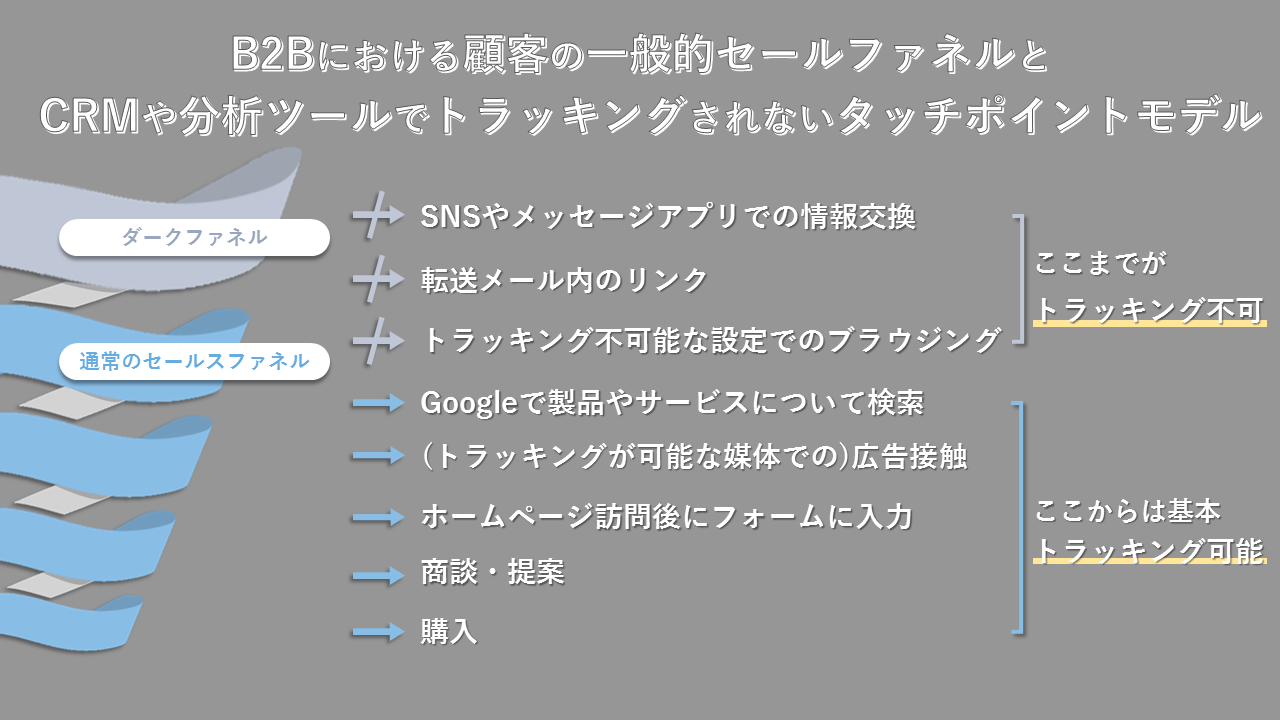
The Dark Funnel occurs because it includes activities that are difficult to track using traditional customer analysis methods such as cookies.
Even though customers express interest through the aforementioned behaviors, the challenge remains that analytical tools cannot track them, making it impossible to capture or understand the context of these actions.
Furthermore, the Dark Funnel can be divided into two categories based on its origin.
• Unidentifiable website visitors
• Potential customers who have not completed a form
• Other contacts from prospective or existing client companies
• Second or subsequent leads from the same account (sometimes treated as "duplicates")
• Traffic from content distribution platforms
• Traffic via product review sites
• Industry news or personal blogs that do not share access data
• Traffic for comparative analysis (leads from competitors)
It is important to understand lead activity within the dark funnel to a certain extent by uncovering areas not visible through conventional CRM, analytics tools, or data-sharing schemes, isolating technical and workflow-related causes, and implementing appropriate measures for each source.
Many B2B companies have traffic sources that cannot be identified, such as direct access to specific web pages (e.g., blog posts). This type of traffic, where it is impossible to determine if a potential customer has accessed the site, accounts for the majority of the dark funnel.
Data suggesting that "67% of the purchasing process is complete before a sales visit" is a frequently cited finding in today's B2B marketing discussions.
If you can segment information about contacts within the dark funnel included in this purchasing process, you can discover new targeting criteria for your marketing efforts.
By understanding the existence of the dark funnel, marketers can more accurately predict the behavior of leads and design efficient demand generation and lead generation strategies based on appropriate cost allocation.
Understanding the dark funnel and demand generation are linked in that both are strategies to promote customer engagement and lead to final sales.
Understanding the dark funnel means tracking and inferring customer behavior across multiple channels and devices, both online and offline, to generate customer insights.
Demand generation means creating relationships with customers through information provision, such as content distribution and campaign execution, to generate needs that lead to sales.
By leveraging insights from the dark funnel and combining them with demand generation, a powerful combination is created that promotes lead generation.
This allows marketers to identify and target qualified leads, enabling the implementation of measures that lead to improved customer engagement, customer acquisition, and ultimately, increased sales.
By leveraging the untapped potential of the dark funnel in B2B marketing, companies can achieve greater results.
By understanding the activities in the dark funnel mentioned above, marketers can better respond to the needs of potential customers and devise and design strategies to satisfy customer needs that are not easily tracked by conventional methods.
While behavior in the dark funnel is difficult to detect with analytics tools or CRM platforms, there are ways to infer what happened in areas that cannot be mapped to the sales funnel through proper data processing and the use of data utilization tools.
Below are representative methods for understanding the behavior of potential customers in the dark funnel.
As mentioned above, a large amount of dark traffic is displayed as "Direct" in analytics tools. If such traffic increases, it is necessary to consider the possibility that blog posts or webinar content have attracted attention and interest, and were influenced by information sharing on social media.
By excluding traffic from easily memorable URLs such as the home page or web pages that may have been bookmarked, you can analyze the remaining traffic, which is almost exclusively dark funnel traffic, and grasp how much user behavior could not be tracked.
To verify the hypothesis that the dark funnel was generated by sharing on social media, introducing a feature to share your content on SNS is one effective way to track customer interaction.
If it is more seamless and easier for users to click a share button to share content with peers than to copy and paste a URL, the likelihood of capturing that behavior increases.
Social listening tools are used to track mentions of your company or keywords related to your brand.
For example, if a B2B influencer posts about your blog post, and it is found that you have gained a lot of direct traffic, it can be inferred that this is access by the influencer's followers.
By setting alerts whenever information is released by influencers on social media, it is possible to logically identify dark traffic.
Asking leads you have actually acquired is also an effective way to identify the source of the dark funnel.
By casually asking during information provision to customers, or by adding a question such as "How did you find us?" to your inquiry form, you can identify the source to some extent.
This is also said to be an effective method for estimating the number of leads triggered by word-of-mouth or face-to-face events such as trade shows, in addition to access from social media.
This is a method to minimize cases where the dark funnel is generated by face-to-face events or offline advertising.
At face-to-face events or seminars such as trade shows, placing 2D barcodes on your booth, handouts, or presentation slides is an effective identification method.
Providing incentives such as receiving a novelty item or a discount will likely increase the probability of having the 2D barcode scanned.
For offline advertising, including taxi advertisements, specifying unique keywords that other companies do not use as search keywords, in addition to 2D barcodes, is also an effective way to bridge the gap between offline and online.
Corporate information databases collect vast amounts of data and can provide unique insights into lead behavior.
Some platforms are equipped with machine learning algorithms that can predict trends of high-potential customers and future customer behavior.
By using corporate attribute data and intent data, it becomes possible to add information to access generated from the dark funnel and verify whether the access was from companies belonging to your target audience.
It can also be used to obtain reference information for discovering new customer segments.
It is impossible to track every action taken by leads and prospective customers.
As evidenced by the series of announcements regarding the phase-out of third-party cookies, privacy and data security have become increasingly prioritized in recent years.
Companies must now exercise greater caution when tracking lead behavior, and due to the inherent technical limitations of current technologies, the dark side of customer behavior from a marketer's perspective is expected to continue growing.
In other words, it is impossible to completely eliminate the dark funnel in B2B marketing.
However, by leveraging various tools and data, it is possible to make the unknown aspects of customer behavior as predictable as possible and continue the effort to understand your customers.
Our customer data integration solution, uSonar, is equipped with a data provision feature that visualizes the companies to which website visitors belong.
Additionally, we provide intent data that allows you to infer user interests and engagement with competitors, and we have also incorporated AI functions to predict the order probability of non-transactional companies.
For more details, please feel free to contact us via this page.
About the Author

uSonar Editorial Department
MX Group Editor-in-Chief
We are the uSonar Editorial Department.
We provide information on data utilization and digital technologies useful for rethinking future business operations, primarily for companies engaged in B2B business.
uSonar is utilized by a wide range of companies across various industries and sectors.
ITreview Grid Award 2026 Summer
Leader in 6 Categories

With uSonar,
we can guide your company toward solving its challenges!
Case Studies and Sample Reports
Download