- Digital Marketing
What Is Buyer Enablement? A Comprehensive Guide to an Approach That Benefits Both Companies and Customers!

Update Date: May 15, 2024
The B2B purchasing process has become increasingly complex, with many factors influencing customer decision-making. In B2B marketing, the "Buyer Journey" has become an essential concept for companies to deepen relationships with customers and build effective communication.
This article explains the overview, importance, and application of the Buyer Journey.
At the end of this article, we also explain how to create a Buyer Journey utilizing the largest corporate database in Japan, uniquely built by our company, uSonar. Please be sure to read until the end.
Recommended Articles

A buyer journey refers to the sequence of stages a B2B customer goes through from the initial awareness of a product or service to the final purchase. It is divided into the following four stages.
This is the stage where the customer identifies the specific challenges or issues they are facing.
The customer begins searching for solutions to their specific challenges.
They focus on proposals from competitors and various options, comparing and evaluating the pros and cons of each solution.
As the solution is narrowed down, customers begin to define their specific requirements and expectations.
They clarify the elements they seek, such as price, quality, and support, and form an intention to select a supplier capable of meeting these requirements.
Evaluation criteria include the simplicity of the hypothesis, consistency with known information, and the explainability of the events.
In the final stage, the customer selects the optimal supplier based on their requirements. Price negotiations and contract terms are finalized, and the purchasing decision is made.
While the term "Customer Journey" is similar, the Buyer's Journey is a concept encompassed by the Customer Journey.
The Customer Journey is not limited to B2B; it is used to represent a broader concept that includes not only the flow from customer awareness to purchase but also post-purchase continuity and repeat purchases.
There are various benefits to understanding the Buyer's Journey.
Understanding the Buyer's Journey leads to a deeper comprehension of customer needs and challenges at each stage. This allows for the provision of appropriate information and support to customers at every stage, facilitating a smoother purchasing process.
Providing appropriate support tailored to the customer's stage serves as the foundation for building trust. This leads to the development of long-term customer relationships and can also be expected to promote repeat purchases and the acquisition of new customers through word-of-mouth.
Furthermore, understanding the Buyer's Journey provides useful information for optimizing marketing and sales resources. It is an important concept for reviewing overall B2B marketing, such as focusing on effective stages and avoiding the waste of resources.
Finally, understanding and strategically utilizing the Buyer's Journey is also effective for differentiating from competitors. By meeting customer expectations and providing information and support at the right time, you can differentiate yourself in the market and establish a competitive advantage.
By understanding the buyer journey in this way and providing customers with the necessary information and support, you can facilitate the purchasing process and build relationships of trust. This approach is also known as "Buyer Enablement" and serves as a critical concept for forming strong bonds with customers.
To create a buyer journey, it is essential to focus on the following three points.
Identify the profile of the user who purchases your products or services.
It is necessary to visualize their department, job title, and the challenges they face as concretely as possible.
In some cases, you can gain further clarity by also considering the industry and performance of the company or organization they belong to.
Define the purchasing stages that a user follows when buying your products or services.
Generally, four stages are defined: Problem Recognition, Solution Exploration, Requirement Building, and Supplier Selection, though these may be customized based on the characteristics of the product or service.
Define the touchpoints you will have with customers as they purchase your products or services.
This includes website visits, social media activity, and email communication.
Based on this information, you create a "Buyer Journey Map." A buyer journey map visualizes the buyer journey by mapping the typical actions and emotions of users who fit your defined customer persona across each stage and engagement point.
It is important to remember that a buyer journey map is not a one-time project; it should be reviewed periodically in response to market trends and changes in engagement points.
The following tools and resources are useful for creating a B2B buyer journey.
Useful for tracking and managing buyer information, purchase history, and interactions.
Utilize these to define customer stages and identify engagement points.
Aggregate information about customers from multiple data sources to visualize buyer behavior.
Utilize these to analyze customer personas and identify high-quality buyers.
Collect buyer research and feedback to identify industry-specific trends and interests.
Utilize these to gain deeper insights when anticipating customer challenges and purchase intent.
Analyze digital buyer behavior across websites, social media, and email.
Utilize these to understand the effectiveness of your initiatives and improve the entire buyer journey.
Understanding and strategically utilizing the buyer journey is a key factor for success in B2B marketing.
By building deep connections with customers and achieving effective communication, you can enhance brand value and contribute to sustainable business success.
About the Author

uSonar Editorial Department
MX Group, Editor-in-Chief
We are the uSonar Editorial Department.
We provide information on data utilization and digital technology useful for companies primarily engaged in B2B business to consider the future of their operations.
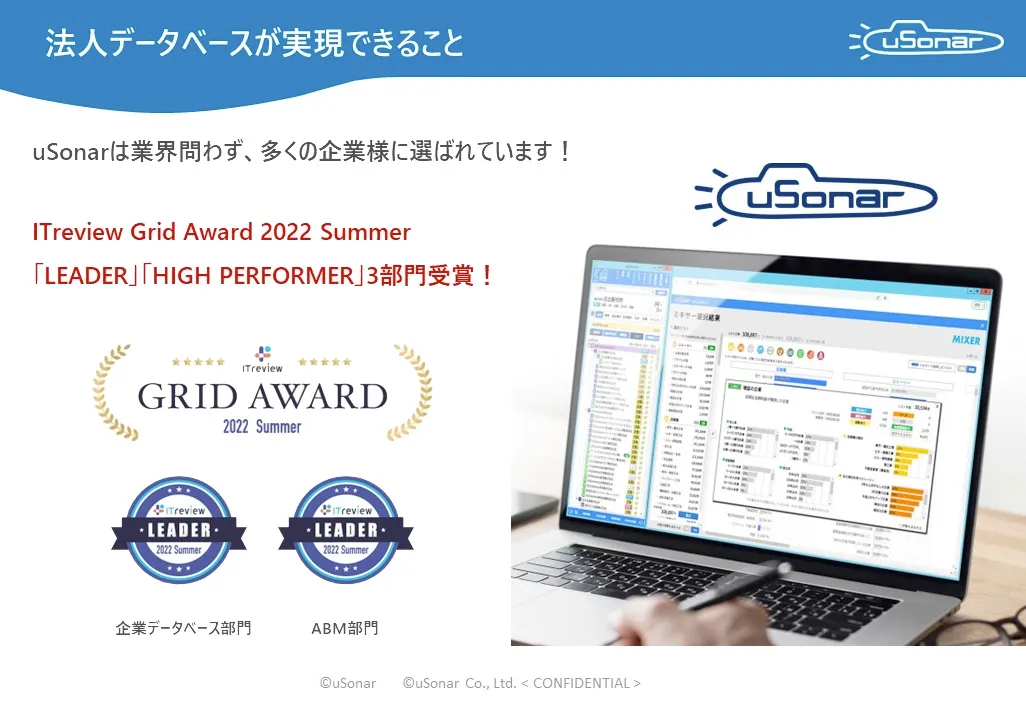
uSonar is utilized by a wide range of companies across various industries and sectors.
ITreview Grid Award 2026 Summer
Leader in 6 Categories

With uSonar,
we can guide your company toward solving its challenges!
Case Studies and Sample Reports
Download