- Data Matching and Data Cleansing
2026 Latest Edition: How to Perform Data Cleansing? Methods, Procedures, and Key Considerations
Last Updated: September 3, 2024
If the customer information registered in a CRM system is accurate and up-to-date, companies can make appropriate proposals at the optimal time for their customers. Conversely, if the data is outdated or inaccurate, it may lead to wasted resources or a loss of customer trust, such as conducting futile sales activities toward companies with which business has already concluded, or approaching the same company multiple times.
It is said that the quality of B2B data is what creates these differences.
In this article, we will explain data quality and provide our perspective on why data quality is critical when companies utilize B2B data.
Recommended Articles

Data Quality refers to how well data is suited for its intended purpose. Generally, the following six elements constitute data quality.
How accurately the data reflects the actual state of reality.
Whether all necessary data is present and no information is missing.
Whether data is maintained without contradictions across different systems or locations.
Whether the data is current and free of outdated information.
Whether data is obtained from reliable sources.
Whether data can be utilized whenever it is needed.
With these elements in place, companies can make faster, data-driven decisions.
Prioritizing data quality is considered to yield the following specific benefits.
Accessibility is closely linked to completeness, consistency, and availability, referring to the ability for anyone to easily view data when needed. High accessibility allows various departments and personnel within a company to access necessary data quickly and effectively. For example, the sales team's ability to access customer data instantly is essential for improving the quality of proposals and customer interactions. Delays in decision-making caused by poor accessibility directly lead to the risk of losing competitive advantage and delays in customer outreach due to inefficient operations.
Productivity is closely linked to accuracy, reliability, and timeliness, referring to achieving maximum results with limited resources such as time, effort, and cost. High productivity in B2B data means that data is utilized efficiently and the benefits derived from data utilization are maximized. For example, by accurately identifying target markets through data analysis and focusing sales activities accordingly, companies can reduce wasted resources and increase revenue. In companies where productivity is low, the lack of strategic resource allocation leads to various opportunity losses, hindering overall corporate growth and causing a loss of market position.
Ensuring security is deeply connected to all elements of data quality, protecting data from unauthorized access and leaks. Guaranteed data security means that critical information, such as customer details and transaction data, is stored safely and protected from external attacks and internal misuse. By strengthening security, data can be utilized as a tool to enhance trust in the company, helping to solidify relationships with customers and partners. If security is not guaranteed, the constant risk of data leaks or tampering causing significant losses to the company makes employees hesitant to utilize data.
The reason data quality is critical in B2B data utilization is that it directly impacts the speed, accuracy, and efficiency of decision-making. Because corporate information, market data, purchase history, and contract details are frequently used, data quality affects smooth operations across all departments, including sales, marketing, customer success, and management.
According to Gartner, poor data quality is said to cause significant losses for companies. For example, when data consistency is lost between different departments or systems, information from individual data sources can become contradictory, leading to situations where customer information held by the marketing department does not match that held by the sales department. Such situations not only delay company-wide decision-making but also lower the quality of those decisions, increasing the risk of opportunity loss.
In fact, other research results indicate, as Gartner points out, that poor data quality can result in an average annual loss of $12.9 million. Therefore, for companies to maintain a competitive advantage in the B2B sector, maintaining and improving data quality is essential, requiring the development of systems and processes to achieve this.
To summarize Gartner's recommendations, the following specific actions are said to be necessary to improve data quality.
First, begin by assessing the current state of your data to verify its accuracy and completeness. This allows you to identify specific problem areas and clarify where improvements are needed.
This process involves deleting or correcting inaccurate or duplicate data. For example, if the same company is registered under multiple different names, this includes consolidating those records.
Establish a framework to integrate different data sources from both inside and outside the company to provide consistent data. This helps eliminate data silos and improves overall data quality.
Clarify data management responsibilities and establish rules for the creation, modification, and use of data. This ensures that data quality can be maintained over the long term.
Data quality is not something that is completed once it has been improved. It is important to continuously monitor data and make improvements as necessary.
For leaders in data management and analysis departments, it is crucial for achieving ultimate business goals to clarify how data quality improvements impact the business, establish company-wide standards, and communicate the benefits of continuously improving data quality across the entire organization.
To improve the quality of B2B data, the following specific initiatives are required.
Data standardization is the process of unifying the formats and definitions of data used within an organization. In Japanese companies, it is common for data to be managed using different formats and definitions across departments, even within the same company. For example, inconsistencies often arise when one department records a company name in Kanji while another uses Roman characters, which complicates data integration and consistent analysis. To advance standardization, it is first necessary to analyze existing data to eliminate duplicates and contradictions. It is also effective to implement tools that automatically unify formats during data entry. For instance, using an address standardization tool to unify addresses entered in different formats simplifies subsequent processing and prevents errors.
The digitization of business processes involves converting paper-based operations into electronic formats to streamline data entry, management, and sharing. Many Japanese companies still rely on paper-based contracts and purchase orders, which presents several challenges. First, paper media requires manual data entry, which is prone to human error. Furthermore, it is difficult to share data in real time, which hinders rapid decision-making. By advancing digitization—for example, by switching to electronic signatures for contracts—data is immediately saved in a digital format and can be shared instantly among stakeholders. This improves data accuracy and enables real-time updates, thereby accelerating business speed. Additionally, digitized data can be easily imported into analytical tools to derive insights that support strategic decision-making.
The utilization of external data is an initiative where companies combine their internal data with highly reliable external data sources to build richer and more accurate datasets. Especially in the B2B sector, leveraging external data—such as domestic and international market trends, competitor information, and customer intent data (purchase interest and behavioral data)—is essential for building a competitive advantage. For example, when a Japanese company expands into overseas markets, it is vital to incorporate data regarding local corporate information and regulations from external sources. Furthermore, by utilizing data from reliable database providers, companies can acquire detailed attributes of target firms and relevant market data, enabling more precise targeting and market analysis.
The standardization and digitization of data, along with the proactive utilization of external data, will become key elements in enhancing corporate competitiveness and supporting success in the global market.
Our customer data integration solution, uSonar, is equipped with LBC, one of the largest corporate information databases in Japan, and is characterized by the accuracy and richness of its data. Furthermore, to evaluate and improve the quality of their own data, companies can effectively utilize matching reports generated by uSonar. These reports compare internal data with LBC data to identify and correct duplicate or inaccurate information. They also provide the information necessary to improve data quality, such as corporate entity resolution, attribute appending, and the visualization of corporate groups.
As Gartner points out, understanding that improving data quality is directly linked to business success and committing to company-wide data quality improvement is the key to enhancing corporate competitiveness. By utilizing a highly reliable external database like uSonar, companies can grasp the current state of their data quality and implement concrete improvement measures to increase the precision of their internal data.
About the Author

uSonar Editorial Department
MX Group Editor-in-Chief
This is the uSonar Editorial Department.
We provide information on data utilization and digital technologies useful for B2B companies to rethink their future business operations.
uSonar is utilized by various companies
across a wide range of industries and sectors.
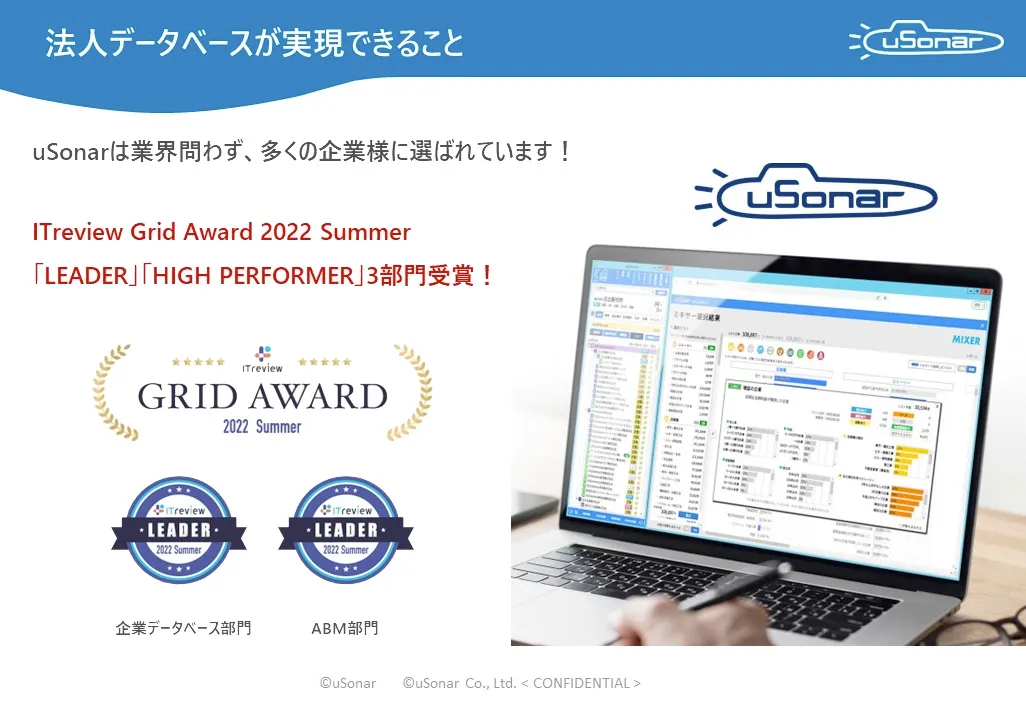
ITreview Grid Award 2026 Summer
Leader in 6 Categories

With uSonar,
we can guide your company to solve its challenges!
Case Studies and Sample Reports
Download