- Data Utilization
Improving Data Quality: Essential for B2B Data Utilization

Updated: April 15, 2021
Click Here to Learn More About Data Utilization ▶
What Is the Reality of Data Utilization
in Market Development?
Digital Transformation (DX) has been a hot topic for some time. DX refers to leveraging digital technology to transform existing business frameworks. While the term has existed since the 2000s, search volume for the keyword has surged in recent years, and many companies are accelerating their DX initiatives.
However, the reality is that there is significant disparity in progress. What challenges are companies facing that prevent them from advancing their DX as intended? This article provides a detailed explanation. *This article is the first in a four-part series.
Recommended Articles

The catalyst for DX promotion was the report published by the Ministry of Economy, Trade and Industry in September 2018, titled "DX Report: Overcoming the '2025 Digital Cliff' and Full-Scale Development of DX." This report pointed out that if Japanese companies fail to achieve DX, they could face potential economic losses of up to 12 trillion yen annually from 2025 onwards. This is the origin of the term "2025 Digital Cliff," which rapidly increased the attention on DX and established it as a critical business topic.
There is a significant disparity in DX progress among companies. While an increasing number of companies are having their management teams directly oversee DX initiatives and utilize them for strategic planning, many others have merely migrated legacy systems to the cloud without addressing the importance of data utilization. Despite the high level of attention, the overall progress remains limited.
Factors hindering the progress of DX include a lack of urgency among management and the difficulty in visualizing return on investment, but the greatest challenge is "Data Integration."
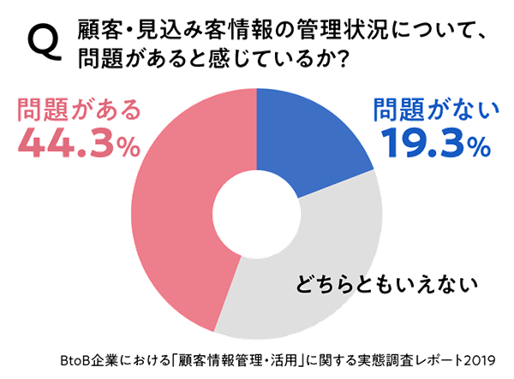
It is common for multiple departments within a company to implement different systems independently. As a result, even if there is connectivity between systems, the differences in data granularity and accuracy often prevent the realization of operational efficiency or effective strategic planning, leading to project failure.
When the sales department implements System A and the marketing department implements System B, there are many cases where the same company is recognized differently in each system, even if the systems are integrated. Issues such as corporate name changes or variations in notation can cause the same entity to be recognized as separate companies.
Such discrepancies in recognition not only cause internal friction but also negatively impact communication with customers. If the marketing department approaches a customer as if they are a new lead while a sales representative is currently in negotiations with them, or if different pricing campaigns are presented, it can lead to customer distrust and potential damage to the brand.
If data is not correctly integrated, the understanding of current conditions, such as customer attributes and sales figures, becomes insufficient, increasing the risk of making erroneous decisions. Since the essence of DX lies in "Rapid Decision-Making," low data accuracy is fatal.
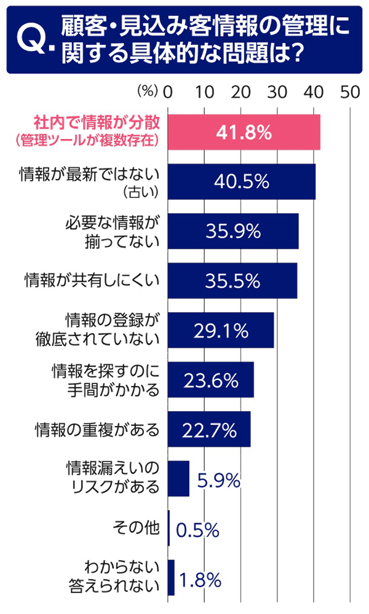
In recent years, the cloud tool market has grown rapidly, and it has become common for companies to implement multiple tools. This has made the fragmentation of information within companies a serious issue. As each department implements cloud tools tailored to their specific needs—such as Customer Relationship Management (CRM/SFA) systems, business card management tools, and customer service-related tools—a situation has emerged where data across these platforms remains ununified.
When information is fragmented, data stored across various tools remains siloed, making it difficult to share information throughout the entire organization. This hinders the ability to grasp a comprehensive view of customers and the market, thereby impeding strategic planning and decision-making. While data is often manually organized, this process is time-consuming, labor-intensive, and ultimately limited in its effectiveness.
Effectively integrating this fragmented information is essential for the success of DX. As the number of tools increases, there is a growing need to integrate and organize data across systems and establish processes that facilitate company-wide information sharing.
To address the challenges of data integration, the "NICE" concept has been proposed. It consists of the following four processes:
Normalize: Standardizing data granularity
Integrate: Assigning common codes
Correct: Unifying notations
Enhance: Adding accurate attribute information
By achieving this, companies can seamlessly leverage data for DX.
When DX is discussed, the focus often tends to be solely on human resources and systems; however, an awareness of "data" is indispensable for achieving true DX. There is no Digital Transformation without Data Transformation. It is necessary to approach data integration with this level of strong commitment.
Companies that achieve "NICE" are the ones capable of overcoming the "2025 Digital Cliff" and thriving in the future business landscape. Enterprises must once again focus their attention on the often-overlooked blind spot of data.
To achieve successful DX, improving the accuracy of data integration is essential. The inconsistencies in data granularity and precision that many companies face serve as significant obstacles to operational efficiency and strategic planning.
By incorporating the "NICE" process, it is crucial to organize data appropriately and establish a foundation that enables rapid decision-making. By strengthening data transformation, companies will be able to overcome the "2025 Digital Cliff" and gain a competitive advantage in the future business environment.
The "Essence of DX" is a four-part series.
You can view the next article here.
[The Essence of DX Vol. 2] Organizing Customer Data from the Entry Point Is the Shortcut to DX ▶
About the Author

uSonar Editorial Department
MX Group Editor-in-Chief
This is the uSonar Editorial Department.
We provide information on data utilization and digital technologies useful for B2B companies to consider the future of their business operations.
uSonar is utilized by various companies
across a wide range of industries and sectors.
ITreview Grid Award 2026 Summer
Leader in 6 Categories

With uSonar,
we can guide your company to solve its challenges!
Case Studies and Sample Reports
Download