- Data Utilization
Improving Data Quality: Essential for B2B Data Utilization

Last Updated: April 15, 2021
Click Here to Learn More About Data Utilization ▶
What Is the Reality of Data Utilization
in Market Development?
For companies to achieve success in DX (Digital Transformation), organizing data is a critical step. The "NICE" framework advocated by uSonar is gaining attention as an effective method for organizing and utilizing data.
In this article, we introduce specific use cases for "NICE" and explain how to promote DX by organizing customer data, such as business cards, from the entry point. Please read until the end. *This article is the second in a four-part series.
— Click here for an article explaining "NICE" in detail —
The Essence of DX Vol. 1: The Surprising Blind Spot of "Data" for Companies That Cannot Achieve DX ▶
Recommended Articles

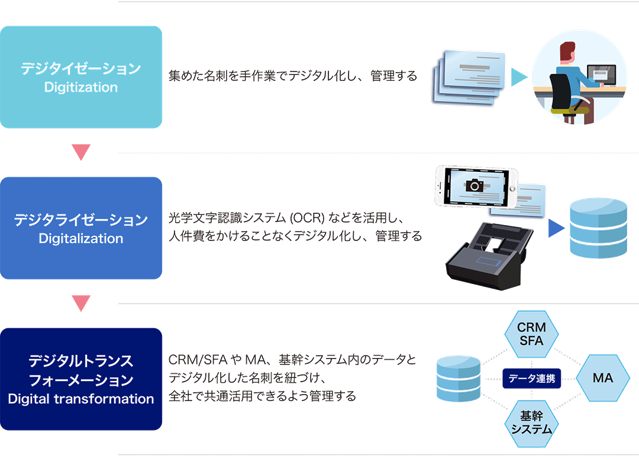
To achieve DX, there are three steps. We will explain these steps using customer data, such as business cards, as an example.
Convert information such as paper slips and business cards into data so that it can be handled as digital information. By converting paper business cards into digital data, you can manage a large volume of cards efficiently, which also leads to the acceleration of work-style reform.
Introduce digital technology to streamline and transform business processes, thereby achieving cost reduction and value enhancement. For example, instead of manually digitizing business card data, utilizing an Optical Character Recognition (OCR) system allows for smooth data storage while reducing labor costs. Furthermore, by adding corporate attribute information such as industry and annual sales, it becomes possible to perform aggregation and analysis across various dimensions, which is useful for business strategy. The "NICE" approach advocated by uSonar is an important method to support this process.
Introduce digital technology based on digital data to create new services and business models. For example, by integrating business card data with CRM or MA systems to build a data infrastructure that can be used company-wide, you can maximize Customer Experience (CX) and gain new competitive advantages.
The importance of digital data is essential for DX. However, there are many challenges in data utilization. For example, there are conflicting departmental needs: the sales department prioritizes order processing and dislikes spending significant time on data entry, while the marketing department requires detailed data. The existence of such contradictions within a company acts as a major barrier to data utilization.
To advance DX, integration between business systems is essential, and data is the key to that integration. If data is not properly maintained, system integration will not proceed smoothly. It is crucial to start by maintaining data from the initial input stage. Let us look at specific DX case studies supported by uSonar.
A certain software company develops and provides FAQ management systems and has implemented Dynamics 365 for customer management. Even after digitizing business cards collected at seminars and exhibitions, they faced issues with data duplication due to variations in notation and company name changes, leading to duplicate approaches to customers. For example, different departments would approach the same customer company redundantly, causing confusion and distrust among customers.
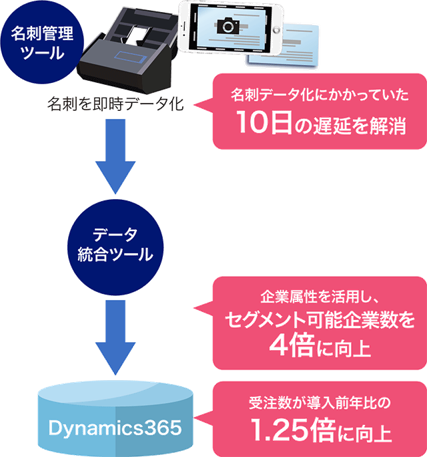
To solve this challenge, the company implemented uSonar and mSonar to achieve automatic data consolidation and centralized management. As a result, business card data is now instantly organized and utilized as consistent information within Dynamics 365. Consequently, the time required for data maintenance has been significantly reduced, enabling rapid approaches to leads obtained at seminars and events, ensuring no business opportunities are missed. As a result, the number of segmentable companies increased fourfold, and the number of orders received increased by 1.25 times. This process benefited both the sales and marketing departments and improved internal business workflows.
Among the data accumulated by companies, 'Dark Data' that remains unused and neglected is also a major obstacle to DX. 'Dark Data' refers to outdated information, duplicate data, or data that is difficult to utilize due to low accuracy. Over time, data becomes obsolete and loses its value. Neglected dark data increases storage costs and poses significant risks by providing misinformation during decision-making or customer interactions.
Furthermore, the existence of dark data carries security risks. Unmaintained data increases the risk of information leakage, which can lead to a decline in corporate brand image and legal issues. Therefore, it is necessary to maintain data quality and perform regular maintenance and reviews.
To effectively utilize 'Dark Data,' it is effective to introduce the concept of ROD (Return On Data). ROD is a philosophy of not just storing data, but maximizing the value of that data and linking it to business results. To achieve this, it is important to thoroughly implement 'NICE': Normalization, Integration, Correction, and Enrichment. This maintains data quality and strengthens the foundation for promoting DX.
By utilizing the 'NICE' process to organize and integrate data, companies can prevent the generation of 'Dark Data' and establish an environment where information assets can be utilized to their fullest potential.
To achieve successful DX, it is essential not only to introduce digital technologies but also to ensure the quality and organization of data. By organizing and utilizing customer data through the "NICE" process, companies can improve operational efficiency and create new business opportunities.
Furthermore, by properly managing dark data and adopting the concept of Return On Data (ROD), companies can maximize the potential value of their data and enable sustainable DX promotion. Companies are expected to actively engage in data organization to strengthen the foundation for transformation.
The Essence of DX is a four-part series.
You can view the next article here.
The Essence of DX Vol. 3: Organizing Customer Data from the Entry Point Is the Shortcut to DX ▶
Author

uSonar Editorial Department
MX Group, Editor-in-Chief
We are the uSonar Editorial Department.
We provide information on data utilization and digital technologies useful for companies primarily engaged in B2B business to consider the future of their operations.
uSonar is utilized by various companies
across all industries and sectors.
ITreview Grid Award 2026 Summer
Leader in 6 Categories

With uSonar,
we can help solve your company's challenges!
Case Studies and Sample Reports
Download