- Data Utilization
Improving Data Quality: Essential for B2B Data Utilization

Last Updated: April 15, 2021
Click Here to Learn More About Data Utilization ▶
What Is the Reality of Data Utilization
in Market Development?
As companies advance their digital transformation (DX), simply organizing data is insufficient. In particular, leaving accumulated and unused data (dark data) unmanaged becomes a significant barrier to successful DX.
This article introduces the concept of ROD (Return On Data) and specific case studies to help you avoid data quality degradation and maintain data in a usable state. Please read until the end. *This article is the third in a four-part series.
Table of Contents
157% of Corporate Data Is "Dark Data" That Remains Unutilized
2Building a Data Infrastructure for ROD Offers Greater Cost Benefits
3Case Study 1: Major Systems Integrator
4Case Study 2: Software Development Outsourcing Company
5Integrating Online Data into ROD-Enabled Data Infrastructure for Enhanced Utilization
Recommended Articles

Data generated by companies can be broadly categorized into the following three types:
Clean Data: Data that is determined to be valid and can be utilized for business.
Dark Data: Data that was temporarily useful but is now stored without its value being recognized.
ROT Data: Data that is redundant, obsolete, or trivial.
According to an article in the Nikkei newspaper dated July 4, 2020, an average of 57% of data held by companies is considered "Dark Data." In addition, a significant amount of ROT data also exists within companies. Leaving these unaddressed leads to various negative factors, such as increased storage costs and the risk of brand devaluation due to data breaches.
As digitalization accelerates as a precursor to achieving DX, companies are rapidly creating and storing data. In B2B sectors especially, data accuracy and freshness are easily lost due to factors such as company name changes, relocations, bankruptcies, and mergers, leading to an increase in Dark Data and ROT data, which results in mounting unnecessary costs.
Many companies assume that building an infrastructure to manage ROT and prevent the creation of Dark Data is prohibitively expensive. While it is true that labor and processing costs for data maintenance are increasing, the evolution of IT technology is simultaneously driving down the actual cost of data retention.
uSonar performs daily data maintenance. In 2019 alone, there were 91,104 company name changes, including business locations, and 159,581 address changes. Since company name changes, relocations, and bankruptcies occur daily, manual processing is impractical. While irregular, spot data maintenance is effective, data is constantly changing; therefore, building a foundation for real-time, automated maintenance is more cost-effective in the long term.
To achieve DX, it is essential to utilize organized data in real time. Building a foundation for ROD and preventing the creation of dark data not only improves operational efficiency but also serves as a means to enhance the overall competitiveness of the company.
A major system integrator, which is part of a large corporate group, provides one-stop services from consulting to operations. The company focuses on inside sales to create business opportunities that lead to negotiations and needed to utilize precise data to analyze the number of prospective customers and generated projects. However, because registration and change requests from sales representatives were processed manually, time lags occurred.
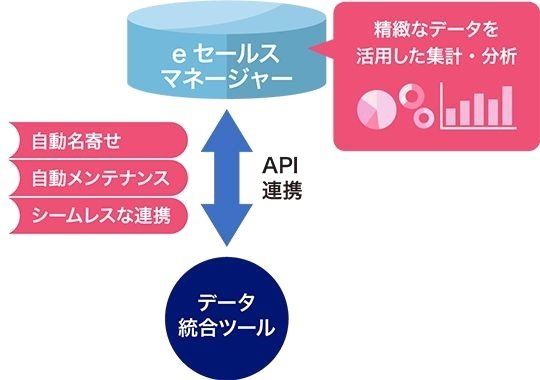
Therefore, by introducing a data integration tool and linking it with e-Sales Manager (SFA), they achieved automated maintenance for company name changes, address relocations, and more. As a result, they reduced the costs and man-hours previously spent on maintaining data freshness, creating an environment where they could focus on inside sales. Furthermore, it became possible to calculate metrics based on accurate, real-time data, leading to the optimization of process management.
At a major contract software development company, data was scattered across various departments and campaigns, hindering coordination in sales activities. Because data maintenance was performed manually, the operational burden was significant, and the situation was prone to creating dark data. This slowed down the speed of business development.
By introducing a data integration tool, they automatically integrated data scattered across departments to build master data. Furthermore, they achieved automation of data maintenance. As a result, the 26,200 annual hours previously spent on data registration and maintenance were reduced by 51%, leading to a reduction of 13,300 working hours. The time gained in this way is now utilized for the development of new business models and services, achieving both operational efficiency and innovation.
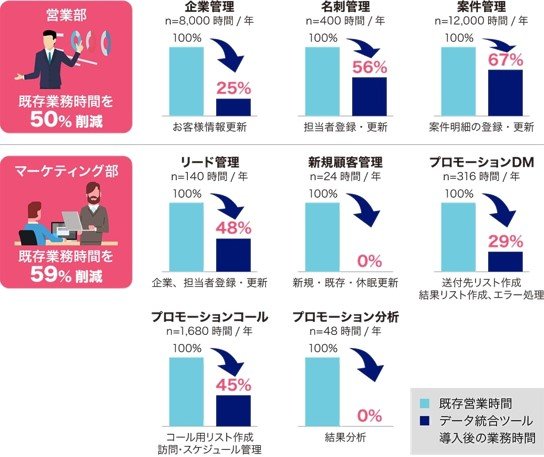
Automating data maintenance and converting dark data or ROT data into ROD is extremely important for smoothly promoting DX. However, to realize DX, it is required not only to simply organize data but also to actively utilize that data to extract value.
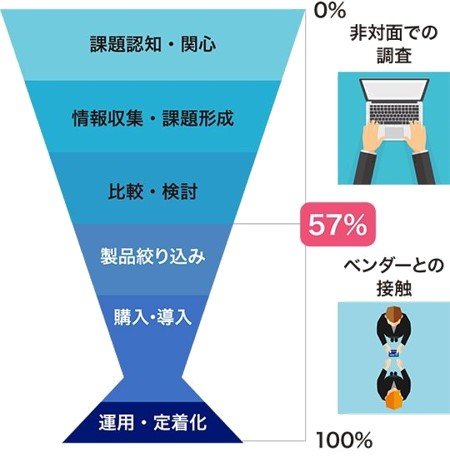
Gartner research indicates that in B2B digital marketing, the majority of the purchasing process is completed before a sales representative even makes contact. By capturing potential needs through corporate websites and online channels and analyzing prospect behavior, companies can execute more precise marketing initiatives. This requires an environment where online data can be integrated and analyzed in real time.
By strengthening the ROD (Return On Data) foundation, companies can leverage online data for targeting and predicting customer purchase intent, enabling a consistent customer experience from marketing through to sales. Furthermore, by linking data acquired online with offline customer data, complex analysis and deeper customer insights can be achieved. This allows companies to design optimal approaches for each customer and implement efficient sales strategies.
By leveraging a data foundation, companies can move beyond mere information storage, enhance their competitiveness through real-time data utilization, and achieve sustainable growth in their DX initiatives.
It is critical for corporate DX initiatives to avoid neglecting "dark data" or ROT data, and instead maintain them properly to practice ROD (Return On Data). By establishing a robust data foundation and automating daily data maintenance, companies can simultaneously achieve cost reduction and improved operational efficiency.
Furthermore, well-maintained data generates new value in marketing and sales activities, serving as a key factor in enhancing competitive advantage. By strategically utilizing data, companies can achieve true success in their DX transformation.
The Essence of DX is a four-part series.
You can view the next article here.
The Essence of DX Vol. 4: How to Accelerate DX Through Data Utilization ▶
Author

uSonar Editorial Department
MX Group Editor-in-Chief
We are the uSonar Editorial Department.
We provide information on data utilization and digital technologies useful for rethinking future business operations, primarily for companies engaged in B2B business.
uSonar is utilized by various companies
across all industries and sectors.
ITreview Grid Award 2026 Summer
Leader in 6 Categories

With uSonar,
we will guide your company toward solving its challenges!
Case Studies and Sample Reports
Download