- Data Utilization
- Sales Strategy
Three Benefits of Sales DX! Explaining Data Utilization Methods and Key Points for Improving Results
Last Updated: April 22, 2024
Go-To-Market Strategy requires a wide range of technologies.
To achieve Sales DX while streamlining marketing, it is necessary to integrate data while utilizing various tools.
In particular, to create integrated data for a Go-To-Market Strategy, it is considered necessary to target both the first-party data held by the company and the third-party data provided by external vendors. Furthermore, it is required to provide an environment where personnel in all departments within the company can easily access the latest data.
This article explains the necessary processes for data utilization and the common challenges that act as barriers to data utilization for those responsible for managing and visualizing various corporate data.
Table of Contents
1Organizing, Distinguishing, and Updating for Corporate Data Utilization
2Four Challenges for Effective Corporate Data Utilization
2-11. Integration and Correction (Data Quality Management)
2-22. Reinforcement and Standardization
2-33. Workflow Organization and Adoption
2-44. Building and Operating a Cloud-Based Data Utilization Framework
3Key Points: Necessary Preparations for Establishing a Data Utilization Framework
Recommended Articles

However, the challenge is that data cannot always be collected in a "clean state." Taking corporate data (company names) as an example:
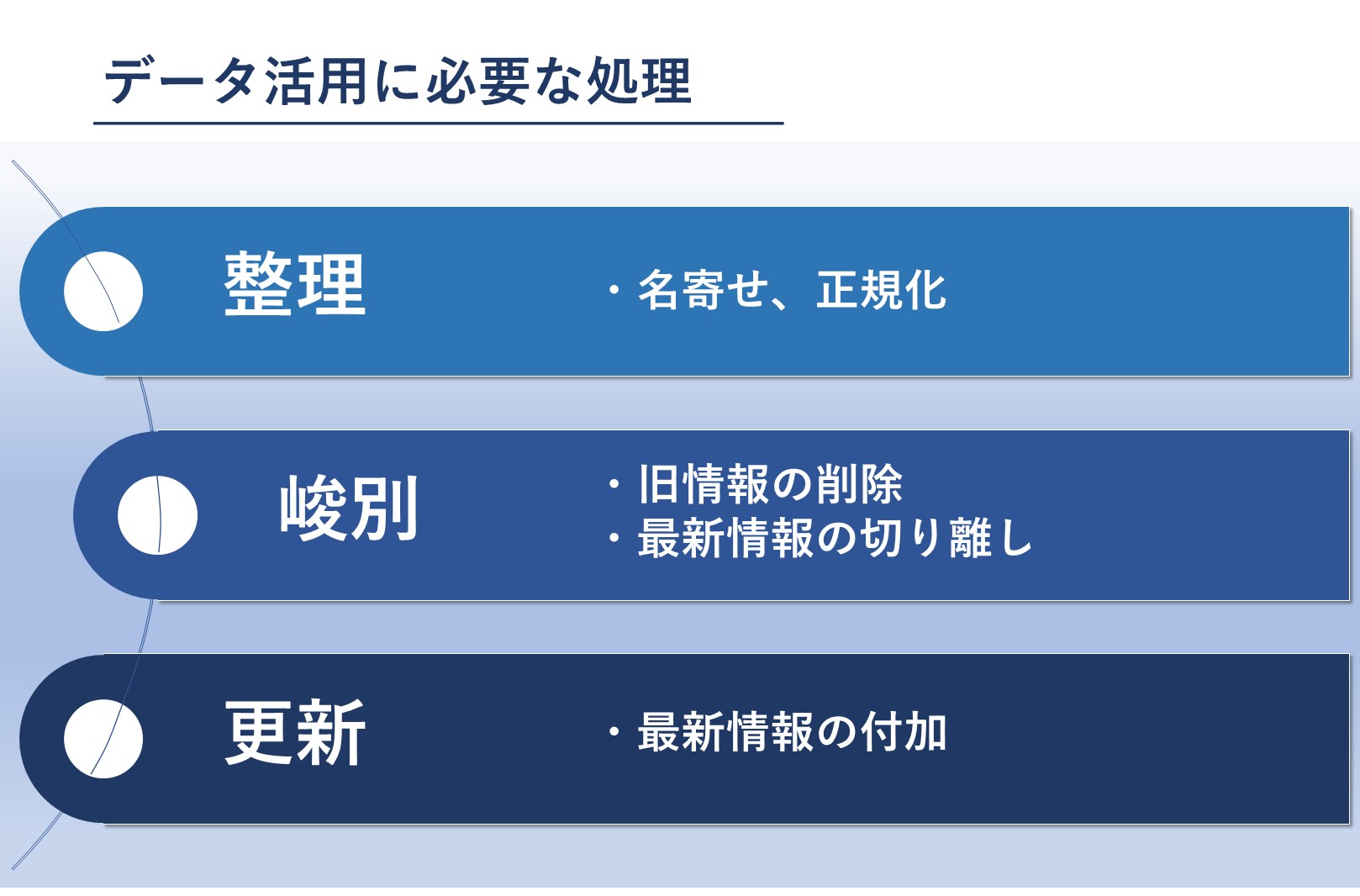
The necessary tasks to make data easier to handle are "Organizing," "Distinguishing," and "Updating." In the specific process of the company name example mentioned earlier, the following tasks occur continuously:
*1: Abbreviation for Segmentation/Targeting/Positioning. One of the representative frameworks in marketing.
*2: Reference URL
The causes of this situation are common to many companies and are referred to as "data utilization challenges." Specifically, there are the following four items:
If you assume that all data collected/held by your company is correct, data utilization will fail. As noted in the company name example, it is necessary to take the perspective that outdated and inaccurate information is mixed in.
By creating a management system that distinguishes between necessary and unnecessary items from the data held by the company, you can improve data quality and create a system for faster and more accurate decision-making.
In the U.S., it is said that the average annual loss for companies due to poor data quality reaches $10 million (*4), and the concept of data quality management utilizing technology has permeated.
In Japan, data quality management is also considered an important response item for companies, and a guidebook (beta version) has been released by the Government CIO (*5). However, since data quality management involves major changes and resistance such as complex tool introduction and workflow renewal, the current situation is that many Japanese companies are not progressing as expected.
There are other positive effects of improving data quality. It means that the "integrity of data" can be better guaranteed. Especially when performing "data reinforcement," such as adding more information using third-party data, being able to prepare high-quality data that is the latest and has no notation variations is a major advantage.
Most providers of third-party data excel in data updateability. Conversely, this means that old data and incorrectly written data are immediately removed from the database.
Also, third-party data is not perfect. There are providers that have less comprehensiveness in exchange for strengths in updateability. To maximize the use of data from providers that offer the latest data under specific conditions (e.g., limited to listed companies or industry-specific), it is important for the recipient to also maintain accurate data.
To maintain accurate data, it is necessary to establish a standard data format. This standardizes the rules for how data is collected/held. It is also important to grasp what kind of reinforcement data is needed by visualizing the parts that can be collected by the company alone (and the parts where data is missing) from the format.
Even if you prepare an environment for accumulation, it does not mean that preparations for data utilization are complete.
As mentioned at the beginning, it is necessary to prepare an environment where collected data can be easily referenced.
By stipulating certain reference rules and having everyone in the company comply with the usage methods according to the rules, you can maximize the resources of the sales and marketing departments to collaborate on lead acquisition and customer satisfaction improvement, thereby maximizing the company's revenue.
Specifically, you can collaborate on activities such as extracting company lists based on conditions like "ideal customer profile," "high-potential customers," and "customers with high similarity in corporate attributes" from high-quality data collected from inside and outside the company, and further narrowing down the targets to approach now while looking at recent behavioral data (interests) and outgoing content (news).
Speed is required in the environment where data is referenced.
If you say, "Data was easily extracted, but it was information from two weeks ago," you cannot approach customers in a way that exceeds their expectations.
Although the sales and marketing departments lead the list creation using data, they cannot handle fresh data with analog methods.
This is where cloud-based data utilization solutions become necessary. The cloud's strengths are the reflection of updated data and the speed of extraction, and it enables multiple people to work simultaneously. Also, since settings can be saved for each individual user, it leads to labor saving and efficiency in routine work.
There is also a secondary benefit that communication between the IT department and sales/marketing can proceed speedily in that data linkage with tools such as MA and CRM that actually create and manage customer touchpoints can be performed smoothly.
To solve all "data utilization challenges," it is important not only to organize data within the company but also to select the provider of third-party data based on certain criteria. A cloud service that combines "updateability" and "comprehensiveness" and has a rich track record of integration with MA and CRM is desirable.
*3: Reference URL *4: Reference URL *5: Reference URL
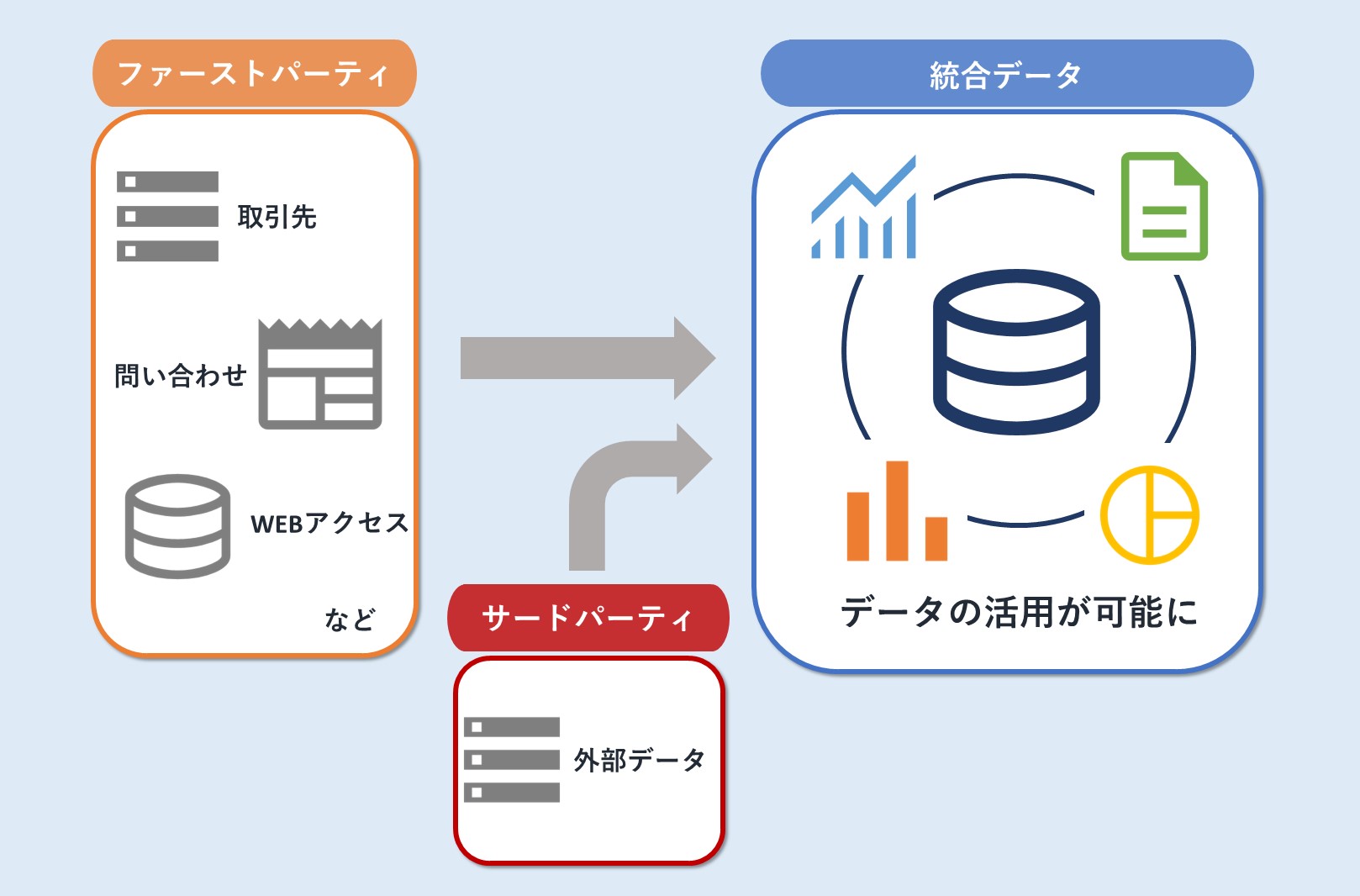
The following points are considered important for maximizing the use of first-party data and third-party data.
Recommended Articles: What is "TAM," Essential for Data-Driven Sales Strategy Formulation?
Recommended Articles: "sideSonar" for Visualizing TAM/SAM/SOM in a Data-Driven Manner
By listing what kind of data can be collected by the company alone and establishing a certain order and regularity in how it is collected, you can aim to save labor in the company's sales activities and marketing.
Also, speeding up decision-making in corporate activities through alliances with others and initiatives with data providers leads to improving corporate profitability in the DX era.
![[sideSonar On-Demand Delivery] What is the Corporate Data Utilization Method for Improving New Business Development Sales Efficiency?](https://usonar.co.jp/seminar/files/top.jpg)
Author of This Article

uSonar Editorial Department
MX Group, Editor-in-Chief
This is the uSonar Editorial Department.
We provide information on data utilization and digital technologies useful for rethinking future business operations, primarily for companies engaged in B2B business.
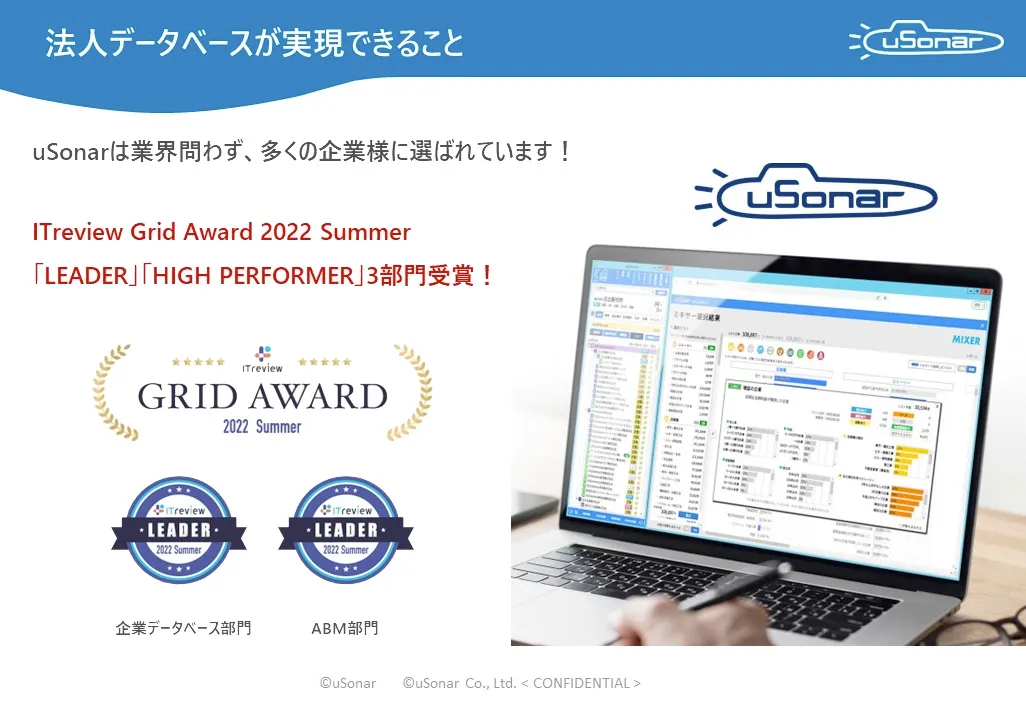
uSonar is utilized by various companies
across all industries and sectors.
ITreview Grid Award 2026 Summer
Leader in 6 Categories

With uSonar,
we can help resolve your company's challenges!
Case Studies and Sample Reports
Download