- Data Utilization
Data Utilization in Enterprises: Essential Processes and Challenges to Resolve

Update Date: May 12, 2023

Data accumulated through corporate activities is filled with a wealth of customer information.
Many companies are successfully leveraging this data to acquire new customers and accurately identify customer needs to improve their performance.
However, some may be struggling with how to effectively apply accumulated data to their sales activities and business operations.
This article explains the importance and benefits of utilizing data in sales, and outlines the steps to implement data-driven sales. By reading this article, you will be able to start efficient, results-oriented sales centered on data.
Table of Contents
2The Importance of Achieving Data-Driven Sales Through Data Utilization
3Benefits of Utilizing Data in Sales Operations
3-1Improving Productivity Through Streamlined Sales Activities
3-2Moving Away From Individual-Dependent Sales Through Knowledge Accumulation
3-3Clarifying Customer Needs Through Data Analysis
4Four Steps to Achieving Results by Leveraging Data in Sales
4-1Step 1: Establishing an Environment for Data Analysis
4-4Iterating Improvements and Verification Based on Analysis Results
5Key Points for Achieving Results Through Sales Data Utilization
6Summary: Achieving Results Through Data Utilization in Sales
Recommended Articles

The primary reasons for the growing importance of data utilization in sales are the need to "understand customer needs" and "improve operational efficiency."
In recent years, digitalization has advanced across all sectors, leading to rapidly shifting customer needs.
Since the "winning patterns" that once captured customer interest can quickly become obsolete, sales departments must now verify and improve their approaches by continuously monitoring customer reactions to stimulate interest and drive results.
This is where "Data-Driven Sales" becomes essential. By recording daily sales activities as data and analyzing customer responses and successful sales pitches, companies can quickly identify rapidly changing customer needs.
Furthermore, sharing this data across the sales department enables the team to provide optimal proposals to customers, regardless of the individual skill level of each sales representative.
By implementing Data-Driven Sales, organizations can replicate the "ability to interpret customer needs" and "proposal skills" typically found in top-tier sales representatives, thereby driving performance improvements across the entire sales department.
By collecting and analyzing data on past wins, losses, and lead generation, companies can streamline sales activities and expect an overall increase in productivity.
This is because collecting and analyzing data allows sales teams to focus their efforts on high-probability targets.
This shifts the approach from inefficient cold calling without knowing the probability of success to targeting customers who are actively seeking the company's products.
Additionally, by reducing time spent on low-probability prospects, teams can achieve better results more easily.
In this way, utilizing data in sales activities leads to greater overall efficiency and improved productivity.
By collecting and analyzing sales activities, you can accumulate valuable sales knowledge and move away from "person-dependent sales" that rely solely on top performers.
This is because by digitizing and analyzing the circumstances surrounding successful deals, you can store this information as knowledge, enabling data-driven sales rather than relying on intuition.
Accumulating this knowledge allows even new sales representatives to approach and follow up with customers at the same quality level as top performers.
By leveraging data analysis in your sales activities and achieving data-driven sales, you can more accurately grasp customer needs.
This is because collecting and analyzing customer data allows you to understand purchasing trends and areas of interest.
For example, by analyzing purchase history, customer attribute data, and the purchasing trends of competitors, you can identify customer interests and preferences, allowing for tailored approaches for each customer.
By collecting and analyzing data from customer inquiries and complaints, you can identify the challenges and latent needs of your customers. This enables you to provide solutions and approach them based on their specific "pain points" and high purchase intent, thereby realizing highly accurate, needs-based sales activities.
In this way, analyzing customer data allows you to clarify needs and develop effective sales strategies.

Before you can leverage data in your sales activities and achieve data-driven sales, you must build a foundational "data analysis environment."
Conducting data analysis requires personnel with specialized knowledge and skills to manage data, as well as tools for data cleansing and matching to remove duplicates.
Once you are prepared to utilize data, proceed with actual data collection.
The quality and results of your analysis will depend heavily on the volume and quality of the data collected.
If you do not collect data appropriately, there is a risk of errors in the analysis results, so you should collect various customer information from all angles.
Specifically, it is recommended to collect the following types of data:
After collecting data, you must organize it to remove duplicates and errors.
If organization is insufficient, analysis results may be inaccurate or omissions may occur, leading to lost opportunities, so preparation is essential.
Since "high-precision data" is paramount when analyzing data, tools that allow for one-click data matching and cleansing to resolve errors and duplicates are highly recommended.
Once data collection is complete, proceed with data analysis.
By using various analytical methods to examine data from multiple angles, you will be able to grasp both the explicit and latent needs of your customers.
Data analysis methods include "Factor Analysis" to find correlations in data and "Cluster Analysis" to find relationships between completely different groups of elements.
If you provide products and services tailored to market trends based on data analysis, you can acquire customers efficiently and operate in a way that keeps you ahead of competitors.
Based on the results of your data analysis, implement improvements and verification of your sales activities.
First, create a schedule based on the analysis results.
For example, set a schedule such as "Propose Product A to the food and beverage industry for one month based on their needs." This makes it easier to execute strategies and verify their effectiveness.
When implementing measures, be conscious of the "PDCA" cycle, which represents the flow of Plan, Do, Check, and Act.
The points for achieving results through data utilization in sales are as follows:
When utilizing data in sales, promote understanding among employees through a top-down approach to ensure smooth decision-making and execution of measures.
To collect, analyze, and verify the effectiveness of data in sales, the cooperation of frontline sales representatives is essential. Without an understanding of data-driven sales, you cannot effectively utilize data in your sales activities.
It is also important to establish a collaborative environment where the data analysis department and frontline sales representatives can share information smoothly.
Once high-probability leads are generated or prospects are nurtured, sharing them with the sales department while interest is high will increase the success rate of closing deals. Furthermore, if a collaborative information-sharing environment is in place, mismatches such as "finding a prospect who was actually a customer lost in the past" are less likely to occur.
About the Author

uSonar Editorial Department
MX Group, Editor-in-Chief
We are the uSonar Editorial Department.
We provide information on data utilization and digital technologies useful for considering future business operations, primarily for companies engaged in B2B business.
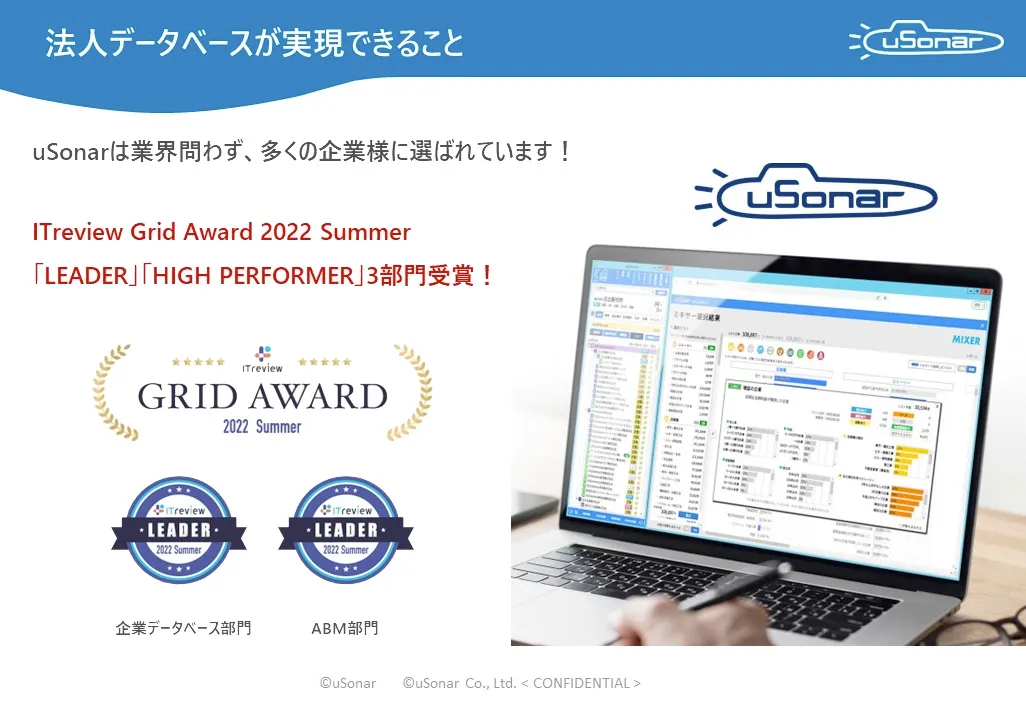
uSonar is utilized by various companies
across all industries and sectors.
ITreview Grid Award 2026 Summer
Leader in 6 Categories

With uSonar,
we can help solve your company's challenges!
Case Studies and Sample Reports
Available for Download