- Market Analysis
Checklist Available: What Is a Go-To-Market Strategy?

Last Updated: June 30, 2025

Scientific Sales
Learn About uSonar in 5 Minutes
When building sales strategies for products and services, sales and marketing teams must collaborate closely from various perspectives. Examples include creating target lists and planning promotional initiatives.
This article explains TAM as a method for identifying target markets and sharing their current status and future potential. Calculating the current market status and potential is crucial for advancing a Go-To-Market strategy. Furthermore, high-quality industry and corporate data are essential for these calculations.
Recommended Articles

The indicator representing the overall monetization opportunity for a product or service is referred to in English as the Total Addressable Market (TAM).
Also known as the maximum potential market size, it allows for the estimation and calculation of specific market sizes, enabling the efficient creation of a list of potential customers.
By identifying the TAM, sales and marketing teams can develop individual approach strategies and plans based on the same list.
Company lists formed through data-driven methods allow organizations to maximize their limited internal resources and focus on the most profitable opportunities.
This not only realizes greater efficiency in daily corporate activities but also serves as material to effectively communicate the company's strategy to investors.
It is also highly regarded as a method to prevent the waste of costs associated with blindly approaching every industry that might have potential opportunities.
Using a corporate database is considered the most efficient way to identify companies included in the TAM.
Specifically, company characteristics and the actual number of companies are visualized using industry, annual revenue, number of employees, and location.
Regarding which segment of the visualized companies to target first, the approach is divided into methods of "grouping companies" and "assigning priority scores."
This is a method of creating groups based on industry and employee size.
It is possible to identify companies with high unit prices that are likely to be acquired frequently, while excluding industries that contain many companies with small deal sizes and high risks of losing the deal.
This is a method of scoring companies that have high similarity to existing customers.
Items used to measure similarity include the following:
After understanding customer characteristics, proceed to calculate the market size.
There are two main approaches: "Top-Down" and "Bottom-Up".
TAM calculated via the "Bottom-Up" approach is sometimes referred to as SAM (Serviceable Available Market) or SOM (Serviceable Obtainable Market).
This is a method of visualizing the entire market to be approached, breaking it down by industry, and multiplying it by information provided by specialized institutions.
The calculation process follows the logic: "The market size of this industry is X, and we define Y% that meets conditions A and B as our TAM."
In this process, companies that meet the usage criteria for the company's products/services are identified from a macro perspective, so it is usually represented as an inverted pyramid.
As one method for Top-Down TAM calculation, uSonar offers a "TAM Calculation Simulator" that utilizes "LBC," a corporate database covering 12.5 million locations nationwide, uniquely constructed by uSonar.
Calculate Your Company's TAM Here:
This is a method of calculating the scale of market needs by multiplying the total number of target approaches by the company's average sales price.
There is also a method of collecting more accurate prospect levels by conducting surveys on customers who could be potential targets.
More precise financial estimates can sometimes be made by distinguishing between small-to-medium enterprises and large corporations, and calculating the sum of the average sales price multiplied by each group size.
In this process, companies that meet the usage criteria for the company's products/services are identified from a micro perspective, so it is usually represented as a pyramid.
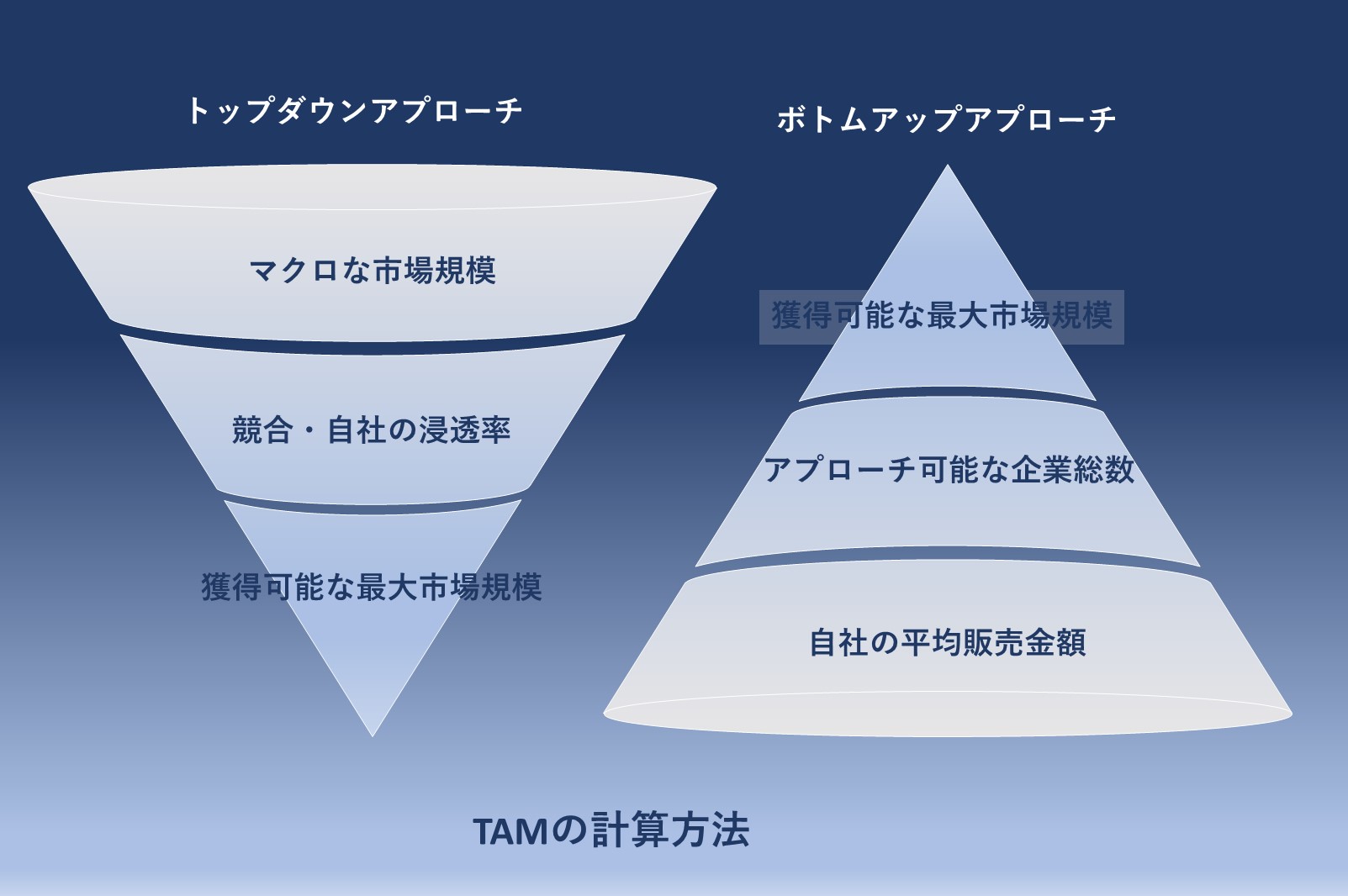
The criteria considered important for selecting companies included in the TAM are as follows:
By using the above selection criteria, the growth potential of markets/companies can be appropriately predicted.
By calculating TAM, companies can demonstrate their activity goals both internally and externally, accurately grasp their current position, and explain how they intend to step up.
Whether in the formulation of medium-to-long-term plans or quarterly investment decisions, having the TAM calculated allows for data-based judgments on which areas to allocate resources to and in what amounts.
Our service, "PLANSonar," introduced in this article, provides the latest corporate data necessary for calculating TAM and SAM, enabling the visualization of targets. Additionally, it enables the calculation of SOM by integrating with SFA and CRM systems.
About the Author

uSonar Editorial Department
MX Group, Editor-in-Chief
We are the uSonar Editorial Department.
We provide information on data utilization and digital technologies useful for companies primarily engaged in B2B operations to rethink their future business practices.
uSonar is utilized by various companies
across a wide range of industries and sectors.
ITreview Grid Award 2026 Summer
Leader in 6 Categories

uSonar Can Help Solve Your Business Challenges!
Case Studies and Sample Reports Available for
Download