- Market Analysis
Data-Driven Go-To-Market (GTM) Strategy Formulation

Last Updated: August 22, 2023

Click Here to Learn More About Market Analysis ▶
What Is the Current State of Data Utilization
in Market Development?
Introducing new services or updates to existing ones is a significant milestone that reflects a company's continuity and growth, often accompanied by great excitement and anticipation.
At the same time, it brings a sense of tension regarding whether customers will embrace these new initiatives. It is essential to ensure they understand your company's direction and perceive your competitive advantages as tangible benefits.
Traditionally, this design process was handled within the framework of marketing. However, in future B2B business, it is equally important to promote these initiatives through sales activities.
This is where the Go-To-Market (GTM) strategy becomes vital. This article outlines how to formulate a GTM strategy and the data required to develop it effectively.
Table of Contents
1What Is a GTM (Go-To-Market) Strategy?
2-4KPI
3Steps to Create a GTM Strategy
3-11. List Characteristics of Target Companies
3-22. Define the Ideal Customer Profile
3-33. Defining the Roles of Sales and Marketing
3-44. Creating Sales and Marketing Scenarios Simultaneously
3-55. Managing Lead Sources and Channels
4Key Takeaways: The Necessity of GTM Strategy
4-1Application for New Services
4-3Application for Existing Services (Upselling and Cross-selling)
Recommended Articles

A GTM strategy is a systematic framework that outlines the necessary steps and presentation methods required to ensure your services are accepted by the market. By formulating this strategy, companies can identify their ideal customer profile and determine the most effective approach for reaching them.
Regardless of whether your service is new or established, it should provide benefits to customers, such as operational efficiency or cost reduction. However, is this value easily understood by others? Simply highlighting the features and benefits of your service in promotional materials will not necessarily heighten a customer's awareness of their own challenges.
By formulating a GTM strategy, companies can ensure that their services are introduced with a shared understanding across all departments, including Sales, Marketing, and Development. By consolidating information—such as where the customer's problems lie, what their pain points are, how the service solves them, and what the ideal operational method is—you can standardize the messaging your company communicates.
Furthermore, implementing a GTM strategy makes it easier to filter constructive customer feedback and further improve service quality. This allows for additional investment focused on the points highly valued by customers and areas where you hold a competitive advantage, ultimately bringing continuous profitability to the company and increasing customer LTV.
For B2B companies, a GTM strategy enables the setting and measurement of success metrics for services introduced to the market. It is generally considered to consist of the following components:
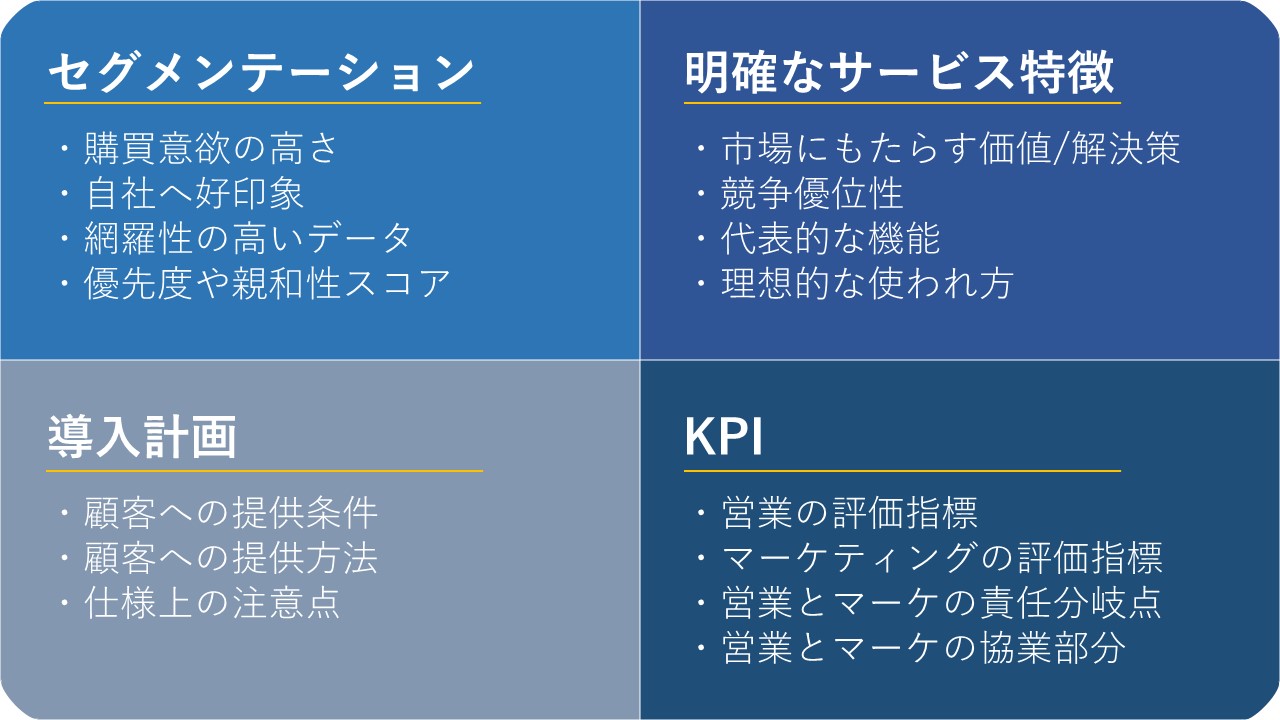
A GTM strategy is formulated by identifying potential customers and concretizing their needs.
Specifically, the following steps are taken to clarify demand and pain points, and to visualize the context in which your service fits.
Group companies that require your service based on metrics, characteristics, and scale.
This can be done more easily by using CRM tools and corporate databases.
This grouping leads to the formulation of targeting and approach methods in later steps.
Extract which companies have the highest purchasing potential in greater detail.
Establish criteria for company characteristics and quantitatively map how well they align with these criteria.
Since the previous step alone cannot strictly measure the purchasing intent for your service, it may include companies unsuitable for purchase. By taking this step, you filter companies to identify the targets that require your focus.
Generally, because Sales teams are in direct contact with customers, they capture the characteristics of current customers more precisely. In contrast, Marketing tends to capture a broader customer profile by attacking the market as a whole. By collaborating, Sales and Marketing organizations can enable sales representatives to devise ways to introduce the company's services as part of the approach strategy for the companies they are currently facing.
A "scenario" is essentially a script. To approach potential customers and increase their purchasing intent, it is important to organize the story. By preparing a set of effective timing and messaging within the customer journey map where they interact with your company, you can promote your services more efficiently.
After deciding how the Sales and Marketing organizations will collaborate in the previous steps, proceed with the following initiatives:
Reach a consensus on the following:
Additionally, establish agreements regarding the tools and workflows to support the execution of the above.
Formulate a diagram that includes the following items:
This serves as a means to understand the customer situation and deepen relationships using appropriate approaches to increase the likelihood of closing.
Reach a consensus on the following:
This makes the KPIs that should be shared between the Sales and Marketing organizations more concrete.
To generate leads, you must first obtain information on groups of companies.
While measures vary depending on whether you approach customers with whom you have already had contact or acquire entirely new groups of companies from external sources, what remains common is to clarify where leads come from and to determine the appropriate approach channels for those leads, both online and offline.
We have converted the above content into specific items and created a GTM strategy formulation checklist.
You can download it for free from the link below, so please feel free to download it if you are interested.
As mentioned above, a GTM strategy plays many roles regardless of company size, such as the following:
Summarize how to present new value or expanded feature sets to existing targets, and estimate the budget increase range for known purchasing departments.
Summarize the loop of experimental entry into untapped markets and improvements based on customer feedback as a continuous flow, and identify untapped purchasing departments.
Quantitatively summarize the continuity and revenue of existing customers along with the resources being utilized, thereby visualizing the contribution of existing customers through numerical data and re-evaluating them.
Evaluate which features lead your service to greater success and which are unnecessary, and endow your service with the ability to adapt to an evolving market.
By using a GTM strategy, companies can efficiently operate limited resources and maximize the return on costs, such as time and money invested.
A GTM strategy can clarify the direction of your services to all stakeholders, both inside and outside the company.
By clearly understanding the points where customer needs and your services align, you can not only identify the factors driving your revenue growth but also highlight unresolved customer challenges and discover new revenue structures to introduce to the market in the future.
Internally, it allows you to consolidate seemingly disparate ideas under a unified consciousness, creates a clear context for setting KBOs and KPIs, and enables the smooth continuation of corporate management. Furthermore, failures and ideas that lack context can also serve as hints for creating new solutions.
While a GTM strategy is created for a single service, it also has the advantage of enabling the creation of a cycle where you can generate and formulate the seeds for new GTM strategies based on it.
Author

uSonar Editorial Department
MX Group, Editor-in-Chief
We are the uSonar Editorial Department.
We provide information on data utilization and digital technologies useful for companies primarily in the B2B sector to rethink their future business operations.
uSonar is utilized by various companies
across a wide range of industries and sectors.
ITreview Grid Award 2026 Summer
Leader in 6 Categories

uSonar Can Help Solve Your Business Challenges!
Case Studies and Sample Reports Available for
Download