- Data Utilization
- Sales Strategy
How Does Data Usage Transform Sales? Explaining the Importance of DX in B2B Sales

Last Updated: May 26, 2023

As mentioned in a previous article, formulating a Go-To-Market (GTM) strategy serves as a critical guideline for corporate activities. However, GTM strategies yield significantly greater results when leveraged with data.
Specifically, by gathering information internally while supplementing missing data from data providers, companies can gain a deeper understanding of the factors necessary for customer decision-making. This helps improve the speed from lead generation to closing.
In this article, we will guide you through the benefits that data-driven GTM strategy formulation and operation bring to corporate activities, as well as the specific methods for implementation.
Recommended Articles

Developing a GTM strategy makes it easier to comprehensively understand market and customer conditions, which is said to provide the following benefits:
For a more detailed explanation of GTM strategies, please refer to this article.
By creating a GTM strategy based on data, you can improve the precision of identifying target companies and streamline the analysis of customer needs and trends.
Furthermore, by providing messages tailored to your targets, you can more strongly impress upon customers that your solution aligns with their needs. Implementing a personalized approach based on data leads to improved sales efficiency and higher deal conversion rates.
In addition, formulating a data-driven GTM strategy helps in understanding competitor trends. By collecting and analyzing information such as competitors' products, services, pricing, and marketing initiatives, you can identify your company's points of differentiation and competitive advantages, thereby maximizing your appeal. The existence of such competitor data will also be valuable information for your partnership strategy.
The more diverse the data utilized in your GTM strategy, the easier it becomes to visualize scenarios that lead to successful deals, enabling the execution and automation of initiatives based on the intentions of prospective customers.
To formulate a data-driven GTM strategy, proceed with the following steps.
To realize a data-driven GTM strategy, both first-party data and third-party data are required.
Generally, it is said that for first-party data—that is, your own company's data—you should prioritize quality over quantity, while for third-party data—external data—you should prioritize up-to-dateness and comprehensiveness.
Examples of first-party data include market and industry research reports, as well as customer information and financial data existing within the company.
Examples of third-party data include target company industry classifications, revenue and profit trends, information regarding the number of employees and departments, areas of focus and capital investment, tools already implemented, and affiliated companies.
This allows you to understand overall market trends and growth potential while getting closer to grasping the specific challenges of individual companies.
Based on the data, segment your target market.
By grouping customers with similar industries, locations, characteristics, and needs, more effective targeting becomes possible.
Additionally, use data to quantitatively judge various priorities.
For example, you can rank the probability of a lead becoming a deal by comparing it with the characteristics of past high-value customers. Alternatively, you can calculate the deal conversion probability for individual companies to extract candidates that are considered to have the highest potential from your target group.
As a method to more accurately determine potential, collect and analyze the trends of competitors.
This allows you to identify your competitive advantage and create account plans for individual companies. By assigning values and additional information to companies within a segment, it will also be possible to implement more granular targeting and 1-to-1 engagement initiatives.
Classify the demands of prospective customers and refine how you present and frame your services for each classification result.
Generally, it is said that it is effective to differentiate between three presentation approaches: "Budget Optimization (Cost Cutting)," "Efficiency Maximization (Time Saving)," and "Business Automation (Reduction of Operational Tasks)."
Service providers often want to convey all the features of their services, but from the customer's perspective, parts unrelated to their current problems are unnecessary (at this moment), and they only hope to learn about them if an opportunity arises in the future.
Instead of providing a uniform and comprehensive service introduction, focusing on specific needs allows you to increase the customer's understanding of your company while simultaneously deepening your own understanding of the customer.
By presenting your services in a way that aligns with the customer's mindset, your conversion rate will improve significantly.
While each company formulates its own unique GTM strategy, companies that succeed in approaching prospective customers share the following elements:
● Granular Segmentation
We classify, understand, and organize the needs held by customers before building a strategy.
By grouping customers based on common characteristics, you can efficiently personalize your approach for each company. It is also important for the sales department to implement various initiatives in cooperation with the marketing department.
● Differentiated Value Proposition
Before starting to sell products or services, companies must confirm potential demand.
Consider who the intended users are, what specific problems the product solves, and whether there are companies providing competing value. Then, refine your approach to ensure that the appeal, which surpasses traditional methods or competitors, is clearly conveyed to prospective customers.
● Continuous Data Utilization and Strategy Evaluation
A sustainable GTM strategy is formulated with its operation in mind.
For the continuous success of products or services, it is also necessary to consider how to generate high-value customers and how to connect customer feedback to further customer acquisition.
Specifically, by establishing indicators to evaluate the achievement level of the GTM strategy itself, you enable strategy formulation that anticipates stable business growth and the continuous operation of the formulated strategy.
Conveying the appeal of your products and services to the fullest is vital for corporate activities.
However, there are times when choosing to "not tell everything" or "focusing on specific features" can create a more favorable impression of your company among prospective customers.
Exploring the right approach tailored to your target audience is the essence of formulating a GTM strategy.
uSonar, developed by our company, allows you to create targeted company lists using the latest corporate data. This enables you not only to define the markets your company can approach but also to extract specific company lists.
Furthermore, Rating 2.0, which we provide, is a service that uses AI to automatically list companies with high potential based on existing customer data. It is used by companies considering the re-evaluation of their prospect lists or the discovery of new prospective customers.
*Rating 2.0 was an optional feature of Side Sonar (new subscriptions ended in February 2025) and its new provision ended as of April 2025. Similar functionality has been integrated into the AI List feature of PLANSonar.
About the Author

uSonar Editorial Department
MX Group, Editor-in-Chief
We are the uSonar Editorial Department.
We provide information on data utilization and digital technology useful for considering future business operations, primarily for companies engaged in B2B business.
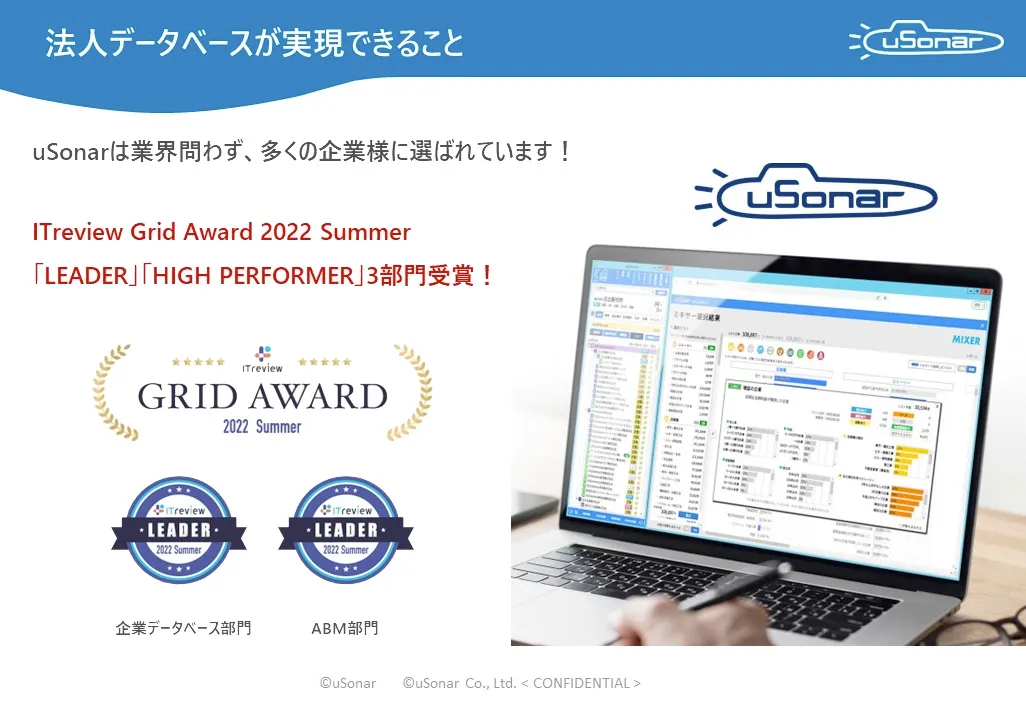
uSonar is utilized by various companies
across a wide range of industries and sectors.
ITreview Grid Award 2026 Summer
Leader in 6 Categories

With uSonar,
we can help solve your company's challenges!
Case Studies and Sample Reports
Available for Download