





- Sales Strategy
Expert Insights from Corporate Database Professionals: A Guide to Developing Sales Strategies—Explaining Key Success Factors

Use Cases by Objective
New Approach Lists
Group Strategy

Digital
Marketing

Client Information Registration

Data Cleansing
Corporate Attribute Analysis

SFA/MA Activation

Business Card Data Integration

Credit & Client Checks

Use Cases by Department
Sales Department

Inside Sales
Department

Marketing &
Corporate Planning Department

Information Systems Department

Management Department

Use Cases by Tool
Meeting Sonar
Last Updated: June 7, 2023
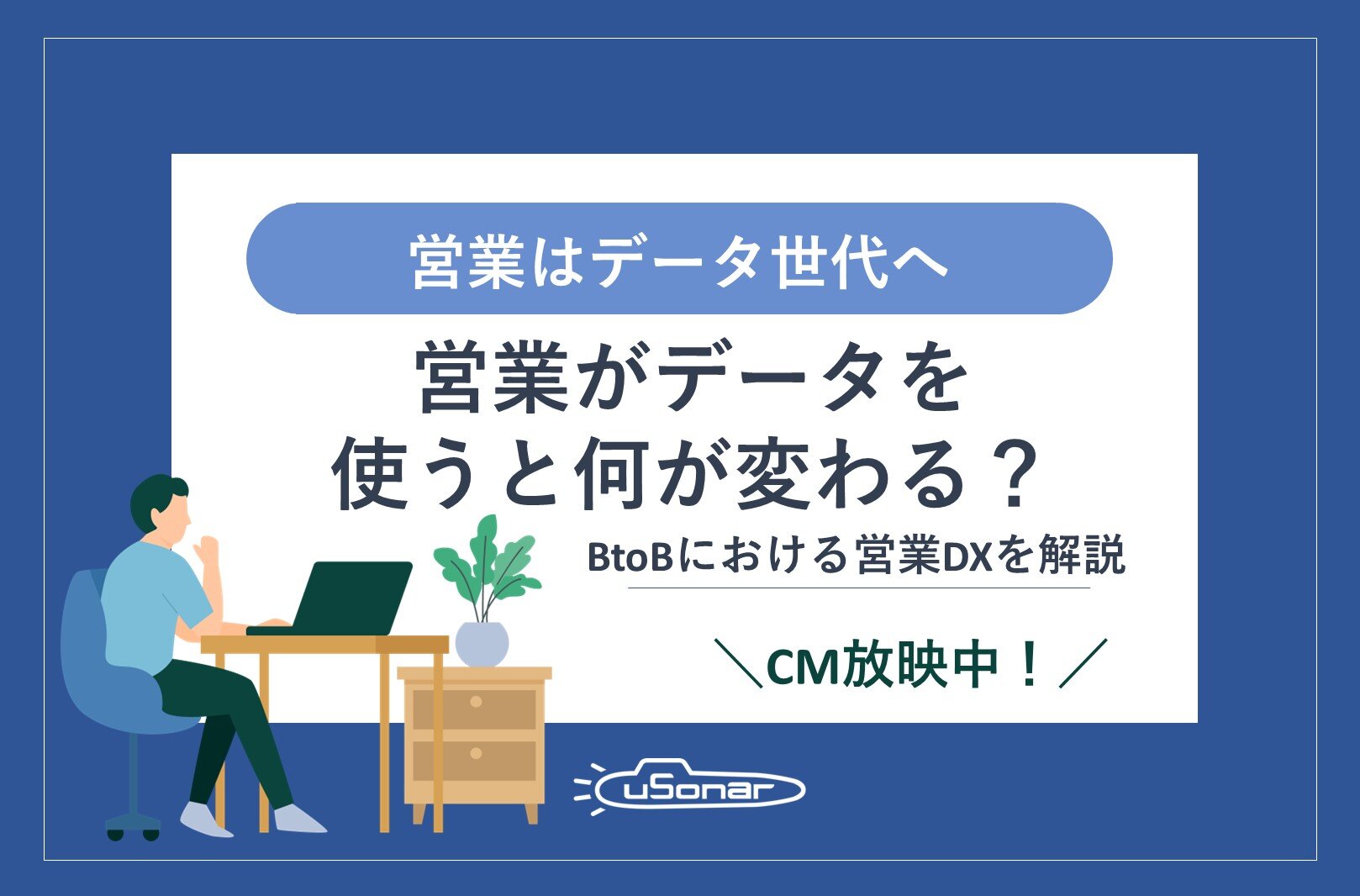
Click here for the uSonar CM.
Click here to learn more about sales strategies ▶
Science of Sales
Learn About uSonar in 5 Minutes
Data is an essential lifeline for modern corporate operations.
Acquiring and integrating data from multiple sources to share advanced insights across an organization is an incredibly complex task. A single misstep in the process can lead to significant misunderstandings.
Modern approaches that automatically integrate, cleanse, and enrich data eliminate these hurdles in data management.
This article explains how leveraging data can shorten sales cycles and secure a competitive advantage, ultimately leading to business expansion.
Table of Contents
1Leveraging Data in B2B Sales to Create a Competitive Edge
2Efficiently Finding Customers Is the Foundation of Business Growth
3-22. Revenue and Profit-Related Data
4What Can Be Achieved by Utilizing Data
4-1Deepening Customer Understanding by Appending Supplemental Information to Companies
4-2Optimizing Customer Approaches Using Highly Fresh Supplemental Information
4-3Reducing Time Costs by Utilizing More Information Sources
Recommended Articles
Expert Insights from Corporate Database Professionals: A Guide to Developing Sales Strategies—Explaining Key Success Factors
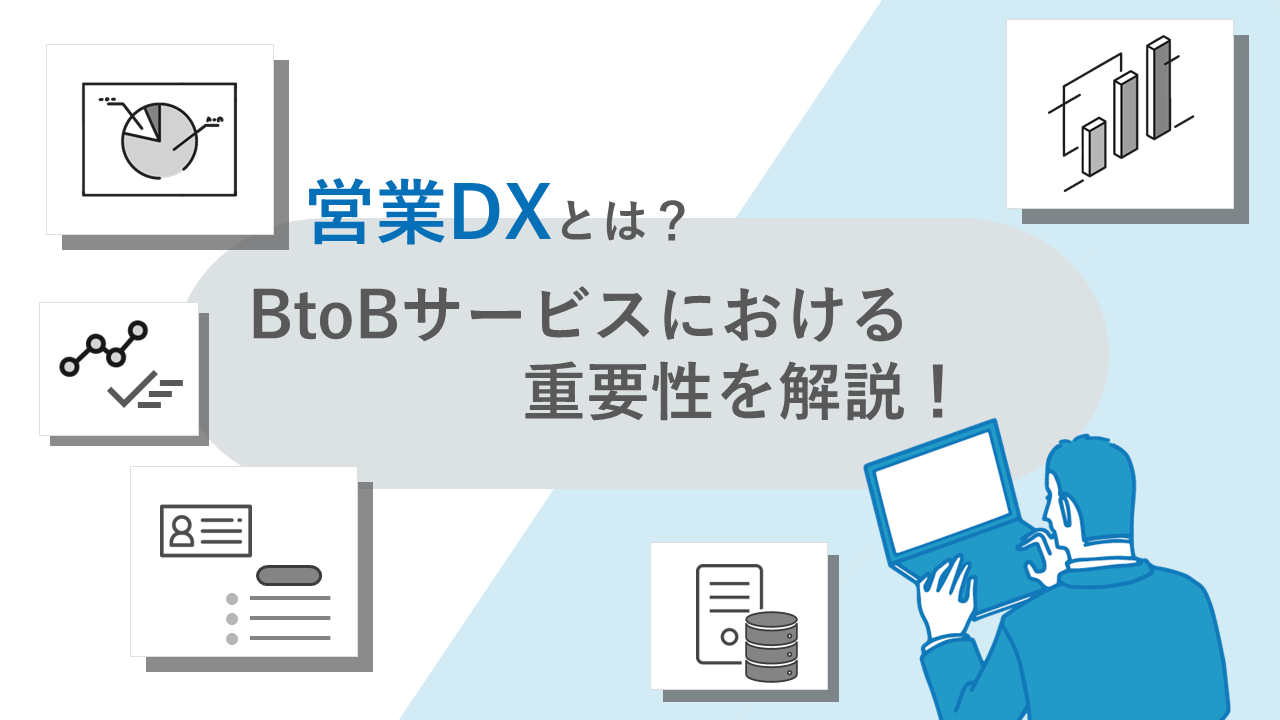
What Is Sales DX? A Thorough Explanation of Its 5 Benefits, Importance, and Keys to Success
Understand in 3 Minutes: What Is B2B Sales? Explaining the Two Essential Elements for Success and the Differences from B2C Sales
Changes in today's B2B business environment affect all companies, regardless of industry, region, or company size. What they all have in common is the potential for any company to rapidly expand its business. It is said that companies that quickly establish a foundation for effective approaches based on the latest data hold a competitive advantage.
The challenges in achieving this vary by company.
For example, emerging companies may struggle with data collection itself. On the other hand, for companies that have recently joined a large corporate group, the confusion caused by data loss or overwriting during the integration of backend systems can act as a brake on promoting data utilization.
Data such as corporate attributes and interests are used to segment and prioritize potential leads. Defining an ideal customer profile and understanding the customer journey are considered essential for effectively making an impression on prospects at an early stage.
To more efficiently promote GTM strategy planning and customer approaches, it is important to utilize data obtained from data providers in addition to the existing customer data within your company, such as the following:
Based on the Japan Standard Industrial Classification and the proprietary classifications of corporate data providers, we segment target company groups and define clusters that have high affinity with our products and services.
We assess whether a company is in a financial position to invest by grasping the upward or downward trends in its sales and profits. We also group information such as "investment status by area" as described in medium-term management plans.
We determine the number of personnel (executives and employees) and understand the scale and location of offices other than the headquarters. Furthermore, by grasping the areas of focus in corporate activities from publicly available information, we identify areas where human resources are planned to be deployed.
We identify the tools implemented on websites to evaluate a company's progress in the digital transformation domain. Marketing-related tools, in particular, can be used to research competitor trends and evaluate the likelihood of business negotiations with a company.
We visualize the interests of companies and personnel based on behavioral trends on media sites and other platforms. We can also obtain information related to approach prioritization, such as whether interest in competing services is increasing.
We clearly define and classify relationships between companies, branches, and organizations based on criteria such as capital. This allows us to identify group companies that may have similar challenges and consider horizontal expansion of B2B sales approaches.
By utilizing multiple data providers that possess the data mentioned above, it becomes possible to understand customers from various perspectives and refine tactics.

So, how exactly should data be utilized?
While there are various success stories, here are three of the most common data utilization policies.
Corporate research through desk research allows you to grasp a company's "current location," such as its company profile, history, and related news. However, it is difficult to understand the connection from the "past" to the present, such as the background leading up to the current situation or the challenges faced by management, as well as their orientation toward the "future." Consequently, the only way to infer BANT is to keep pushing for appointments.
By understanding in advance which departments have potential needs related to your company and what kind of investments those departments are making, B2B sales efficiency will improve dramatically.
By aggregating various information disseminated by the target company, connecting highly relevant information, and reading the context of corporate activities, it is possible to infer the content and urgency of their needs.
Increasing the accuracy of these inferences and enhancing customer resolution is the advantage of utilizing the data mentioned earlier.
Long-established data providers have primarily built their businesses through manual data collection and verification. While this method ensures data accuracy and the comprehensiveness of necessary data, it often lacks the "freshness" (real-time nature) of information.
Generally, it is said that data providers that also offer online data improve the freshness of information while also enhancing accuracy and comprehensiveness.
By utilizing data providers that engage in data collection using online data and digital technology while retaining the benefits of offline data collection, you can establish an environment where you can access a large amount of corporate data while ensuring data "freshness." This allows you to consider ways to advance business negotiations advantageously while grasping information faster than competitors.
Information from a single data provider cannot satisfy all needs.
However, when utilizing multiple data providers, integration is considered difficult due to the aforementioned differences in "freshness."
By integrating multiple data sources and centralizing the flow of information into a single data management system, you can eliminate data-related tasks previously performed manually using CRM tools, allowing you to devote more time to strategic discussions.
Business opportunities exist everywhere. By quickly assessing their scale and identifying fit-and-gap areas, you can concentrate your resources on prospects with the highest potential for conversion.
Corporate activities generate a wide range of data. Leveraging a data provider often yields a higher return than attempting to collect all such information through self-directed efforts.
uSonar, provided by our company, operates multiple databases in parallel to integrate various data sources with high precision, continuously updating enriched corporate data on a daily basis.
Serving as a central hub, uSonar provides comprehensive information on companies, enabling efficient customer understanding and more effective internal communication within B2B sales organizations.
About the Author

uSonar Editorial Department
MX Group, Editor-in-Chief
We are the uSonar Editorial Department.
We provide information on data utilization and digital technologies useful for rethinking future business operations, primarily for companies engaged in B2B business.
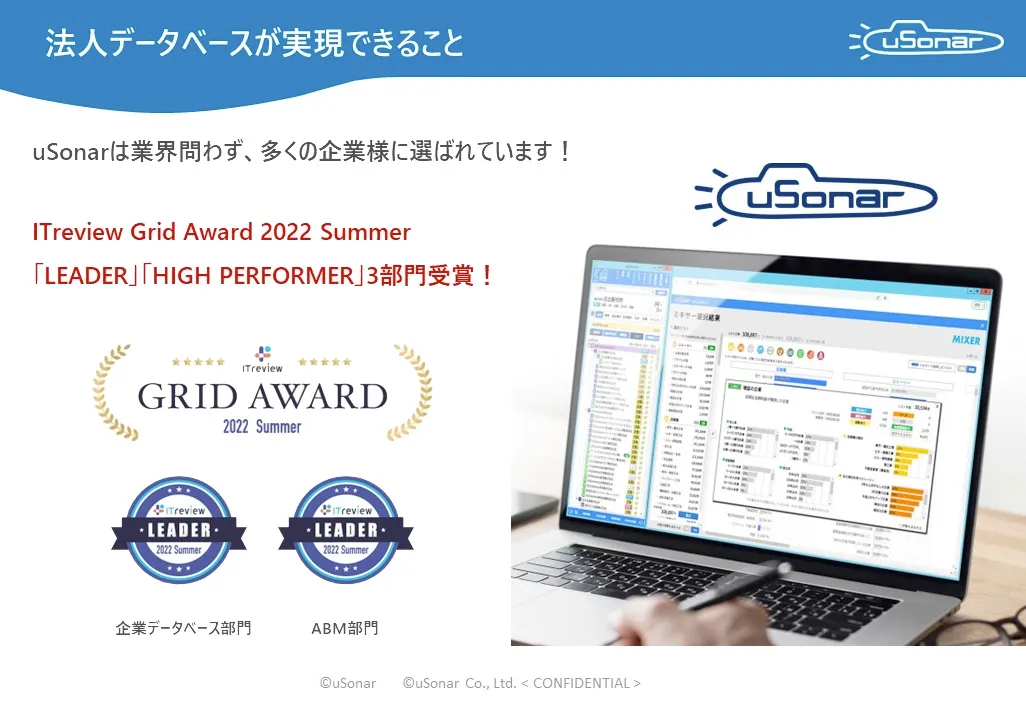
uSonar is utilized by
various companies across all industries and sectors.
ITreview Grid Award 2026 Summer
Leader in 6 Categories

With uSonar,
we can help solve your company's challenges!
Case Studies and Sample Reports
Download