- Data Utilization
- Sales Strategy
How Does Data Usage Transform Sales? Explaining the Importance of DX in B2B Sales

Last Updated: April 26, 2024
Click Here to Learn More About Sales Strategies ▶
What Is a Strategic Sales Approach
Using Corporate Data?
B2B sales and B2C sales differ in their target audience. B2B stands for Business to Business, which refers to transactions between companies. B2B sales involve companies targeting corporate clients. B2C stands for Business to Consumer, which refers to transactions targeting individual general consumers.
This article explains the fundamentals of B2B sales, the differences from B2C sales, and the challenges involved.
Table of Contents
2Differences Between B2B and B2C Sales
3-2Purchasing Decisions Based on Organizational Consensus
3-4Utilizing SFA (Sales Force Automation)
4-1Prevalent New Customer Acquisition
4-2Making Purchasing Decisions Based on Emotion
4-3Listening Directly to the Voice of the Customer
5-1The Complexity of the Sales Process
5-2Expanding the Client Base and Avoiding Customer Dependency
5-3Understanding Customer Reluctance Toward Sales Outreach
6-2Follow-Up
7Two Essential Elements for Successful B2B Sales
Recommended Articles

B2B (Business-to-Business) sales refers to the sale and transaction of products or services between companies. Specifically, in B2B sales, one company provides products or services to another, and the transaction occurs between legal entities. Key characteristics include complex decision-making processes and a requirement for higher professional expertise. It is often contrasted with B2C (Business-to-Consumer) sales, as there are many differences in sales styles. This article will explain the details.
In B2C transactions, the general consumer and the decision maker are the same person. In contrast, in B2B transactions, the person being sold to and the decision maker are different.
In B2B transactions, the authority to approve a purchase lies with the company's CEO or executives. When multiple people are involved in a purchase, the lead time for the purchase increases due to internal approval processes.
A persona is a concrete representation of a prospective customer, including gender, age, and hobbies, who would purchase your company's products. This differs between B2B and B2C. In B2C, persona settings involve collecting information directly related to general consumers, such as age, gender, family structure, and place of residence.
In B2B, since an organization uses the product or service, it is necessary to collect information about the company, the organization, and the personnel involved. On the other hand, B2B persona settings tend to be more complex than B2C due to factors such as personnel turnover or differences in departments holding purchasing authority.
B2B sales are characterized by a high frequency of route sales, where existing customers are visited regularly. Unlike B2C transactions, which may end after the sale, follow-up is essential. It is necessary to improve skills in listening to existing customers and proposing solutions to perform cross-selling and up-selling, thereby increasing the average customer value.
As mentioned previously, multiple people are involved in B2B purchasing decisions. For example, a sales representative may propose a product to the sales department of a client company and gain their interest. However, conflicts of opinion may arise, such as the manufacturing department requiring different features.
In B2B transactions, each stakeholder's opinion is consolidated to make a comprehensive judgment on product selection. Consequently, the time required to finalize a contract is typically longer.
The goal of B2B sales is to solve corporate challenges. In many cases, service implementation is not the end of the problem-solving process, but rather the beginning. Sales representatives who actively share information and work toward problem-solving even after implementation are highly valued by customers. This increases trust and enables stable, long-term transactions, which in turn allows for fundamental problem solving.
SFA is a digital tool for schedule management and sales analysis. By utilizing SFA, you can identify issues within the sales process.
In B2B sales, simply increasing the number of contacts without a clear target is ineffective. By utilizing SFA to accumulate small improvements and strengthen the sales process, you can successfully lead to closed deals.
Compared to B2B sales, B2C sales are characterized by a higher volume of new customer acquisition. However, because many products are low-cost and transactions are often completed entirely online, the acquisition cost is generally lower than in B2B.
While B2B transactions are based on comprehensive evaluations, B2C transactions tend to be driven by emotion. Therefore, in B2C sales, it is crucial to connect product benefits to the personal emotions of the customer. Another characteristic of B2C sales is that products are sometimes purchased solely due to the charm of the sales representative.
However, a disadvantage is that if a sales representative is transferred or resigns, the likelihood of contract cancellation increases. This occurs because customers may become fans of the individual representative rather than the product itself. Consequently, efforts are required to foster interest in the product and the company as a whole.
In B2C sales, the consumer and the decision-maker are the same, allowing for more direct feedback. While this often means receiving direct complaints, it also provides frequent opportunities to receive appreciation, which can boost the motivation of the sales team.

The objective of B2C sales is to improve customer satisfaction upon using the product, and needs are limited to those related to the product itself. In contrast, the expectation in B2B sales is to generate profit for the client company. This includes consultative proposals beyond the product itself, such as "store shelf layout" or "labor-saving solutions," making continuous information gathering essential. Although the B2B sales process is complex, once a product is understood and adopted, it is less likely to be switched to a competitor's service, making it easier to secure stable revenue.
The number of customers in B2B sales tends to be smaller than in B2C. As mentioned, because B2B transaction values are high, there is a tendency to become overly dependent on a single company. If the client company's business declines due to external factors such as the COVID-19 pandemic and the limited number of transactions ends, the loss to one's own company can be immeasurable. It is important to strive for continuous acquisition of new customers while also ensuring that transactions are diversified.
Many customers believe it is more convenient to purchase via a website before having any contact with a sales representative. This is one of the most difficult aspects of B2B sales, as customers prefer to purchase corporate products at a time of their own choosing.
However, because some products are highly specialized and complex, the intervention of a sales representative is indispensable. Therefore, to succeed in B2B sales, it is essential to build a sales process that makes customers want to purchase from you even before you make direct contact.
When hearing "new business development," many may imagine cold calling, but other methods such as phone outreach, email approaches, and direct mail are also effective. Handwritten direct mail, in particular, can be effective in B2B sales as it is more likely to elicit a response from decision-makers such as executives. There are various other new business development methods, including web-based approaches.
In B2B sales, large sums of money often move in a single transaction, and a significant portion of revenue is frequently generated by a few high-value customers. In B2B new business development, quality is just as important as quantity.
According to "60 Important Statistics to Help Improve Sales Performance" by HubSpot Japan, "60% of customers say no four times before saying yes, yet 48% of sales reps never make a single follow-up attempt." As mentioned above, for B2B companies, a few high-value clients are of the utmost importance. Ideal follow-up content includes announcements of event appearances or new service releases that capture the interest of the contact person. Be sure to conduct individual follow-ups with key prospective customers in conjunction with press releases and advertising campaigns.
According to the aforementioned HubSpot Japan survey, "Consumers are 4 times more likely to buy when referred by a friend, and prospects referred by other customers have a 37% higher retention rate." It goes without saying that people are more likely to trust a referral from a well-known friend or industry peer than words from an unknown salesperson. Efforts to improve usability, such as releasing new features or conducting interviews, directly lead to sales results. Additionally, a more controllable B2B measure is listing your products on comparison sites. Listing on highly reliable sites provides the same effect as a referral from an acquaintance. By utilizing customer reviews in sales activities, it is possible to appeal to the authentic voice of the user, which is usually difficult to obtain in B2B sales.
B2B products are often high-priced, and many stakeholders are involved in purchasing decisions.
Since it is unrealistic to persuade all stakeholders by yourself, the success of a sale depends on whether you can cultivate a key person on the client side who will champion the introduction of your product.
It is important to actively engage with internal key figures, such as project managers or department heads with decision-making authority.
BANT is a B2B sales framework consisting of four English words: Budget, Authority, Needs, and Timeframe. By conducting sales with BANT in mind, you can efficiently promote the introduction of your products.
◯Budget = Maximum available budget
◯Authority = Decision-making power for the internal approval process
◯Needs = Requirements and requests for the service
◯Timeframe = Service implementation timeline
Recommended article: Tips for Efficient Business Negotiations | Sales Strategy Planning Guide ▶
In this article, we have explained the differences and challenges between B2B and B2C sales. In both cases, it is important to build long-term relationships with customers. In B2B sales, in particular, you cannot achieve continuous transactions unless you deliver your message to the decision-maker level. Within this process, it is important for B2B businesses to treat the client company's "challenges" as a shared goal to be solved.
About the Author

uSonar Editorial Department
MX Group Editor-in-Chief
This is the uSonar Editorial Department.
We provide information on data utilization and digital technologies useful for B2B companies to consider the future of their business operations.
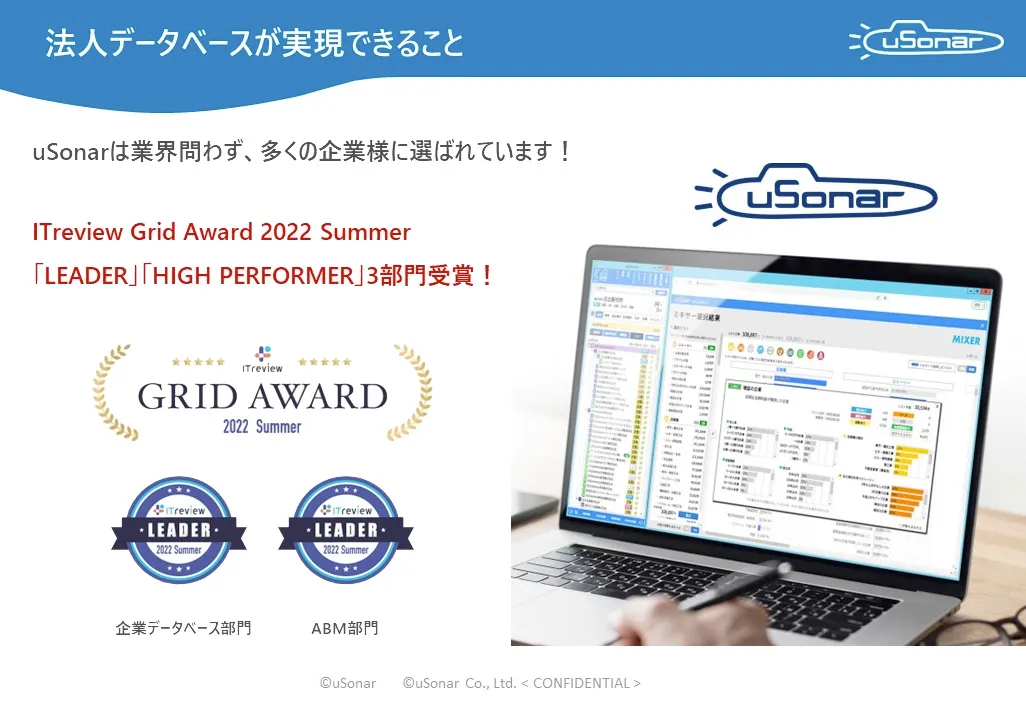
uSonar is utilized by various companies
across all industries and sectors.
ITreview Grid Award 2026 Summer
Leader in 6 Categories

With uSonar,
we can help solve your company's challenges!
Case Studies and Sample Reports
Download