- Credit and Anti-Social Force Checks
- Sales Strategy
- New Business Development and Sales Lists
- Corporate Registry
How to Choose a Corporate Registry Information Acquisition Service: 6 Criteria and Selection Processes Explained!

Last Updated: April 24, 2024

Click Here to Learn More About Sales Strategy ▶
Scientific Sales:
Understand uSonar in 5 Minutes
Driven by social factors such as the increasing complexity of customer needs and digital technologies, as well as the focus on operational efficiency due to population decline, "Sales Enablement"—the strengthening of sales organizational structures—is gaining significant attention in Japan. To ensure you stay ahead of the times, learn the fundamental concepts and implementation tips for Sales Enablement.
At the end of this article, we also introduce uSonar, a recommended tool for resolving data challenges within sales organizations. Please be sure to read until the end.
Table of Contents
1-1Basic Concepts and Definitions of Sales Enablement
2What Are the Benefits of Sales Enablement?
2-1Improving Sales Activity Efficiency
2-2Increasing Sales Top-Line Revenue
2-3Relationship With Marketing
3Market Size and Latest Trends in Sales Enablement
3-1Adoption Rate of Sales Enablement
3-2Global Sales Enablement Market Trends and Forecasts
4Background Behind the Demand for Sales Enablement
4-1Increasing Complexity and Diversification of Product Benefits Due to Diverse Needs
4-2Growing Emphasis on Efficiency Driven by Demographic Shifts and Work-Style Reform
4-3Advancement of Specialized Technologies Due to the Proliferation and Deepening of Digital Technology
5Key Factors for Successful Sales Enablement
5-1Establish a Specialized Department
5-2Share Sales Know-How to Prevent Dependency on Individual Skills
5-3Implement Sales Support Tools Such as CRM and SFA
5-4Develop a Data Infrastructure for Performance Measurement
6Frameworks for Sales Enablement
6-1The SPIN Approach to Enhance Hearing Skills
6-2Learning Persuasion Techniques: Influence: The Psychology of Persuasion
6-3BANT: The Fundamentals of B2B Sales
7Success Stories of Sales Enablement
8Recommended Tools for Sales Enablement
8-1uSonar
Recommended Articles
How to Choose a Corporate Registry Information Acquisition Service: 6 Criteria and Selection Processes Explained!

Why the Corporate Registry Information Service Is Essential Now: Background on Its Necessity and the Risks of Neglect

The term "enablement" in "sales enablement" is derived from the verb "enable," meaning to make something possible or effective. Consequently, sales enablement can be interpreted as a strategic approach to strengthening and streamlining sales organizations. While its core meaning refers to a framework for developing sales talent that leads to results, in a broader sense, it encompasses not only talent development but also the improvement of the entire sales process to build an organization that empowers sales representatives to achieve results more effectively.
The fundamental concept of sales enablement is to provide the resources necessary to support sales teams and lead them to success. This includes the optimization of information, training, tools, technology, and processes. Sales enablement contributes to corporate revenue growth by supporting effective communication, the development of sales strategies, the strengthening of competitiveness, and the delivery of value to customers.
There are various approaches and methods for sales enablement. Common types of sales enablement include the following:
Each type is customized to meet corporate needs and industry requirements, providing a foundation for sales team success.
There are many benefits to implementing sales enablement. The details are as follows.
By implementing sales enablement, sales representatives can perform their duties more efficiently. Specifically, task automation reduces repetitive work, allowing the sales team to spend more time engaging with customers. Lead management is also optimized, with improved tracking and scoring that helps take action at the right time.
Sales enablement contributes to increasing corporate revenue. This leads to the benefit of increasing the top line (sales revenue). Specifically, it supports lead generation, effective closing, and the building of long-term customer relationships. These elements combine to increase sales revenue and contribute to corporate growth.
Sales enablement, which aims to optimize the entire sales organization, also benefits the marketing team in terms of sharing customer information and providing effective content.
Sales enablement and marketing share customer information to achieve effective collaboration. Sales representatives and marketing teams can share lead progress and interests to execute appropriate follow-up actions. Furthermore, data regarding target markets is shared, enabling effective approaches to target audiences.
Content provided by marketing plays a crucial role in sales enablement. Content such as proposal materials and presentations helps sales representatives provide value to customers. Educational materials for customers are also provided to build trust and deliver value.
By strengthening collaboration, marketing and sales become unified, allowing for the smooth execution of processes from lead generation to closing.
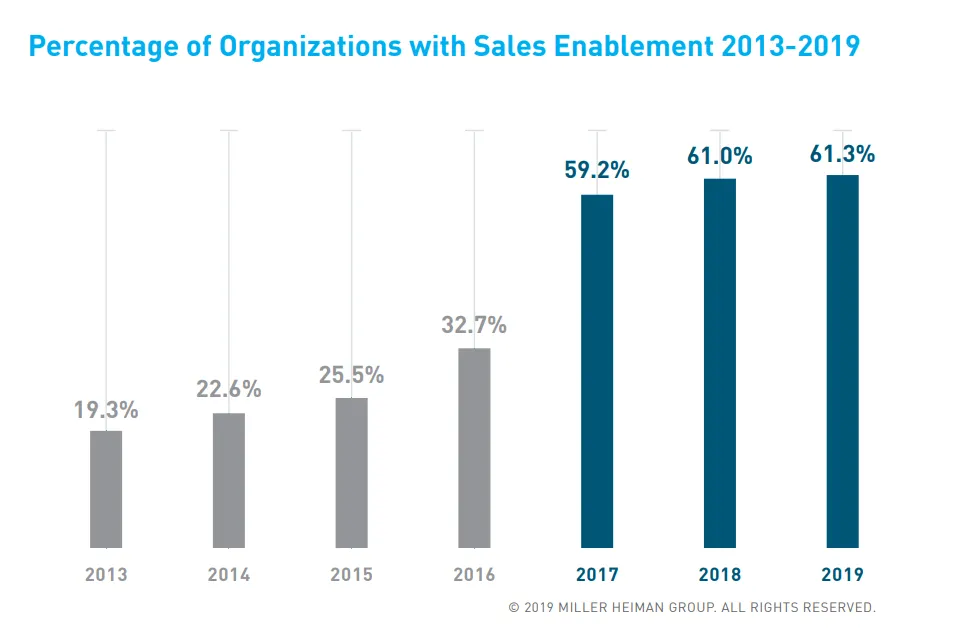
According to the "Sales Enablement Report" published in 2019 by the major international research firm CSO Insights, the adoption rate of sales enablement surged from 32.7% in 2016 to 59.2% in 2017. This percentage continued to increase through 2019, and further growth is projected due to the impact of the pandemic.
According to a report published by Research and Markets in 2021, the global market for sales enablement platforms was valued at approximately 1.3 billion USD in 2020. It is projected to grow at a compound annual growth rate (CAGR) of 19.5% from 2020 to 2027, reaching an estimated market size of approximately 4.5 billion USD by 2027.
Why is sales enablement gaining attention, and what lies behind it? This section explains the background behind the rising demand for sales enablement.
In today's market, customer needs are becoming increasingly diverse and personalized. Consequently, the benefits of products and services offered by companies are also becoming more complex and varied. Sales representatives must address these diverse customer needs and accurately communicate the value provided by their products and services. Sales enablement supports sales representatives in addressing these challenges and providing optimal solutions to customers.
In many countries, including Japan, the population is aging and the workforce is shrinking. Furthermore, as work-style reforms progress, there is an increasing demand for efficient business execution. Sales enablement streamlines sales processes and establishes an environment where sales representatives can work productively. This enables companies to achieve greater results with fewer resources, thereby strengthening their competitive edge.
The rapid proliferation and deepening of digital technology have transformed many industries. This has led to a demand for higher levels of specialized technology and knowledge. Sales representatives must possess advanced knowledge of products and services to provide professional advice to customers. Sales enablement provides the framework necessary to equip sales representatives with the required information and training to enhance their expertise. This allows sales representatives to maintain high levels of professionalism and increase their credibility.
The scope of sales enablement is broad, and the optimal approach varies depending on the sales organization. Here, we focus on the common points essential for success.
Establishing a specialized department for Sales Enablement is the key to success. This department is responsible for planning and executing Sales Enablement strategies. By collaborating with sales representatives, the specialized department develops training programs, selects tools, and evaluates performance. By providing expertise and leadership in Sales Enablement, the specialized department contributes to the success of the entire organization.
Sharing know-how among sales representatives significantly impacts Sales Enablement results. To prevent dependency on individuals (personal-dependent models), it is crucial to establish a system where sales representatives can share success stories and best practices. By introducing platforms that promote internal communication and knowledge sharing, you can create an environment where the entire team can cooperate toward common goals.
In Sales Enablement, the implementation of effective sales support tools is essential. Tools such as CRM (Customer Relationship Management) and SFA (Sales Force Automation) assist with customer information management, task automation, and lead management. By leveraging these tools, sales representatives can improve productivity and gain easier access to critical information.
To evaluate and improve the results of sales enablement, a data infrastructure for measuring effectiveness is essential. By utilizing data analysis tools and dashboards, you can quantitatively assess the impact of your sales enablement initiatives. Tracking metrics such as customer responses, lead conversion rates, and revenue growth will help you adjust your strategies accordingly. Data-driven decision-making is the key to the success of sales enablement.
This section introduces specific frameworks to strengthen sales capabilities. Each of these methods has been socially and scientifically validated for its effectiveness. We recommend starting with the frameworks that best align with your organization.
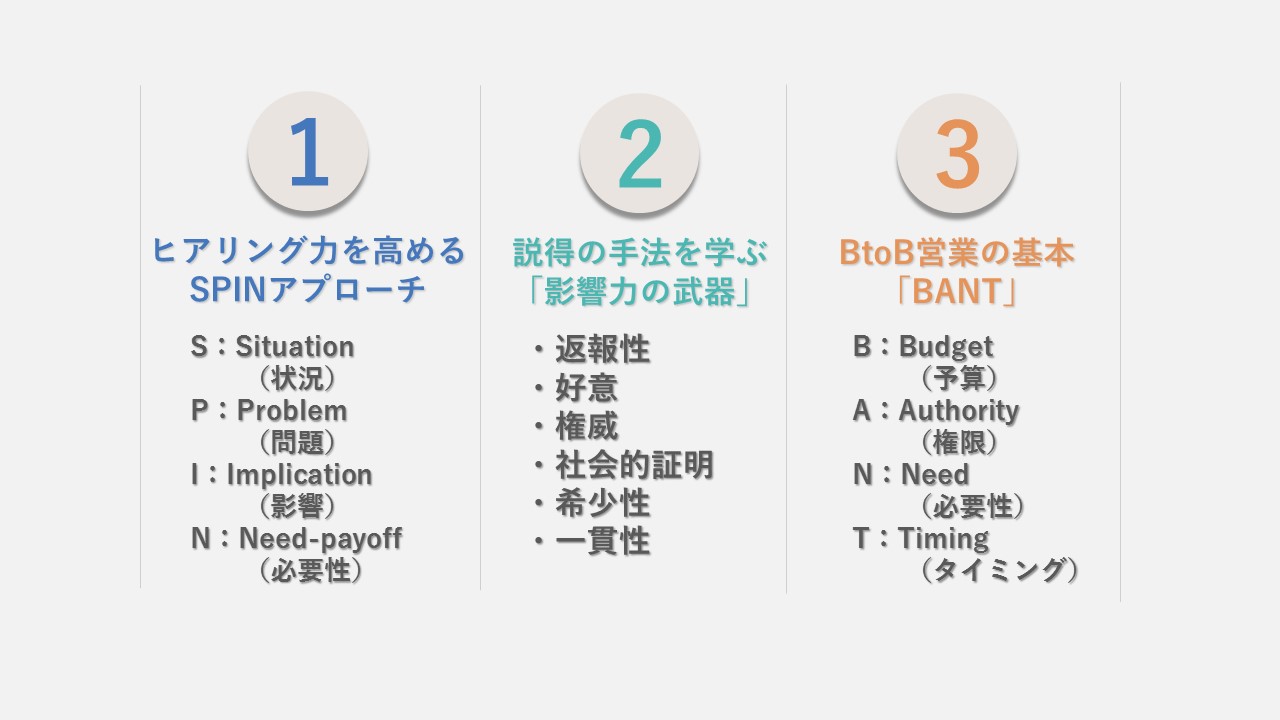
The SPIN approach is a framework that emphasizes effective listening and questioning techniques. SPIN stands for Situation, Problem, Implication, and Need-payoff. Through these elements, it provides an approach to deeply understand customer needs and challenges, allowing for the delivery of effective solutions. Through sales enablement, sales representatives can master the SPIN approach, improve their listening skills, and strengthen their dialogues with customers.
The persuasion techniques known as Influence: The Psychology of Persuasion were proposed by Dr. Robert Cialdini. This framework includes psychological principles for persuading others, such as social proof, scarcity, and authority. Through sales enablement, sales representatives learn these principles of persuasion to enhance their communication skills and increase their ability to influence customers. This serves as a powerful tool for building trust in the sales process and improving closing rates.
BANT is a model that provides a fundamental approach to B2B sales. This framework serves as a guideline for evaluating lead quality and determining purchasing intent. BANT stands for Budget, Authority, Need, and Timing. By confirming these elements, organizations can improve lead quality and achieve effective lead qualification. Through sales enablement, understanding and integrating the BANT model into the sales process leads to higher lead quality and increased closing rates.
Since its founding, OTSUKA CORPORATION has consistently focused on the pursuit of customer satisfaction, growing alongside its clients by staying close to their needs. By utilizing the customer data integration tool uSonar, the company has been able to identify current customer challenges that were previously invisible through sales touchpoints alone, as well as future challenges related to realizing their long-term visions, thereby streamlining their sales activities.
• Desire to meet the increasingly diverse needs of customers in line with changing times
• Improved customer relationships by providing relevant information to clients
For more details on this case study, click here
If you are looking to maximize the effectiveness of your sales enablement by leveraging SFA tools like Salesforce, uSonar is highly recommended.
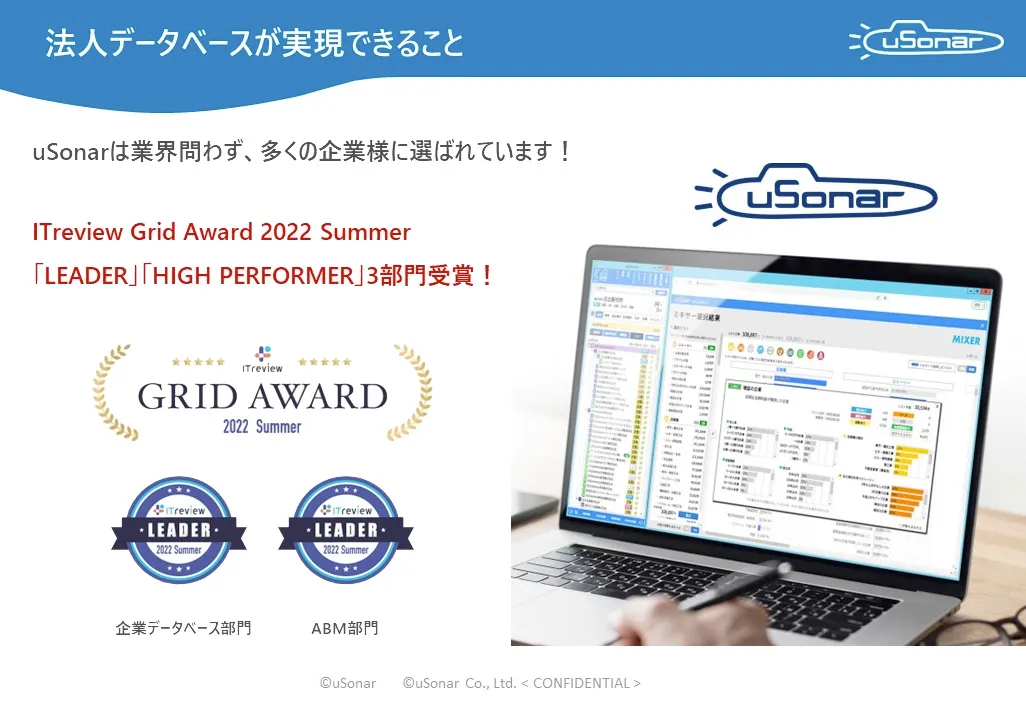
The key features of uSonar lie in the comprehensiveness and integration of its corporate data.
Our proprietary corporate database covers 12.5 million business locations across Japan. The data includes a wide variety of information, such as location, industry, and annual revenue, as well as corporate characteristics categorized by over 200 segments. This tool centralizes information gathering, which is often prone to becoming siloed or dependent on specific individuals.
More than 20 types of data matching masters enable the integration of customer information that is often scattered across different departments and business locations. By centralizing customer data, you can perform effective measurements by analyzing various data points across the entire organization.
For more details about uSonar, please check here.
Author

uSonar Editorial Department
MX Group Editor-in-Chief
We are the uSonar Editorial Department.
We provide information on data utilization and digital technologies useful for rethinking future business operations, primarily for companies engaged in B2B business.
uSonar is utilized by various companies
across a wide range of industries and sectors.
ITreview Grid Award 2026 Summer
Leader in 6 Categories

With uSonar,
we will guide your company toward solving its challenges!
Case Studies and Sample Reports
Download