Hello. This is Watanabe from the uSonar Marketing Team!
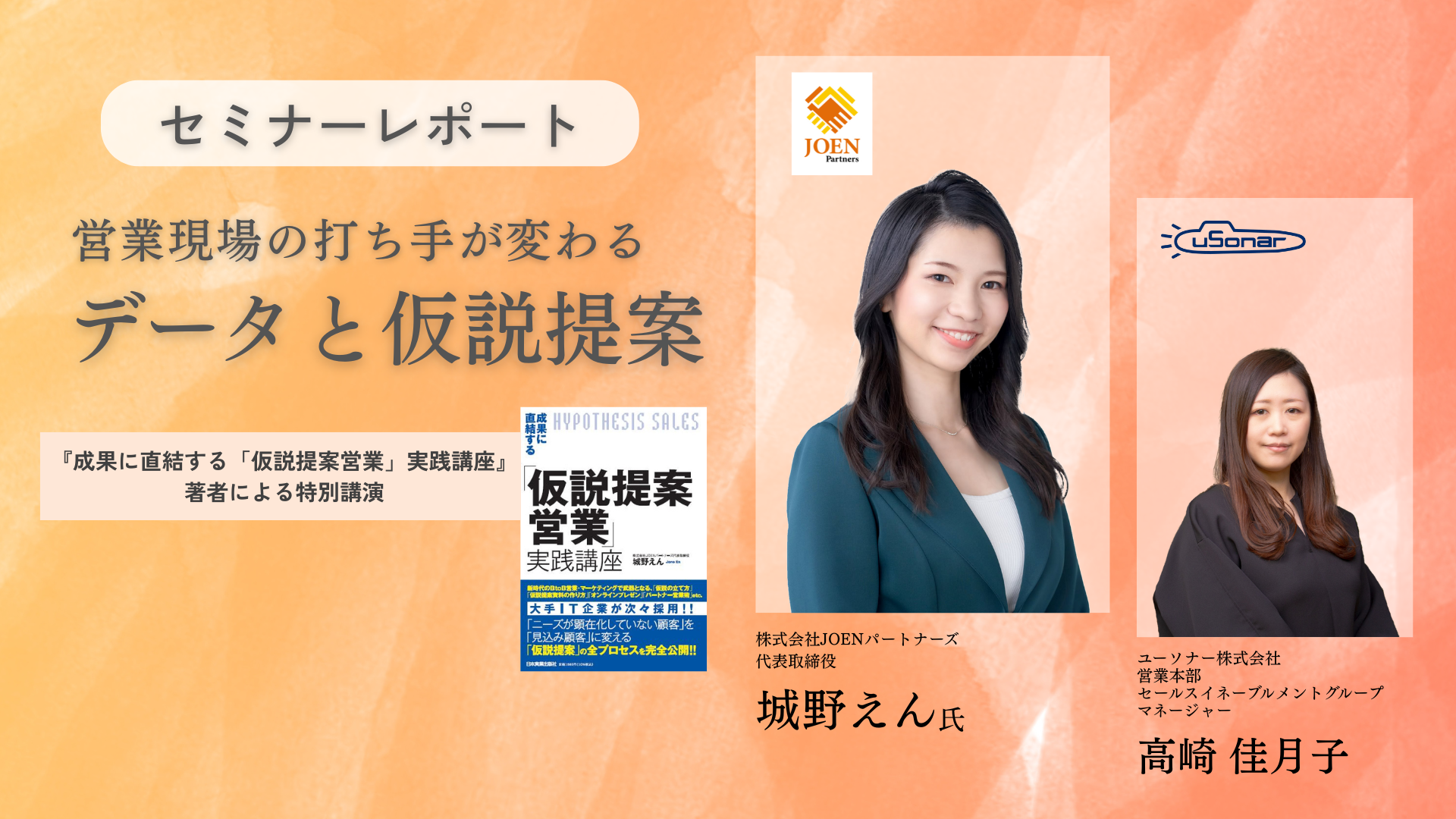
Today, we are sharing a report on the seminar hosted by uSonar on July 17, 2025, featuring En Shiro, author of "Practical Course on 'Hypothesis-Based Proposal Sales' That Leads Directly to Results."
In the first session, Mr. Shiro presented, followed by Takasaki from uSonar in the second session. Both speakers shared their insights on the latest approaches to new business development in corporate sales.
Part 1
Recent Changes in Sales Activities and Their Background
As a preliminary step before entering the main discussion, Mr. Jono shared his insights on the characteristics of sales organizations that have reached a plateau in performance.
According to Mr. Jono, the sales activities traditionally conducted by companies are primarily divided into two types: inquiry-based sales and product-introduction sales.
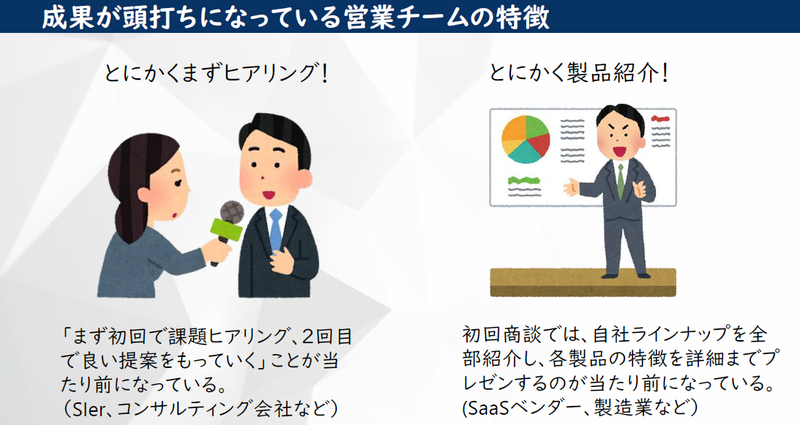
Inquiry-based sales refers to a sales style where the representative focuses on thoroughly listening to the customer's thoughts and interests starting from the very first appointment. Mr. Jono notes that even among the companies he consults for, such as SIers and consulting firms that handle a wide range of products, there is often an atmosphere where it is considered standard practice to conduct inquiries during the initial meeting to uncover customer needs.
Next, product-focused sales is the opposite of consultative sales; it refers to a sales style that prioritizes demonstrating how attractive a company's products or services are from the very first appointment. Mr. Shiro explains that this style is frequently used by manufacturing companies and SaaS firms that possess inherent strengths in their own products.
Of course, there is absolutely nothing wrong with the approach mentioned above, and Mr. Shiro notes that it has traditionally produced solid results. However, he points out that in the last few years, especially since the COVID-19 pandemic, there have been many cases where performance has plateaued or growth rates have declined compared to the past. Some of you reading this report may also be feeling a similar sense of stagnation.
So, what are the underlying factors? Mr. Shiro identified the following two points as the primary causes.
Mr. Shiro explains that as the range of products and services available to customers has increased, making comparison and evaluation easier, it has become difficult to increase sales using traditional sales methods.
So, what kind of sales activities should be conducted? In response to this question, Mr. Shiro stated that "by developing your own hypotheses on how your company's products can contribute to a customer's revenue, and presenting them logically and with passion," you can significantly improve your results through this newly proposed approach.
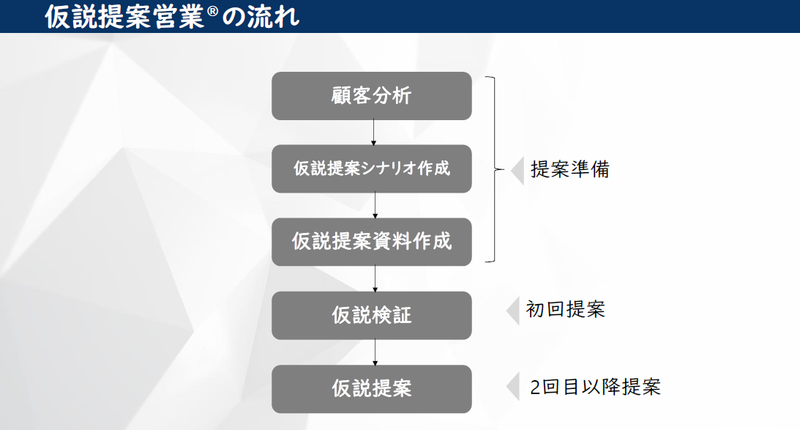
Mr. Shiro calls this sales method of preparing hypotheses in advance "Hypothesis-Based Proposal Sales."
So, what are the necessary elements to realize this Hypothesis-Based Proposal Sales? Let us examine them in detail in the next chapter.
Essential Elements for Sales Activities
Mr. Shiro asserts that the essential elements for sales activities are, quite simply, "Trust, Passion, and Logic." He emphasized their importance by noting that various famous figures throughout history, such as Aristotle and Dr. Stephen Covey, have advocated these as necessary components for influencing people, stressing that when these three elements are present, people are naturally moved to action.
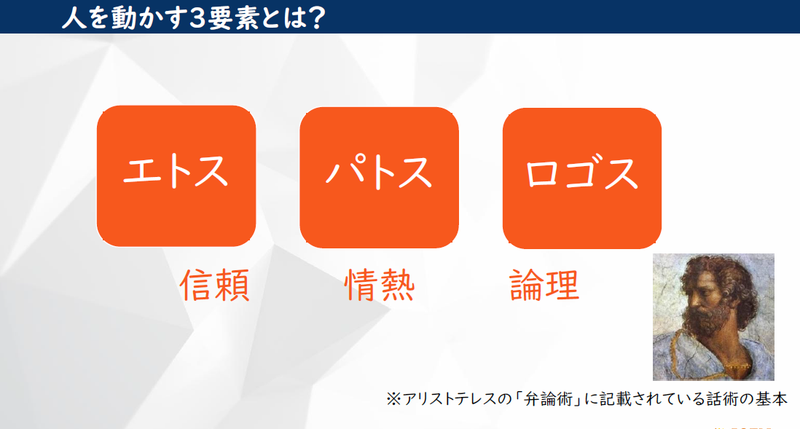
So, what exactly constitutes sales activity that incorporates "Trust, Passion, and Logic"? Mr. Shiro states that it is important to prepare your own logical hypotheses regarding the customer's challenges before the initial meeting, even at a stage where you have not yet conducted a hearing. As a result, the customer will appreciate the logical preparation, thinking, "Even though I haven't consulted with them specifically yet, this salesperson put in so much effort to research and think through a logical path for our company." Even if the prepared hypothesis turns out to be incorrect, the very fact that you prepared to that extent conveys your enthusiasm to the customer. He emphasizes that, as a result, you will be seen as someone they would like to entrust with work, thereby earning their trust.
How to Implement Hypothesis-Based Sales in the Field
We have covered the fundamental elements of hypothesis-based sales. Now, let us explore the process of integrating these practices into actual sales operations and how they take shape.
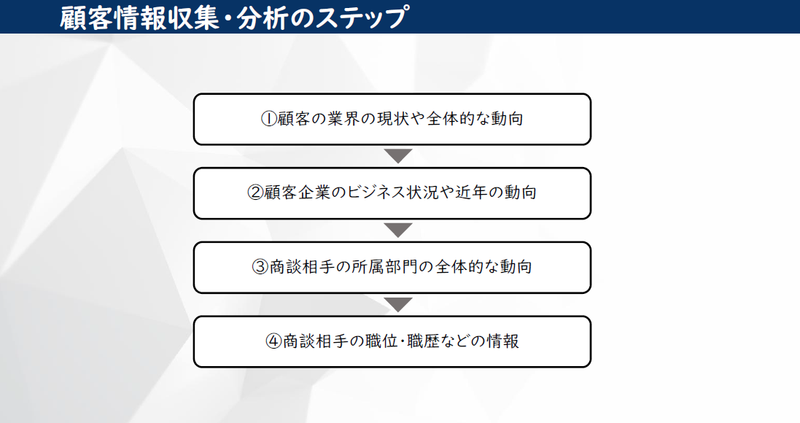
Mr. Shiro notes that when creating a hypothesis-based proposal in the field, he aims to complete it within one hour. He emphasizes that information gathering does not need to be exhaustive, and specifically highlights the importance of the following four points.
Mr. Shiro explains that it is essential to construct a logical narrative based on this information, demonstrating how your company's products and services can contribute to solving the client's management challenges and lead to the vision or future they desire. He stresses the importance of passionately and logically articulating why your company is the right choice over competitors, providing a concrete explanation using the example of a building materials manufacturer.
Mr. Shiro continues by stating that the following three elements are indispensable for implementing hypothesis-based sales within a sales organization, noting that without them, such a strategy is difficult to instill.
These elements serve as critical perspectives when integrating hypothesis-based sales into an actual sales organization.
Part 2
Achieving Hypothesis-Based Sales with uSonar Tools
As Mr. Shiro has explained, hypothesis-based sales require both passion and logic to earn trust. Furthermore, even when dealing with hypotheses, the foundation for a logical argument relies on data, such as information about the client's company, their departments, and the industry surrounding them.
The question then arises: how can such information be obtained reliably and rapidly?
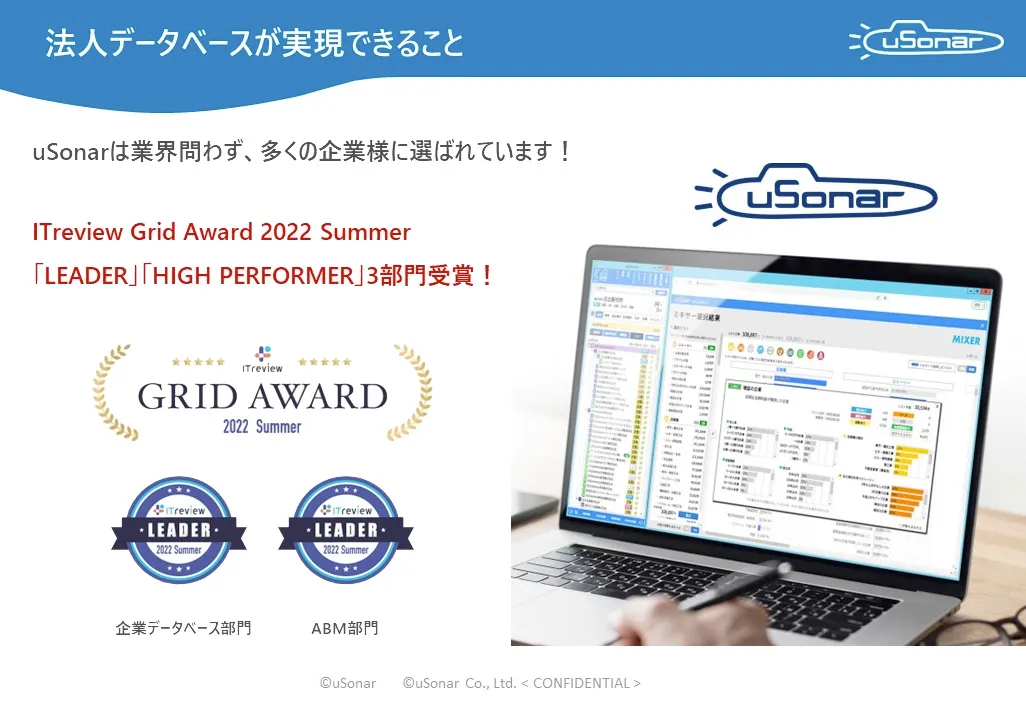
In this seminar, to address such questions, Takasaki provided an explanation and demonstration of the tools owned by uSonar as a means to realize compelling hypothesis-based proposals. uSonar, a database company in its 36th year, maintains LBC, one of Japan's largest corporate databases, for which it collects information in-house. LBC holds information not only on corporations but also on individual business establishments, including restaurants, hospitals, and schools.
At the same time, various information sources exist for the creation and updating of LBC, such as commercial corporate registries, securities reports, and corporate websites.
By leveraging the uSonar database, sales activities can be conducted more effectively, making it possible to implement the hypothesis-based sales approach advocated by Mr. Shiro in the field.
Networking Session After the Lecture
Following the lecture, a networking session was held where attendees could speak with the speakers and interact with one another.
It became a very lively event, serving as a venue for networking and information exchange that is difficult to achieve in the course of daily business or personal relationships.

▶︎ Learn More About uSonar Services
▶︎ For Consultations and Inquiries, Click Here