






- Data Utilization
Data Utilization in Companies: What Are the Necessary Processes and Challenges to Solve?

Use Cases by Objective
New Approach Lists

Group Strategy

Digital
Marketing

Client Information Registration

Data Cleansing

Corporate Attribute Analysis

SFA/MA Activation

Business Card Data Integration

Credit and Client Screening

Use Cases by Department
Sales Department

Inside Sales
Department

Marketing &
Corporate Planning Department

IT Department

Administrative Department

Use Cases by Tool
Meeting Sonar
Updated: April 22, 2024

The value of data management in B2B companies varies depending on the organization's objectives. For sales organizations, increasing revenue and streamlining business processes are critical, while marketing organizations require the optimization of strategic planning and the efficiency of campaign execution. However, to achieve these goals, it is necessary to build a data management environment. Establishing such an environment requires many elements, including technology investment, human capital investment, strategic partnerships, training and education, and the establishment of governance frameworks.
By establishing these investments and organizational structures, companies can effectively utilize data, leading to strategic decision-making, efficient business processes, and improved customer experiences. Let's understand the fundamentals of data management in this article.
Recommended Articles

Data management in B2B companies is operated with different objectives depending on the organization. While the following are just examples, the methods of data utilization vary according to organizational goals.
By classifying trends such as the industries and company sizes of customers, and utilizing historical information leading to purchases—such as sales negotiation history—organizations can analyze the scale of closed deals against customer trends. This helps identify new sources of revenue and supports corporate activities such as streamlining outbound sales processes and approaches.
Furthermore, by identifying additional purchase histories of high-value customers, organizations can explore measures to maximize revenue from existing clients by discovering cross-selling and up-selling opportunities. By calculating LTV predictions for each customer in conjunction with purchase frequency, organizations can improve productivity, profitability, and resource management.
By segmenting customers with high potential from the market, companies can conduct sales activities in fields where they excel. By considering appropriate messaging for each target customer, companies can establish a favorable position and differentiate themselves from competitors.
By defining customer criteria for lead generation, companies can execute marketing measures that accurately capture both potential and explicit customer needs.
Additionally, by understanding the customer journey and utilizing existing customer negotiation history and purchase data, it is possible to implement measures to ensure more customers continue to use the company's products and services, such as creating effective messages and offers for similar customers.
While data utilization methods and evaluation metrics change depending on the objective, building an environment where multiple organizations can process and utilize data based on the same source is considered a necessary investment for companies to leverage data effectively.
If the data handled differs between organizations, the impact of organizational measures on customers becomes fragmented. Therefore, to achieve high business results, it is crucial that communication between organizations is conducted seamlessly based on the same data.
Based on various publicly available frameworks and best practices, we explain below what is generally considered an "appropriate data management environment" for B2B companies.
This refers to establishing and executing rules and processes to aggregate information from different systems and data sources. Especially in B2B companies, where various systems and data sources spanning online and offline channels often exist across departments, centralizing data visualization promotes a better company-wide understanding of customers.
Data quality refers to evaluation metrics regarding the accuracy, consistency, and completeness of data. By setting standards for data quality, monitoring to ensure the latest information is continuously maintained, and performing tasks such as deleting unnecessary data, updating old data, and integrating duplicate information (data cleansing), companies can increase the reliability of data-driven decision-making.
The primary use cases for utilizing a data management environment are data analysis and insights.
It is necessary to add functions that enable data-driven insights, such as analyzing customer behavior, understanding market trends, and conducting competitive analysis. By visualizing target data using charts and graphs, organizations can gain insights that aid in decision-making.
Additionally, leveraging machine learning and predictive analytics to organize customer behavior patterns and provide recommendations on future trends and next best actions has become increasingly important in recent years.
One of the most common outputs obtained through data analysis and insights is the performance measurement and evaluation of sales and marketing measures.
For example, by creating a database of key metrics such as revenue, profitability, and customer acquisition rates and monitoring them regularly, companies can grasp and evaluate their performance. The scope of a data management environment also includes measuring the effectiveness of campaigns and marketing activities, as well as ROI analysis. This allows companies to visualize results and consider measures for improvement.
Complying with industry regulations and implementing personal information management and security measures are critical elements of data management. By implementing proper data storage and access control, and performing tasks such as data anonymization or pseudonymization and setting security policies as needed, companies can meet internal and external compliance requirements and ensure data safety.
Data strategy involves setting guidelines to drive corporate activities by establishing the importance and priority of data utilization based on business goals. By analyzing accumulated data and understanding market needs and trends, companies can not only discuss the direction of product development but also discover new business models.
Governance plays the role of establishing rules and processes to manage data quality, security, and compliance, ensuring the reliability and availability of data for utilization.
By utilizing customer behavior data and feedback to provide personalized services and targeted advertising, companies can offer experiences that match customer needs. Promoting a customer-centric approach strengthens uniqueness and competitiveness in the market.
Furthermore, achieving consistent customer touchpoints across multiple channels contributes to improving customer satisfaction and NPS.
By conducting strategy formulation and decision-making based on accurate data and analysis results, organizations can promote information sharing and accelerate corporate activities across the entire company. Continuous efforts in this area bring significant value in terms of business efficiency and strengthening competitiveness.
To build a data management environment as described above, it is necessary to establish the following organizational structures and make appropriate investments.
Introduction of systems and analytical tools necessary to configure an efficient data management environment
Recruitment of data scientists, data engineers, analysts, and other professionals to formulate data strategies
Collaboration with data service providers to simplify access to data
Improvement of data literacy through education on data utilization methods and best practices
Appointment of departments or personnel responsible for data quality management and security measures
Ensuring data accuracy and consistency through the introduction of tools and processes to maintain data quality
Development of security infrastructure to ensure data protection and privacy
Construction of an appropriate architecture to streamline data collection, integration, processing, and utilization
Organizational transformation in response to environmental changes and the cultivation of a data-driven culture among employees
By preparing these investments and structures, companies can effectively utilize data to realize strategic decision-making, efficient business processes, and improved customer experiences.
By building a data management environment, companies can achieve a smoother business collaboration environment than ever before and accelerate business growth.
To successfully build a data management environment, it is important to understand the objectives of each internal organization, identify the necessary data, establish use cases—sometimes with external cooperation—and build an implementation and operational structure.
While this article introduces general content, our company provides unique data management expertise tailored to the characteristics of our client companies. If you are interested, please feel free to contact us via this page, and we will introduce case studies relevant to your industry and situation.
About the Author

uSonar Editorial Department
MX Group, Editor-in-Chief
We are the uSonar Editorial Department.
We provide information on data utilization and digital technology useful for considering future business operations, primarily for companies engaged in B2B business.
uSonar is utilized by various companies
across all industries and sectors.
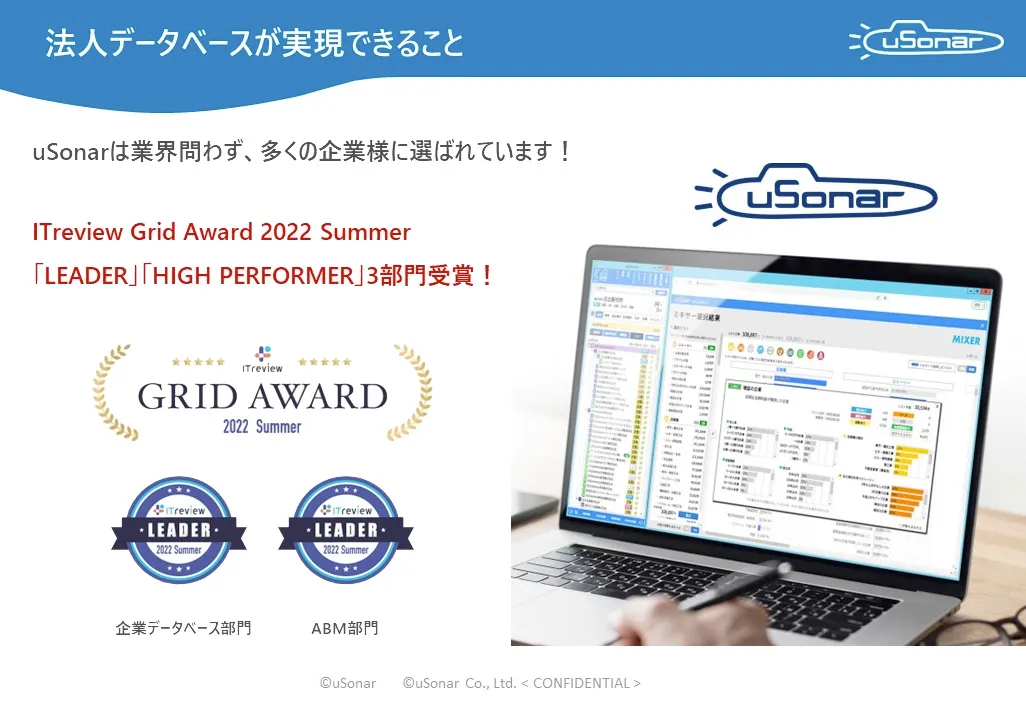
ITreview Grid Award 2026 Summer
Leader in 6 Categories

With uSonar,
we can help solve your company's challenges!
Case Studies and Sample Reports
Available for Download