Generated at: 2026-07-01 03:58:45

Group Data Integration, Business Card Management, Data Maintenance

Data Utilization Strategy Across the Group to Visualize Professional Networks and Transactions

~ Evolution of Proposal Capabilities Through the Implementation of mSonar and Centralization of Client Data ~

Resona Bank, Limited

Financial Services

INTERVIEWEE

  • Group Leader, Management Support Group, Corporate & Premier Strategy Department, Yuki Kase
  • Manager, Management Support Group, Corporate & Premier Strategy Department, Keito Nakai

As a core member of the Resona Group, Resona Bank provides a wide range of financial services to diverse clients, including owner-managed businesses and high-net-worth individuals. The Management Support Group within the Corporate & Premier Strategy Department is tasked with strengthening the sales capabilities of corporate relationship managers. They have been working to enhance traditional face-to-face sales while improving the efficiency of non-face-to-face interactions. Furthermore, under the Resona Group's medium-term management plan, which emphasizes "Group-wide Consolidated Operations," the group is required to provide optimal proposals to clients through collaboration among all Resona Group companies. However, the lack of a common key to centralize information across these companies led to duplicate corporate data. Additionally, frequent personnel transfers made it difficult to properly hand over professional network information. To address these challenges, the bank selected uSonar for its extensive database covering both large enterprises and SMEs, its ability to perform data cleansing, and its seamless integration with Salesforce. In this article, we spoke with two members of the Management Support Group about the reasons behind their decision, the tangible results achieved, and their future outlook.

  • Challenges Before Implementation

    • While the policy of "Group-wide Consolidated Operations" was established, transaction information could not be shared among Resona Group companies.
    • Frequent personnel transfers resulted in a failure to properly hand over professional networks and contact information, preventing their effective use in sales activities.
  • Reasons for Implementation

    • Extensive data coverage spanning from large enterprises to small and medium-sized businesses.
    • High accuracy in data cleansing, capable of correctly identifying and consolidating records despite inconsistent naming or outdated information.
  • Results Achieved

    • Transaction status across all Resona Group companies was visualized, expanding the scope of business proposals.
    • The digitization of business card information enabled the sharing of contacts held by executives and sales representatives, facilitating strategic sales activities.
    • Email marketing based on business card data contributed to sales activities that leverage established contact information.

Challenges Before Implementation

Duplicate Data and Disconnected Professional Networks: How Resona Tackled the Challenge of "Invisible Customers"

First, could you please describe your respective roles and missions?

Kase

Our Corporate and Premier Strategy Department, Management Support Group, is tasked with strengthening our sales capabilities. We serve corporate clients, business owners, and high-net-worth individuals. In addition to enhancing our traditional face-to-face sales approach, we have been working on improving sales efficiency, including non-face-to-face channels, since this fiscal year.

Nakai

I am responsible for the improvement, maintenance, and management of systems such as SFA/CRM. We perform ongoing modifications, and when we receive requests from headquarters or branches for specific features, we proactively handle configuration changes and updates. Furthermore, a key part of my role is promoting data utilization by supporting data consolidation, data cleansing, and the dissemination of information to various departments.

In that context, what challenges did you face before implementing uSonar?

Kase

We first implemented uSonar in 2018. At that time, a major challenge was that Resona Bank was not effectively centralizing customer information. Although we had implemented Salesforce to store our customer data, there was no common key to identify companies, which led to duplicate corporate records. To resolve this, we introduced uSonar's corporate database, LBC, and integrated it with Salesforce. This enabled us to manage customers not only at the headquarters level but also at the corporate group level.

Nakai

Subsequently, the Medium-Term Management Plan set forth a strategy for "Group-wide Consolidated Operations." This required us to move beyond Resona Bank as a standalone entity and provide optimal proposals to our customers across all Resona Group companies. To achieve this, we expanded the data utilization infrastructure—which integrates uSonar with Salesforce—from Resona Bank to all companies within the Resona Group.

It is difficult to integrate information managed across disparate systems, is it not?

Kase

Indeed. To begin with, we lacked a common key to identify that different records belonged to the same company, which made building an integrated infrastructure extremely challenging. By adopting LBC as our common key, I feel we have finally established the foundation necessary to connect data between the bank and our group companies.

Resona Bank also utilizes the corporate information and business card management application mSonar. Were there any specific challenges from the perspective of business card management?

Nakai

At Resona Bank, our corporate sales representatives use mSonar, but we have long faced the challenge of customer information not being properly handed over due to frequent personnel transfers. In the banking industry, there is significant staff mobility, and not only the primary representatives but also their supervisors change frequently. Consequently, relationship data—specifically "who met with which customer"—was not being effectively transferred, leaving us unable to fully leverage these valuable touchpoints for our sales activities.

Deciding Factors for Implementation

The Key to Connecting Scattered Information Lies in "Comprehensiveness" and "Accuracy"

Please tell us the deciding factors for implementing uSonar.

Kase

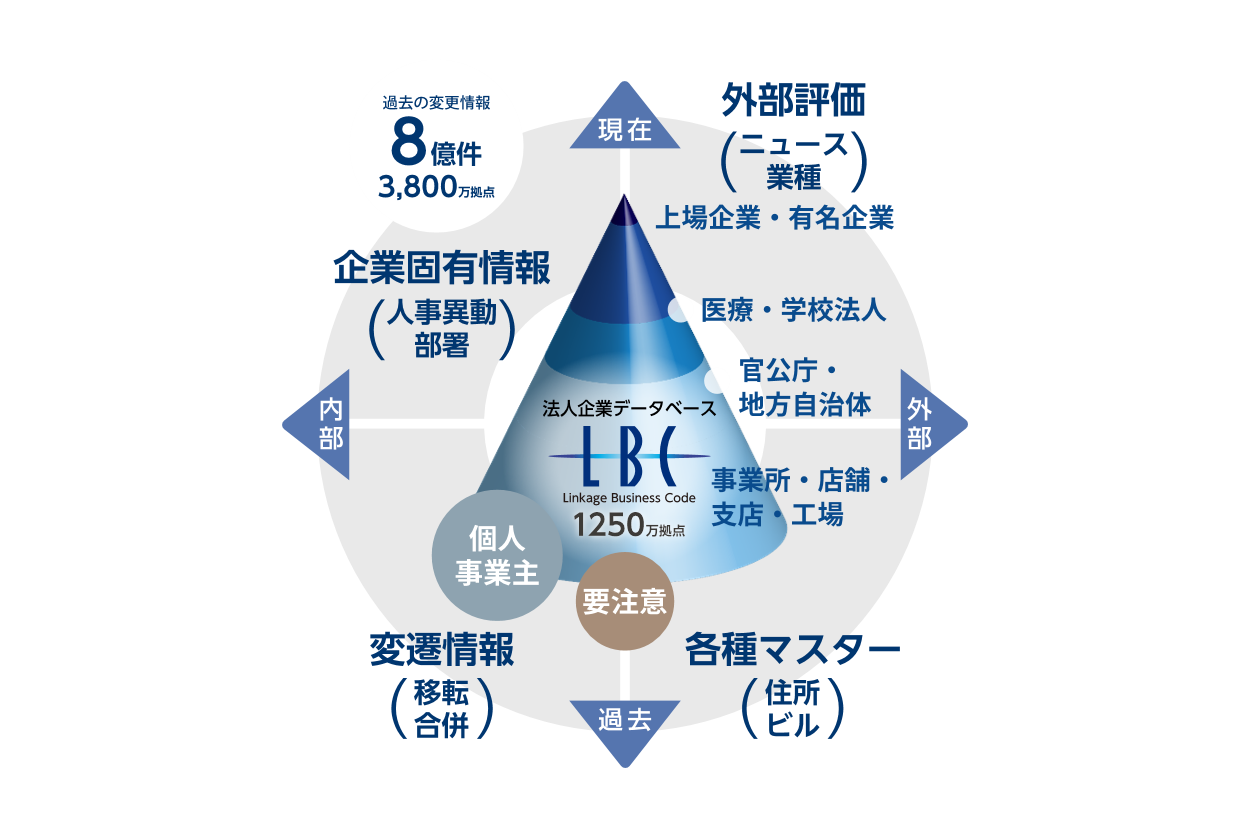
It was definitely the "comprehensiveness." We have many small and medium-sized enterprise clients, so being able to cover that segment thoroughly was extremely important. LBC covers a wide range of companies, from large corporations to small and micro-enterprises, and I felt this was a strength that other companies simply do not have.

LBC_ver2.png

Corporate Database "LBC"

Nakai

In addition, the "accuracy of data matching" was a major factor. Honestly, our internal database was not necessarily clean at the beginning; the information entered by staff contained variations in notation and outdated data. It was difficult to perform accurate matching as it was, but by utilizing LBC, we can correctly identify corporate information. This was a key point we expected from uSonar.

What changes have occurred since the introduction of LBC?

Kase

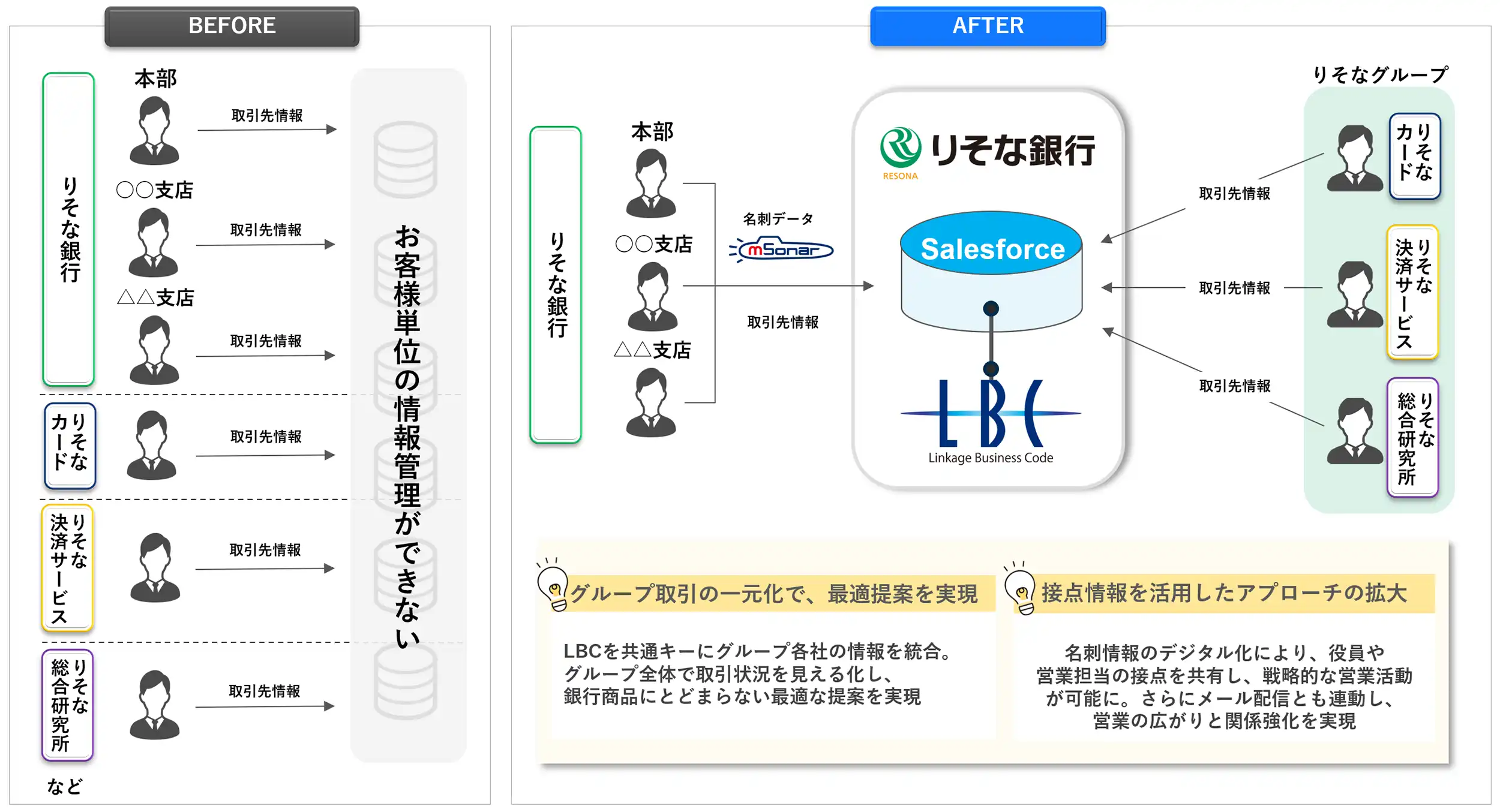
By utilizing LBC, we are now able to seamlessly visualize corporate CIF information and business card data within Salesforce. This allows us to see at a glance which department is dealing with which client and whether there has been any past contact, which has significantly improved the precision of our sales activities. Furthermore, by using LBC as a common key, data integration across the entire group has become smoother, and information within the group can now be shared easily.

So, you also highly value the integration with other systems such as Salesforce.

Nakai

At the time of implementation, we were just beginning our Salesforce deployment project. We decided that by introducing mSonar as our business card management tool simultaneously, we could achieve seamless integration. The deciding factor was that, rather than using it as a standalone tool, connecting it with our CRM (Customer Relationship Management) and MA (Marketing Automation) systems would significantly broaden the scope of its application.

Results Achieved

Expanded Scope of Proposals Through Group-Wide Transaction Visibility and Sales Support

What are your thoughts regarding data integration across Resona Group companies and its effects?

Nakai

By using LBC as a common key to integrate information across Resona Group companies, we are now able to grasp transaction statuses across the entire group, rather than just at the bank level. It is a significant advantage to be able to see at a glance on Salesforce that a specific company is doing business with both Resona Bank and other Resona Group companies.

202511resona_fig01.webp

Resona Bank, Limited Integration Concept

Kase

Furthermore, being able to understand how the entire Resona Group views our customers has broadened the scope of our proposals. I feel we are moving closer to a structure where we can present optimal solutions that include not only Resona Bank products but also the services offered by each Resona Group company.

What benefits have you experienced by utilizing mSonar?

Kase

Currently, mSonar is utilized by approximately 20 headquarters departments (about 800 employees) and 120 corporate branch areas (about 1,500 employees) to share business card information. The digitization of business cards and the subsequent sharing of this information have expanded our sales activities.

For example, while our sales team frequently meets with accounting and finance personnel, opportunities to connect with individuals from other departments are rare. Furthermore, by sharing business card information exchanged by executives at meetings, we can now view contact information for high-level decision-makers. I feel that by being able to record and share this information through mSonar, we have been able to leverage previously invisible connections, allowing our sales representatives to operate more strategically.

We are also utilizing it from a marketing perspective. Based on the business card data collected in mSonar, we conduct email campaigns and have our branches approach customers who have shown interest. Contact information that was previously underutilized has now led to new sales approaches and strengthened relationships.

Future Outlook

Evolving Proposal Capabilities Through Group-Wide Information Infrastructure and AI Utilization

How do you intend to utilize uSonar in the future?

Nakai

First, we want to deepen collaboration across all Resona Group companies more than ever before. Our ideal is to share even the records of sales activities across the entire Resona Group. There are many challenges that Resona Bank cannot solve alone; by combining solutions from group companies such as credit cards, payment services, and think tanks, we believe that if we can visualize who is having what conversations with which customers, we will be able to provide a wider range of proposals. To that end, we want to continue advancing the centralization of data by leveraging uSonar, which covers 12.5 million corporate location records.

Kase

That said, sharing data within the Resona Group is not without its difficulties. Issues regarding information management rules and system investment exist, so I believe it is crucial to determine how to overcome these hurdles. With compliance and regulatory aspects in mind, we are proceeding step-by-step, navigating challenges and building consensus as we go.

How do you view this from the perspective of data utilization?

Nakai

We have begun connecting the data consolidated in Salesforce to a data lake for further analysis. By combining this with corporate attributes and touchpoint information, I believe we can leverage AI and BI tools (management analysis tools) to identify similar companies and predict which prospects to approach next.

Kase

That is exactly right. Our medium-term management plan also highlights "Group Consolidated Operations," making the promotion of strategy across the entire Resona Group a major theme. By combining information from our sales front lines with uSonar's corporate data, I hope we can further enhance the value we provide to our customers.

Consult with uSonar

You may unsubscribe from service and event information at any time. Please review our Privacy Statement regarding our company policies.

Other Case Studies

For Urgent Inquiries, Please Call Us03-5388-7000Business Hours: 10:00 AM - 5:00 PM (Closed on Weekends and Holidays)

The Definitive Solution for Sales DX Through Data Utilization

Service Brochure

uSonar in 5 Minutes

Understand uSonar in 5 Minutes

Download Materials