Background and Objectives of uSonar Implementation
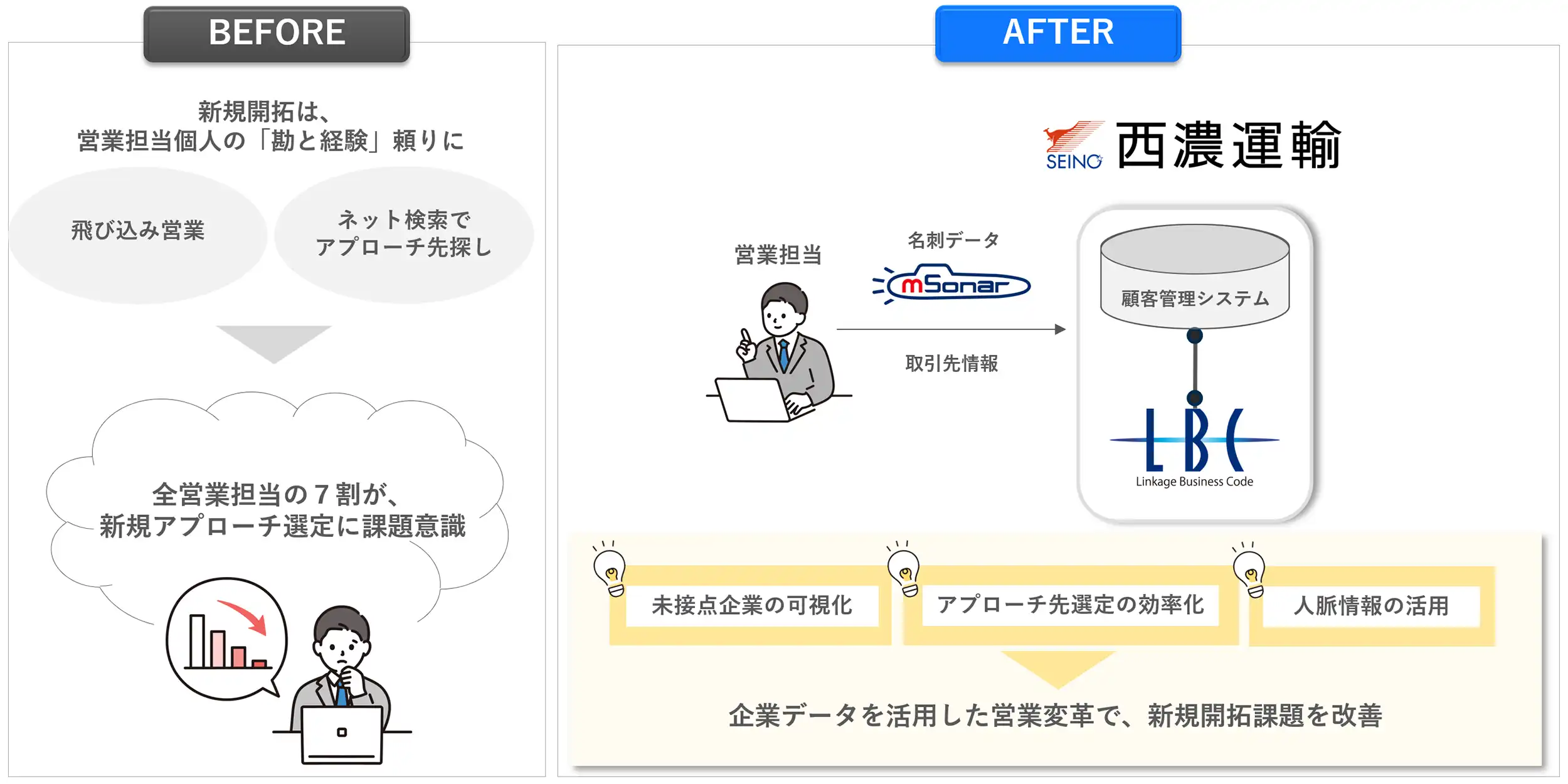
Founded in 1930, Seino Transportation is a core company of Seino Holdings, operating as a "Comprehensive Logistics Trading Company" with a focus on land transportation and trucking services. Meanwhile, the domestic logistics market is entering a period of structural transformation aimed at sustainable growth due to demographic shifts and labor shortages, necessitating the correction of long working hours caused by driver shortages and the improvement of productivity. While there was a need to acquire new customers and expand the market under these circumstances, many sales representatives expressed difficulty in selecting new sales targets. Traditional sales approaches were dependent on individual intuition and experience, and a fixed mindset that "companies that have rejected an approach in the past are unlikely to convert" had become entrenched, leading to patterned target selection.
To resolve these issues, the company decided to implement "LBC," a corporate database covering 12.5 million locations nationwide, aiming to transform its sales style through the use of corporate data.
Reasons for Choosing uSonar
The uSonar corporate database "LBC" met the company's needs for problem-solving by enabling the visualization of the entire market size and the group of companies that the company had not yet approached. The decision to implement was driven by LBC's high comprehensiveness, data quality, and its ability to integrate smoothly with the existing customer management system. In addition, the attentive proposal process tailored to their needs and the robust post-implementation support system were highly evaluated, leading to a nationwide rollout.
Furthermore, to accelerate sales by leveraging professional networks through the management and sharing of business card information, all sales representatives are using the corporate information and business card management app "mSonar."
Effects of uSonar Implementation
Through the sales transformation utilizing uSonar services, the company visualized potential business partners that could not be identified under the traditional sales style and promoted data-driven approaches. As a result of promoting adoption across each branch, a survey of sales representatives conducted one year after implementation showed that the number of representatives reporting "challenges regarding new target selection" decreased from 70% to 30%, confirming an improvement in awareness of the issue. Furthermore, an analysis of new shipper registration data showed that "new registrations originating from uSonar" accounted for approximately 80% of the total, indicating that data utilization has become firmly established in the field.
Moving forward, the company will further strengthen data integration with its core systems by linking its internal management codes with LBC codes, thereby expanding the scope of corporate data utilization and advancing its sales activities.