- ABM
Detailed Explanation of ABM Strategy Implementation and Best Practices for Problem Solving

Last Updated: November 16, 2023
Click Here to Learn More About ABM ▶
ABM Implementation: The Complete Guide
Download the eBook for Free
Equipped with comprehensive master data, uSonar enables high-precision targeting, data maintenance, and integration to maximize your ABM results.
In the world of B2B marketing, target-oriented strategies are gaining attention over traditional mass-market advertising approaches. Among these, Account-Based Marketing (ABM) is rapidly growing as a strategy for companies to focus on specific accounts or businesses and provide personalized approaches. Success in ABM requires accurate target selection, personalized communication, a data-driven approach, and collaboration.
In this article, we provide an overview of uSonar, the definitive ABM tool.
Table of Contents
1Common Challenges in ABM Implementation
2Why a Comprehensive Master Database Is Essential for ABM
3uSonar: The ABM Tool Powered by Japan's Largest Corporate Database
3-1uSonar Is Adopted by Many Leading Companies Across Various Industries!
3-2Awarded Leader in the ITreview ABM Category for 16 Consecutive Quarters
4Why SFA and CRM Are Insufficient for ABM Implementation
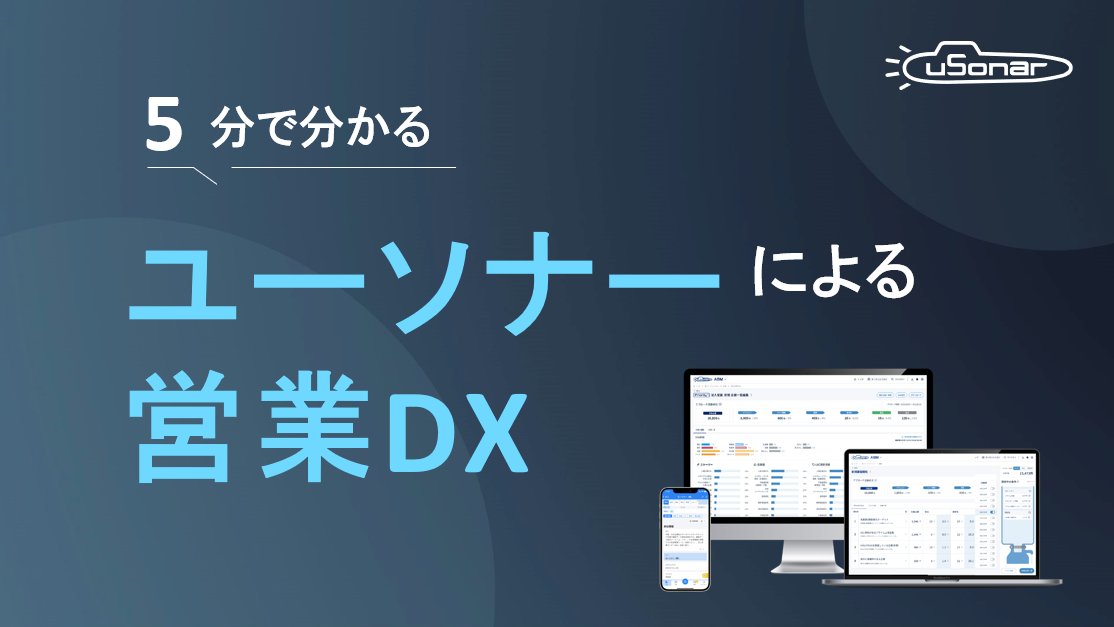
5-1Materials Explaining uSonar to Support Your ABM Implementation
Recommended Articles
Account-Based Marketing (ABM) is gaining attention as a B2B marketing approach that focuses on specific companies or accounts to deliver effective, customized messaging and engagement. However, there are several typical challenges to achieving success with ABM.
The most critical success factor for ABM is the selection of effective target companies. To succeed, it is necessary to analyze the characteristics of existing customers in detail and identify the attributes common to companies with high purchasing potential. Attribute segments are more effective when they are specific and quantitative, such as "manufacturing companies with 100 or more employees." To accurately grasp these characteristics, it is essential to organize internal customer data and visualize the market universe.
Once you have selected your target accounts, it is crucial to provide customized messages to each company or account. Delivering content tailored to customer needs and adopting approaches that align with their attributes significantly increases response rates.
The problem here is that information registered in internal CRM or SFA systems is often incomplete, making it difficult to accurately understand customer needs. For example, even basic corporate characteristics like industry type can be expressed in various ways, and attempting to comprehensively collect this data for thousands or tens of thousands of records requires significant effort.
Strong collaboration between sales and marketing departments is indispensable for ABM success. Cooperation is required to convey consistent messages to customers and improve the overall customer experience.
However, in general, sales teams often pursue direct revenue while marketing teams focus on brand awareness or lead generation, leading to misaligned goals. As a result, sales may complain that they "want higher-quality leads," while marketing may feel that "leads are not being followed up on," leading to mutual dissatisfaction.
While ABM offers an opportunity for both departments to align on common targets and goals to drive sales results more efficiently, there is a risk that legacy organizational structures may hinder effective collaboration.
Executing an ABM strategy requires an accurate master database that integrates internal data and covers the entire market. We will explain its importance in relation to the three challenges described in the previous section.
As mentioned above, the foundation of ABM is the selection of target companies. An accurate master database, free of duplicates and inconsistent naming, enables precise current-state analysis. By leveraging various attribute information—such as company size, industry, location, past transaction history, and total transaction value—you can select the optimal targets. This facilitates management buy-in and allows for the efficient allocation of resources.
By utilizing the rich attribute information contained within corporate master data, you can design the optimal approach for each target company. This allows you to provide customized messaging and content tailored to the company's specific needs and challenges, as well as approach them at the right time based on the latest status and touchpoint information. This makes it easier to build relationships with target companies and maximize results.
Corporate master data helps promote data sharing and collaboration between departments. By using common data across different departments—such as sales, marketing, and customer support—you can provide consistent messaging. Utilizing shared data also makes it easier to resolve the aforementioned goal misalignment and enables comprehensive performance analysis for each initiative.
In the following section, we will explain uSonar, which supports ABM implementation by utilizing a comprehensive master database.
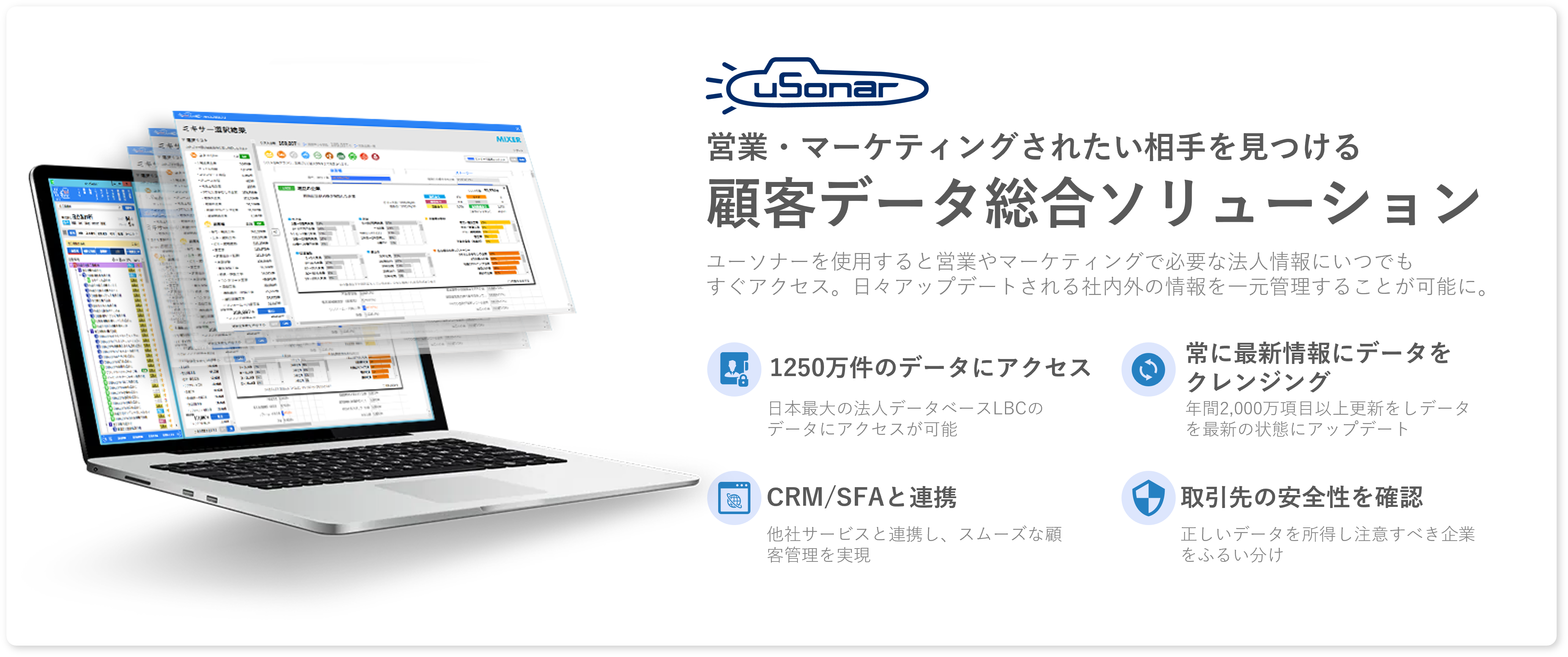
uSonar is equipped with LBC, one of the largest independently constructed corporate databases in Japan, and provides all the necessary functions for executing ABM strategies.
uSonar allows you to create target lists that lead to successful orders based on the LBC corporate database, which contains 12.5 million records.
The corporate database covers domestic locations. Since it allows you to grasp capital affiliations as well as head office and branch relationships, group-wide penetration is also possible. Furthermore, you can extract lists by considering news, implemented services, website visit status, and transaction safety.
It achieves high-precision cleansing and matching at the business location level using LBC as the master data.
Using LBC as a dictionary, it cleanses and matches customer and lead data scattered across departments and business locations with high precision. Additionally, you can supplement missing items using LBC.
By assigning a unique code to each business location, we support the construction of an integrated master database.
Integrate lead and client data with LBC to visualize priority approach targets.
By centralizing customer data, you can visualize your "whitespace." This enables the identification and approach of high-potential companies that have not yet been engaged, which is a common challenge in ABM.
uSonar is adopted by many customers, especially industry leaders, who value the comprehensiveness and accuracy of its database, as well as its seamless integration with internal systems such as SFA and CRM.
☆-☆-☆ Image Insertion Start ☆-☆-☆
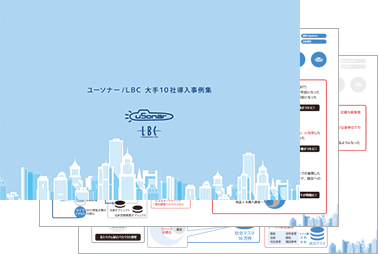
>> Click Here for Details on uSonar Case Studies
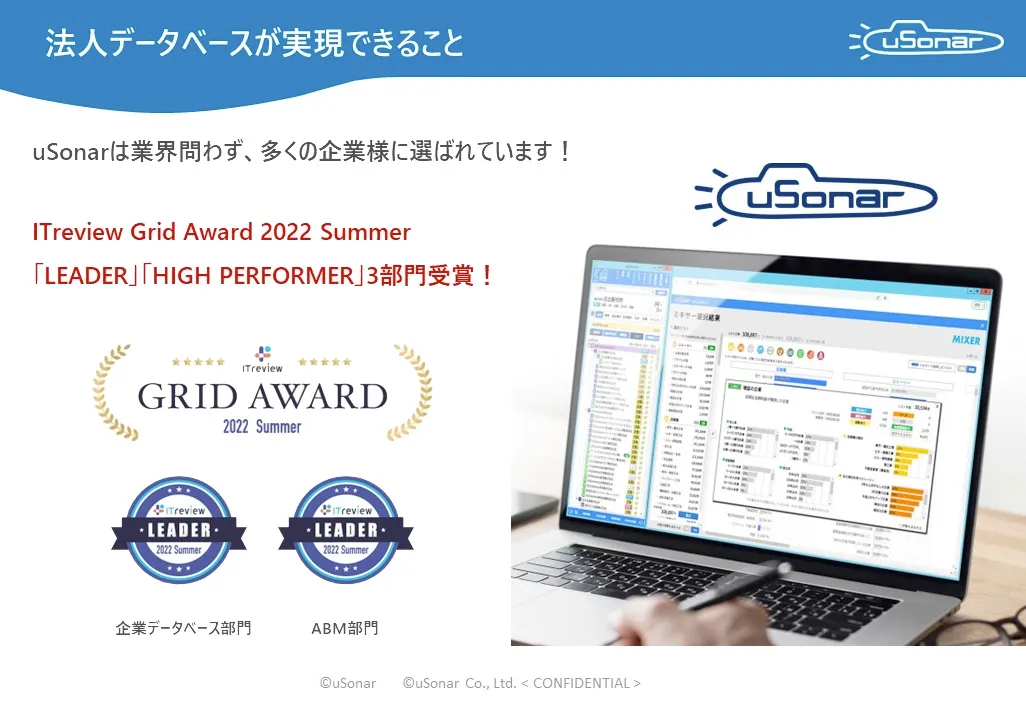
ITreview is one of Japan's largest cloud service review sites. uSonar was awarded the Leader position in the ABM category at the "Grid Award 2026 Summer" as a cloud application highly rated by many customers.
This marks the 16th consecutive term that uSonar has received an award in the ABM category, and it has also received consecutive awards in five other categories.
Its high-precision data maintenance and the efficiency of sales and marketing activities through market visualization are highly regarded. Please check below for more details on uSonar.

SFA and CRM are frequently used as sales support tools. However, from the perspective of ABM implementation, SFA and CRM are insufficient.
SFA and CRM are suited for recording interactions with companies you have already engaged with and for managing pipelines. On the other hand, it is difficult to visualize the entire market, and they lack the information necessary to conduct effective new business development.
Sales data is entered into SFA and CRM by individual sales representatives. Because data entry is somewhat removed from the goal of increasing sales, it tends to be neglected. Furthermore, corporate data inherently tends to suffer from input errors such as abbreviations, name changes, and notation variations. For example, the official name of "Kewpie Corporation" is "Kewpie Corporation" (using the large 'yu' character).
uSonar, a customer data integration solution, solves these problems by linking with SFA and CRM. uSonar supports SFA and CRM from a data perspective and enhances their functionality.
Its integration track record is highly regarded, as evidenced by winning the "Salesforce Japan Partner Award 2023." It also has a proven track record of integration with many other SFA/CRM systems besides Salesforce.

>> uSonar Wins Salesforce Japan Partner Award 2023
>> uSonar Selected for High-Rated Customer Review Feature on Salesforce AppExchange
You can stop receiving information about services and events at any time. Please check our "Privacy Statement" regarding our company policies.
An ABM (Account-Based Marketing) strategy is a marketing approach focused on specific companies or accounts, and its success requires accurate data, target selection, personalized communication, and collaboration. Furthermore, a comprehensive corporate database (master) is essential for the success of the strategy, and ABM tools are indispensable for effective execution. ABM tools like uSonar support data integration, real-time personalization, analysis, and collaboration, serving as the key to success. Effective ABM implementation emphasizes long-term relationship building and a customer-centric approach, making it a vital strategy for the future of B2B marketing.
☆-☆-☆ Material DL Link Start ☆-☆-☆ ☆-☆-☆ Material DL Link End ☆-☆-☆Author

uSonar Editorial Department
MX Group Editor-in-Chief
This is the uSonar Editorial Department.
We provide information on data utilization and digital technologies useful for B2B companies to consider the future of their business operations.
uSonar is utilized by
various companies across all industries and sectors.
ITreview Grid Award 2026 Summer
Leader in 6 Categories

With uSonar,
we can help solve your company's challenges!
Case Studies and Sample Reports
Available for Download