- ABM
What Is ABM? A Comprehensive Guide to Implementation and Strategies for Success

Last Updated: September 9, 2024

Click Here to Learn More About ABM ▶
ABM Implementation: The Complete Guide
Download the Free Ebook
In B2B marketing strategies, many companies employ methods that involve acquiring a broad range of leads and narrowing them down.
However, this approach often leads to issues such as wasted resources and difficulty in executing effective outreach.
This is why ABM (Account-Based Marketing) strategies are gaining attention.
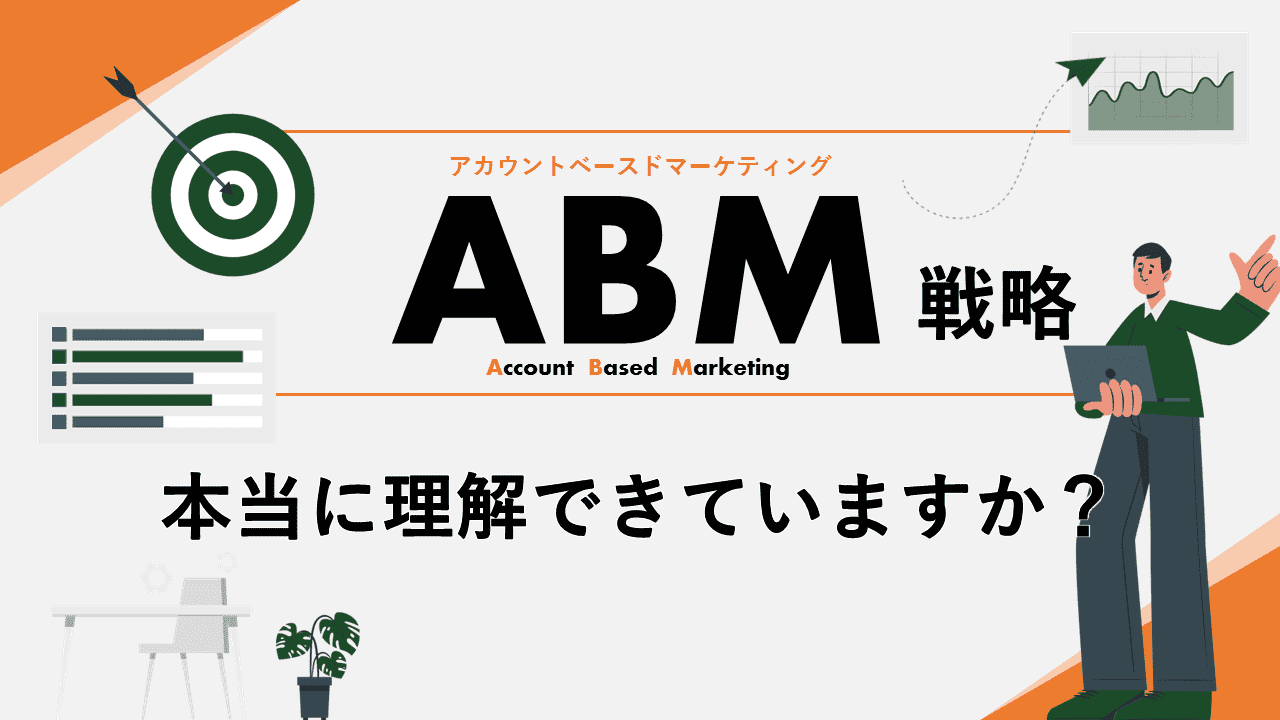
ABM refers to a marketing strategy that focuses on specific high-value target accounts and deploys personalized approaches.
In this article, we introduce how to proceed with an ABM strategy and the best practices for resolving challenges that arise during the process.
Table of Contents
1-1Differences Between ABM and Traditional Marketing
2-1Step 1: Selecting Target Companies and Key Persons
2-2Step 2: Determining the Approach Method
2-3Step 3: Creating Personalized Content
2-4Step 4: Executing Marketing Campaigns
2-5Step 5: Measuring and Improving Campaign Effectiveness
3Challenges Hindering ABM Strategy
3-1Insufficient Attribute Data for Targeting
3-2Difficulty in Grasping the Overall Market Landscape
3-3Lack of Alignment Between Sales and Marketing Departments
4Best Practices for Successful ABM Strategies
4-2Continuously Collect and Utilize Customer Insights
Recommended Articles
An Account-Based Marketing (ABM) strategy focuses on specific high-value target accounts, deploying personalized marketing approaches tailored to the unique needs of each.
This methodology views the entire organization as a single market, executing meticulously planned marketing activities directed at decision-makers and influential individuals within specific target companies.
The core of ABM lies in maximizing the use of limited resources to achieve more effective results.
What Is ABM? A Comprehensive Guide to Implementation Benefits and Strategies for Success! ▶︎
Fundamentally, traditional B2B marketing adopts a lead-based approach.
Traditional marketing approaches aim to acquire as many leads as possible by broadcasting general messages to a broad range of prospective customers.
Subsequently, it is common practice to gradually narrow down the acquired leads to identify final prospective clients.
In contrast, ABM identifies target companies from the outset and develops and executes marketing strategies specifically tailored to those organizations.
The difference between the two is most evident in their messaging and approach methods.
In traditional marketing, while needs are narrowed down, messages are broadcast broadly to various companies, and individual leads are approached separately.
In ABM, personalized messages are created for each account, and a consistent approach is applied to the entire organization.
In B2B business, complex purchasing processes involving multiple decision-makers are common, and high-ticket items are frequently handled.
Because ABM is designed to address this complexity and high price point, it is an approach method particularly well-suited for B2B companies.
By approaching the entire organization and delivering appropriate messages to each decision-maker, you can build long-term relationships and secure high-value transactions.
Furthermore, the personalized approach of ABM is also well-suited for sales pitches tailored to the niche needs of B2B customers.
When implementing an ABM strategy effectively, there are generally five steps to follow.
Let us examine each of these individually.
In the first step, identify the most valuable customer companies for your business and locate the key persons within those organizations.
Utilize past transaction data, market analysis, and competitive intelligence to select target companies based on their potential profitability and strategic importance.
Simultaneously, it is necessary to identify the decision-makers and key stakeholders who influence the adoption of products and services within the target companies.
Once the target companies and key persons are identified, determine the optimal approach method for each.
Consider various methods beyond direct sales activities, such as digital marketing and event participation.
A 'Right Timing, Right Content' approach is required, selecting the most effective communication channels and frequency tailored to the characteristics of each company and the preferences of the key persons.
The core of ABM is providing personalized content for each target company.
To achieve this, it is necessary to create highly personalized content based on the specific challenges, industry trends, and business goals of each company.
In ABM, you will approach prospects using diverse content formats such as white papers, case studies, and customized sales materials for each company.
Once the content is prepared, you can proceed to launch your marketing campaigns.
Based on your internal strategy, utilize the personalized content you have created to approach your target companies.
When executing campaigns, it is essential for sales and marketing teams to collaborate closely to deliver a consistent message across various channels.
Finally, measure the effectiveness of the implemented initiatives and strive for continuous improvement. In ABM, in addition to traditional marketing metrics, the following KPIs are measured:
< Marketing Activity Effectiveness >
< Sales Activity Effectiveness >
Based on these measurement results, we will adjust our approach methods and content accordingly to maximize the effectiveness of the ABM strategy.
By continuously implementing the process of effectiveness measurement and improvement, you can enhance the precision and impact of your ABM strategy.
While ABM strategies offer numerous benefits, their implementation presents several challenges.
The following three points represent the primary challenges faced when executing an ABM strategy.
The following sections provide a detailed explanation.
An ABM strategy requires the selection of appropriate target companies and the execution of highly personalized approaches toward them.
However, many companies lack the detailed corporate information required for precise targeting.
Specifically, data such as company size, industry, technical data, financial information, and intent data (behavioral data) is often insufficient.
A lack of such information makes it difficult to select target companies and hinders effective personalization.
As a result, the effectiveness of ABM may be significantly reduced.
To effectively implement an ABM strategy, it is necessary to accurately understand market trends, including your company's positioning and the competitive landscape.
However, for many companies, grasping this overall picture is not easy.
As of 2024, the rapid pace of change in market trends, combined with the lack of transparency in competitor strategies, makes it difficult to accurately evaluate your own positioning.
These background factors make it challenging to select target companies for ABM and to formulate appropriate approaches for those companies.
The success of an ABM strategy requires close collaboration between the sales and marketing departments. On the other hand, many companies lack sufficient coordination between these two departments.
At the root of this are issues such as a lack of shared goals, insufficient information sharing, and communication gaps.
If interdepartmental collaboration is inadequate, it becomes difficult to maintain a consistent approach toward target companies, which can significantly reduce the effectiveness of an ABM strategy.
Based on the challenges mentioned above, we will introduce best practices for executing an ABM strategy while addressing these issues.
High-quality, integrated data is essential for the success of an ABM strategy.
To achieve this, it is critical to collect, integrate, and organize information from various data sources both inside and outside the company.
Specifically, this involves integrating data such as "data accumulated in CRM," "website behavioral data," and "third-party data" to build a 360-degree view of target companies.
A 360-degree view refers to a state where information from "every angle"—including basic information about target companies, transaction history, behavior on websites, and responses to marketing initiatives—can be centralized and understood.
By integrating data in this manner, more precise targeting and more effective personalization become possible.
In addition, "maintaining data quality" is also important.
Performing regular data cleansing and enrichment to keep information current and accurate enables appropriate approaches to target companies.
Implementing an ABM strategy requires a deep understanding of target companies.
Therefore, it is essential to continuously collect customer insights and reflect them in your strategy.
Methods for collecting customer insights include "feedback from sales," "direct interviews with customers," and "behavioral analysis on the web."
By combining these methods, you can gain a deeper understanding of the challenges and needs of target companies, allowing you to adjust your approach and content accordingly.
In addition, it is essential to share and utilize the collected insights across the entire organization.
By leveraging these insights across departments such as sales, marketing, and product development, it becomes possible to deploy more effective ABM strategies.
Specifically, the marketing department can create content based on customer needs, while the sales department can utilize it to make precise proposals.
PLANSonar is a business strategy platform that supports the data utilization essential for implementing ABM strategies.
It leverages one of Japan's largest corporate databases to help expand your sales pipeline.
Its primary feature is a database covering information on over 4.9 million companies.
By utilizing basic information and intent data of target companies, you can grasp the entire market and perform detailed targeting.
Furthermore, its integration with SFA allows you to visualize the approach status for target companies and optimize your sales strategies.
PLANSonar provides over 1,500 "Stories" that represent the characteristics and trends of companies, enabling more precise target selection, which is indispensable for ABM strategies.
Please check the details of PLANSonar below.
Business Strategy Platform "PLANSonar" ▶
To succeed in ABM strategies, a deep understanding of target companies and a personalized approach based on that understanding are essential.
To achieve this, high-quality, integrated data and the ability to utilize it effectively are required.
By deploying data-driven ABM, both sales and marketing departments can share goals and critical information while maintaining a consistent approach.
In this rapidly changing era, it is essential to continuously collect and leverage customer insights.
Utilize data to respond quickly to market trends and shifting customer needs, allowing you to adjust your strategies with flexibility.
About the Author

uSonar Editorial Department
MX Group Editor-in-Chief
We are the uSonar Editorial Department.
We provide information on data utilization and digital technologies to help companies, primarily in the B2B sector, rethink their future business operations.
uSonar is utilized by various companies
across all industries and sectors.
ITreview Grid Award 2026 Summer
Leader in 6 Categories

With uSonar,
we can help solve your company's challenges!
Case Studies and Sample Reports
Available for Download