- ABM
What Is ABM? A Comprehensive Guide to Implementation and Strategies for Success

Last Updated: September 3, 2024
Click Here to Learn More About ABM ▶
ABM Practice: The Complete Guide
Download the Free Ebook
Amidst this, ABX (Account-Based Experience) has gained significant attention. ABX is a strategic approach that prioritizes the customer experience at the account level, further strengthening the connection between companies and their customers. In this article, we will delve into the fundamental concepts of ABX and key points for its implementation.
Recommended Articles
ABX (Account-Based Experience) is gaining attention as a rapidly evolving business strategy. This approach focuses on specific accounts (companies or clients) while simultaneously prioritizing the customer experience throughout the entire journey, from product and service acquisition to long-term retention.
To understand ABX, it is necessary to examine related concepts such as ABM (Account-Based Marketing) and CX (Customer Experience).
ABM is an account-centric marketing strategy that involves delivering customized approaches to high-value potential customers, aiming to build relationships from every possible angle.
On the other hand, CX refers to the comprehensive experience a customer gains through their interactions with a company. This encompasses not only rational values such as functionality and price but also emotional values, including the customer's feelings and experiences throughout the process of considering, purchasing, and utilizing a product or service.
By its nature, traditional ABM is company-centric, focusing on identifying high-value accounts and attempting to build relationships. Consequently, there has been a tendency to overlook whether the information provided is truly valuable to the customer or if the timing of that engagement is appropriate.
ABX integrates the principles of both ABM and CX. It is characterized by its focus on optimizing the customer experience at the account level, ensuring that the right approach is delivered to the right account at the right time.
The first step to achieving ABX is to identify the target accounts. This step does not differ significantly from identifying accounts in traditional ABM. For more information on ABM and ABM tools, please refer to the page below.
In the ABX approach, providing the right content at the right time to identified accounts is a critical point. To determine the appropriate timing and content for an account, it is first necessary to understand the account's purchasing decision-making process.
By providing appropriate and effective content and communication to specific accounts according to the stage of their decision-making process, you can stimulate purchasing intent and lead to improved engagement.
Furthermore, collaboration between different teams within the company is essential for achieving ABX. By having sales, marketing, and customer support teams work as one to provide a consistent experience for the account, you can further strengthen your relationship with the customer.
To improve the customer experience for an account, it is necessary to accurately grasp which stage of the decision-making process the account is in. A data-driven approach is an effective method for this.
In a data-driven approach, it is important to analyze by combining first-party data and third-party data.
First-party data refers to data that a company collects directly from customers, including past touchpoints, purchase history, and behavioral information on the company's website. This data provides the most accurate information regarding the behavior and tendencies of specific customers.
Third-party data refers to data obtained from external data providers or market research, including industry trends, market movements, competitor information, and behavioral information on external websites. This data complements first-party data and helps in understanding the trends of specific accounts within the broader context of the market and industry.
In particular, behavioral information that indicates customer needs—such as what information they are interested in and what topics they are researching—is known as "Intent Data." It is gaining significant attention as a vital resource for understanding the stages of the decision-making process.
For example, if a customer is researching issues related to a product or service, it can be assumed they are in the early stages of the decision-making process. Conversely, if they are seeking information on specific service names, product comparisons, or pricing, they are likely closer to a purchase. Therefore, grasping customer intent directly leads to a better understanding of their decision-making process.
The following tools and services are useful when implementing an ABX strategy.
Optimizing the customer experience and building long-term customer relationships is a vital strategy for companies to achieve sustainable growth as part of a customer-centric business philosophy.
The success of an ABX strategy depends on a deep understanding of the unique needs and decision-making processes of each account. Through a data-driven approach, companies can accurately grasp the stage of each account and provide the most effective content at the optimal time.
Our customer data integration solution, uSonar, is equipped with one of the largest corporate information databases in Japan, allowing for the centralized visualization of company attributes and characteristics that we have uniquely collected. It also features functionality to provide "Intent Data" that concretizes the interests and concerns of companies, enabling the derivation of deeper customer insights when integrated with SFA and CRM systems.
For more details, please feel free to contact us via this page.
About the Author

uSonar Editorial Department
MX Group, Editor-in-Chief
We are the uSonar Editorial Department.
We provide information on data utilization and digital technology useful for considering future business operations, primarily for companies engaged in B2B business.
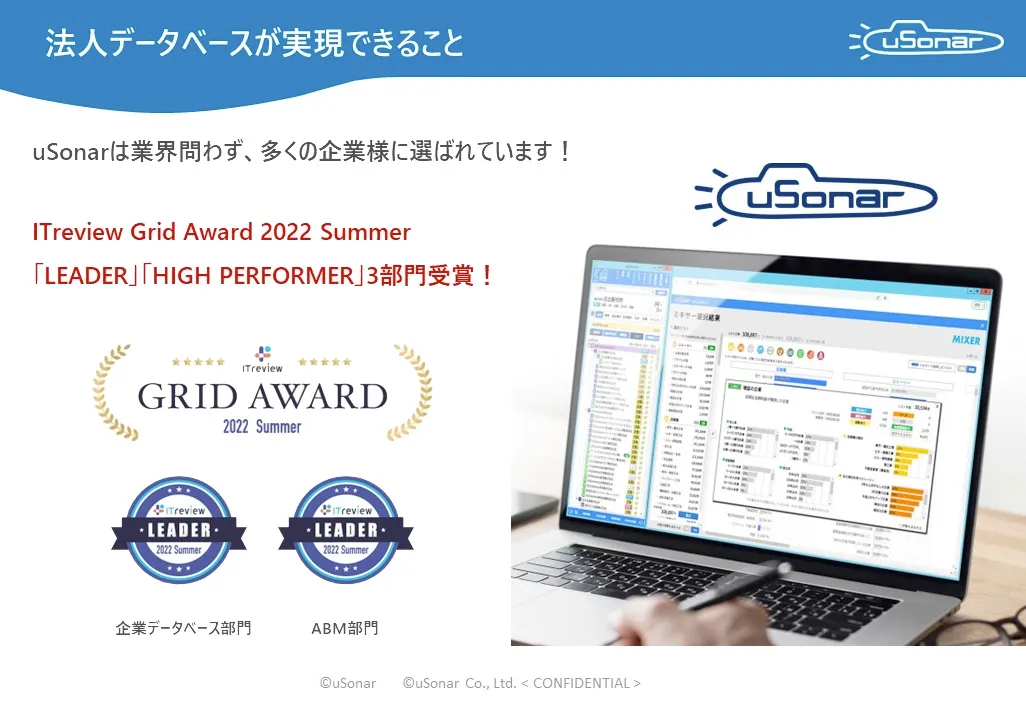
uSonar is utilized by
various companies across all industries.
ITreview Grid Award 2026 Summer
Leader in 6 Categories

With uSonar,
we can help solve your company's challenges!
Case Studies and Sample Reports
Download