- CRM/SFA/MA
[5-Minute Read] What Is CRM Marketing? An Easy-to-Understand Guide to Analytical Strategies and Benefits

Last Updated: April 22, 2024
Click Here to Learn More About SFA and CRM ▶
Solving SFA and CRM Challenges:
What Are the "Truths" That Tool Vendors Won't Tell You?
Many companies are considering the implementation of a CRM tool in the expectation that customer management will improve sales efficiency and increase revenue.
CRM is an essential tool for developing future sales strategies, as it can be used for managing and analyzing prospective and existing customers, creating lists of high-probability leads, and streamlining administrative tasks related to customer management.
However, for companies that have not yet implemented a CRM, it is common to wonder what benefits CRM utilization can provide and to seek reference from the success stories of companies that have already implemented it. By understanding the key points of utilization, you can prevent potential failures during implementation.
Therefore, this article introduces methods for utilizing CRM, three key points for effective implementation, and actual CRM success stories where companies achieved tangible results. By reading this article, you will not only be able to visualize the CRM implementation process but also confirm the necessary preparations and key strategies for achieving success before you begin.
Table of Contents
1-1Management and Analysis of Prospects and Existing Customers
1-2Creating Lists of High-Probability Prospects and Potential Customers
1-3Streamlining Administrative Tasks
1-4Accelerating the PDCA Cycle for Sales Activities
1-5Strengthening the Sales Department
2Three Key Points for Utilizing CRM
2-1Prioritize Selecting Tools That Are Easy for Field Staff to Use
2-2Perform Data Consolidation and Data Cleansing Before Utilization
2-3Start by Managing and Analyzing Your Own Customer Data
3Two Customer Success Stories Leveraging CRM
3-1Case Study: Demaecan Co., Ltd.
Recommended Articles

CRM allows you to manage and analyze not only your existing customers but also your prospects. With CRM, you can manage and analyze basic customer information, such as capital, number of employees, and industry type. By uploading your own customer data, you can also extract information on specific companies by filtering criteria such as usage amount, retention rate, capital, and number of employees.
Furthermore, CRM tools allow you to review communication history with customers and the progress of projects and negotiations, which helps facilitate project advancement and improves customer satisfaction by reducing missed responses.
Recommended Articles:
CRM systems are equipped with features to import and analyze external data in addition to existing customer data. By integrating data on non-customers based on the management and analysis results of existing customers, you can identify and list high-probability prospects and potential customers that your company should target.
For example, if you find that your service is utilized by companies in the service or construction industries with 10 or fewer employees, you can create a sales list with a high probability of conversion by approaching companies that meet the same criteria.
This allows you to share high-quality leads with the sales department, enabling efficient sales activities that focus exclusively on prospective customers.
Recommended Articles:
Explained by Corporate Database Professionals | Sales Strategy Planning Guide: Key Success Factors
CRM allows for the centralized management and analysis of customer information and project progress, which leads to increased efficiency in administrative tasks.
Many companies that manage customer data across Excel, legacy systems, or multiple disparate platforms suffer from fragmented information and inconsistent data formats, preventing them from fully leveraging customer data as a corporate asset.
By using a CRM, you can consolidate cross-functional data—such as Excel files, Word documents, and information from other systems—into a single source. Furthermore, the ability to easily input and add data streamlines administrative workflows.
CRM enables the visualization of individual customer interactions and project progress, making it possible to accelerate the PDCA cycle for sales activities.
Visualizing customer interactions and progress not only clarifies the next steps but also allows for precise instructions based on status, such as, "This project has been stagnant for a few days since the last meeting; please follow up."
This helps move away from personalized sales processes where tasks are left entirely to individual sales representatives. By visualizing customer information management and project progress, the next actions become clear, thereby accelerating the PDCA cycle for sales activities.
Leveraging a CRM also contributes to strengthening the sales department. CRM allows you to assign sales representatives to specific projects and monitor their interactions and progress in real time. This makes it possible to identify projects with poor progress and provide timely support.
Additionally, by storing successful approaches and top-performing sales scripts as knowledge within the CRM, even new sales representatives can achieve a high level of sales performance.
By leveraging CRM for "real-time feedback" and "sharing knowledge from top sales performers," you can elevate the overall sales capabilities of your sales department.
Recommended Articles:
Many CRM tools with various features have been released by different companies, but when selecting a tool, choose one that your field sales representatives and administrative staff find easy to use.
A common failure is when "management or the corporate IT department selects a tool unilaterally." While administrators who manage and analyze data are important, it is usually the field staff who touch the tool to update daily figures and project progress.
Therefore, when selecting a CRM tool, have field staff test the demo to ensure you choose a tool that is user-friendly for them.
When utilizing a CRM, perform data matching (removing duplicate entries or variations in company names) and data cleansing (removing inaccurate or irrelevant data) for the data subject to management and analysis.
If data is not organized through matching and cleansing, the same company might be registered under both its formal and abbreviated names, leading to data inconsistencies and potentially lowering the accuracy of analysis results.
While data matching and cleansing can be done in Excel, it is common to use specialized tools to process data more quickly and with higher accuracy.
However, some CRM tools come with built-in data matching and cleansing features, so if your company does not have an environment for these tasks, choose a CRM that includes data maintenance features from the start.
★★★★Image Here★★★★ Recommended image size: 424×282 ★★★★Image End★★★★
To maximize results from CRM utilization, you should start by deepening your understanding of your existing customers. This is because if you can grasp the timing of orders, customer status, and scale, you can discover the optimal approach for new prospects.
For example, if analysis confirms that "other company products or services are utilized within three months of an order," you can implement effective upselling and cross-selling strategies for new customers.
CRM is a tool particularly well-suited for strengthening relationships with existing customers and finding prospects—whether active or latent—based on existing customer trends. Therefore, after introducing a CRM tool, put new customer acquisition on hold and start by analyzing your existing customers.
By integrating CRM with the corporate data tool "uSonar", it is possible to maximize the benefits of CRM implementation.
Details of the case study can be found here
Details of the case study can be found here
In this article, we introduced case studies and specific methods for utilizing CRM tools, along with key points. CRM tools are not only for customer management but can also be used for fundamental reforms within the sales department. In addition to streamlining administrative tasks, they allow you to focus appointments and negotiations on promising leads, enabling sales that are more likely to lead to results.
However, simply introducing a CRM tool does not guarantee success. Before implementation, ensure you "select a tool that is easy for field staff to use" and "perform data maintenance through matching and cleansing," then start by "analyzing and managing your own customers."
uSonar provides a "Customer Data Integration Solution" that can integrate existing customer information with the LBC, a corporate database of 12.5 million companies.
By incorporating these features, you can build a sales structure that drives revenue growth and eliminates waste through fundamental sales reform.
For case studies of success using uSonar and specific utilization methods, please check the materials below.
About the Author

uSonar Editorial Department
MX Group, Editor-in-Chief
This is the uSonar Editorial Department.
We provide information on data utilization and digital technology useful for considering future business operations, primarily for companies engaged in B2B business.
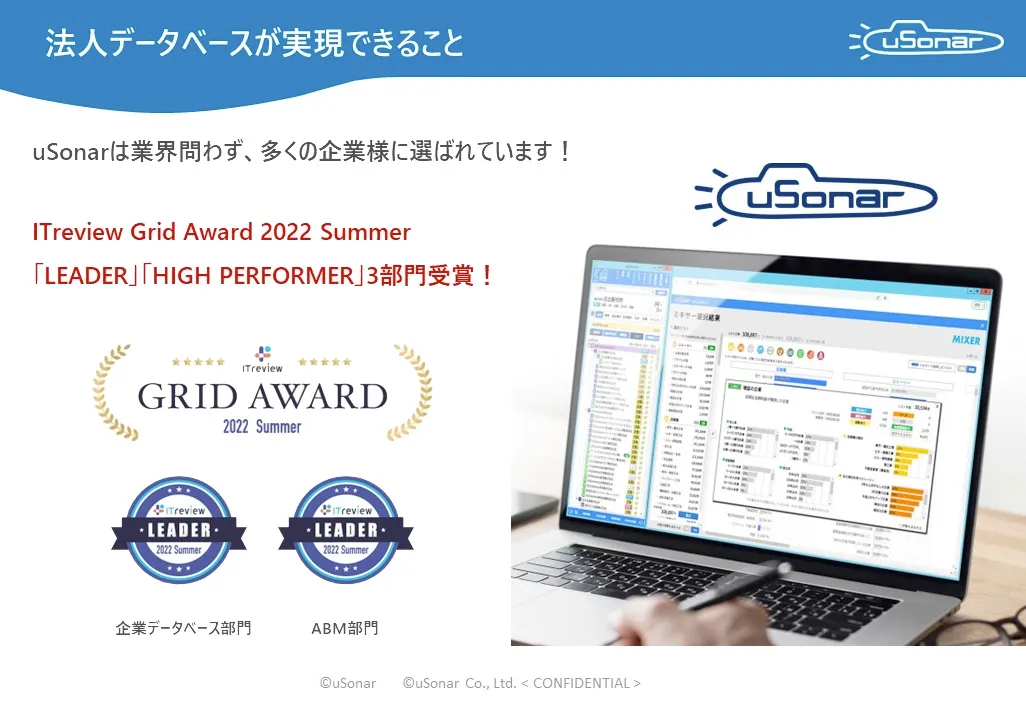
uSonar is utilized by a wide range of companies
across various industries and sectors.
ITreview Grid Award 2026 Summer
Leader in 6 Categories

With uSonar,
we can help solve your business challenges!
Case Studies and Sample Reports
Available for Download