





- ABM
What Is ABM? A Comprehensive Guide to Implementation and Strategies for Success

Use Cases by Objective
New Approach Lists
Group Strategy

Digital
Marketing

Client Information Registration

Data Cleansing
Corporate Attribute Analysis

SFA/MA Activation

Business Card Data Integration

Credit and Client Screening

Use Cases by Department
Sales Department

Inside Sales
Department

Marketing &
Corporate Planning Department

IT Department

Administrative Department

Use Cases by Tool
Meeting Sonar
Last Updated: March 22, 2024
Click Here to Learn More About ABM ▶
ABM Practice: The Complete Guide
Download the Free Ebook
Account-Based Marketing (ABM) is a marketing strategy that involves executing optimized approaches toward highly targeted companies.
ABM is a company-wide initiative that requires significant resource allocation. While it enables efficient and precise proposals, it necessitates the acquisition of detailed data on target companies.
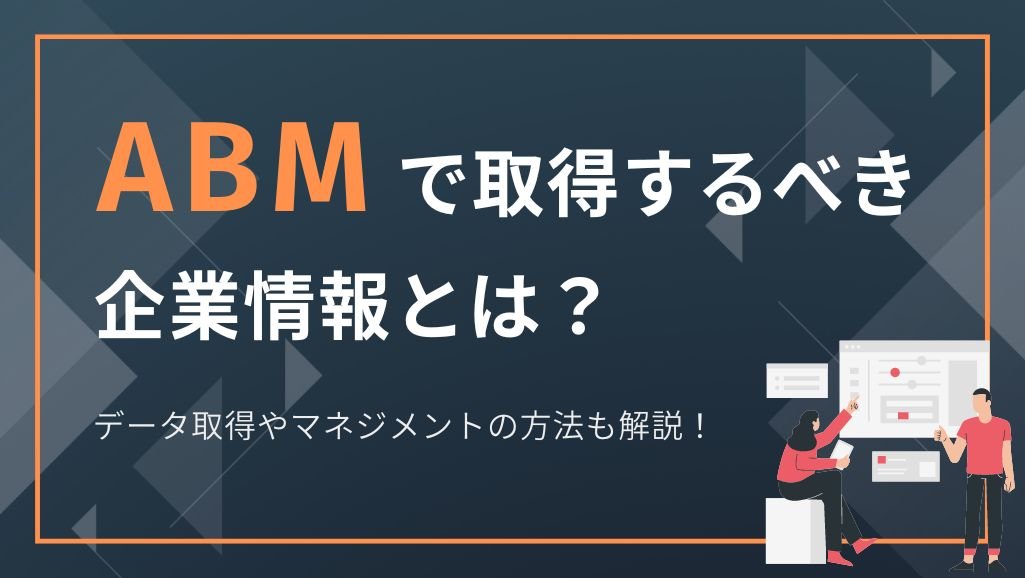
This article explains the types of corporate data required for ABM, methods for acquisition, and the importance of data management.
Let us gain a solid understanding of the data definitions essential for executing ABM.
Table of Contents
1What Is Account-Based Marketing (ABM)?
2Corporate Data Required for ABM
2-44: Intent Data (Behavioral Data)
3Benefits of Acquiring Accurate Data Through ABM
3-1Increased Targeting Precision
3-2Ability to Make Proposals That Match Customer Needs
3-3Effective Improvement Cycles for Marketing Initiatives
4Methods for Acquiring Corporate Data for ABM
Recommended Articles
Unlike traditional marketing methods that promote products or services to a broad audience, ABM is a strategy that identifies specific target companies (accounts) and implements an optimal approach tailored to their unique needs.
By allocating resources at the company level, you can achieve more efficient marketing activities.
Reference Article: What Is ABM? A Thorough Explanation of Its Benefits and Strategies for Success! ▶︎
ABM is also a data-driven marketing initiative.
To ensure success, you must acquire the following types of data.
Let us examine the details of each below.
Since ABM involves approaching companies on an individual basis, it is first necessary to collect basic corporate information.
Specifically, this includes company size (capital, revenue, number of employees, etc.), industry and business sector, location, and business activities.
In addition, identifying decision-makers and the departments or personnel involved in purchasing is crucial for advancing business negotiations.
This data should be collected from publicly available corporate information on the web or from paid databases.
To secure contracts, information regarding the technical fields related to the products or services being proposed is essential. Therefore, identify the technologies currently utilized by target companies, as well as new technologies they are expected to consider in the future.
Technical information can be obtained from corporate press releases, exhibition participation records, and patent applications. It is also important to conduct research on technology trends to assess the level of alignment with your own products.
It is necessary to grasp a company's financial indicators and performance trends to determine their investment capacity.
For publicly traded companies, this information can be collected from securities reports. For private companies, financial information can be obtained from reports provided by credit research agencies.
To also understand cash flow and financing status, refer to information such as press releases.
Intent data (behavioral) refers to behavioral data that indicates a company's purchasing intent.
In addition to access data from your own company website, purchasing corporate web behavioral data from third parties enables a more detailed analysis of behavior to better understand customer needs.
In ABM, it is effective to utilize MA (Marketing Automation) tools to collect data such as website browsing history and white paper download status.
Furthermore, social media post content and participation in industry seminars or events can also serve as clues to grasp corporate needs, so these should be referenced as well.
As described above, the difficulty of acquiring accurate data for ABM is by no means low.
Nevertheless, there are many benefits for corporate organizations to acquire data regarding target companies when implementing ABM.
Specific examples are as follows:
We will explain each of these in detail.
In ABM, narrowing down target companies is critical to success. Based on accurate corporate data, you should select companies with high potential demand and a greater openness to your proposals.
Conversely, using inaccurate data leads to incorrect targeting, resulting in the wasteful consumption of sales resources.
By acquiring accurate data, you can analyze business scale, industry, performance, and management policies from multiple perspectives, allowing for appropriate scoring and segmentation.
As a result, you can develop effective approach strategies, significantly improving targeting accuracy.
Accurately grasping a target company's technological trends, new technologies under consideration, and need-related information leads to optimal proposals that match their requirements.
By acquiring accurate data, you can precisely capture the challenges companies face and their expectations for products and services.
To correctly measure the results of ABM initiatives, accurate intent data—such as "website visit history" and "document download information"—is essential.
Without behavioral data that indicates intent and needs, you will be unable to properly evaluate your initiatives.
By analyzing accurate data, you can correctly calculate the ROI of your ABM. You can quantitatively identify areas for improvement and smoothly engage in the PDCA cycle.
In ABM, it is necessary to collect and integrate various data on target companies. Utilizing an ABM tool is effective for this purpose.
An ABM tool refers to a solution that stores, integrates, and analyzes data on customers and prospective companies necessary for ABM, thereby supporting the execution of your ABM operations.
By integrating the built-in database with your own internal data, you can select high-quality accounts that are more likely to lead to purchases, and plan and execute approach strategies tailored to specific corporate characteristics.
Using an ABM tool allows you to prioritize companies based on their likelihood of conversion and enables customized approaches.
By leveraging the corporate data accumulated in an ABM tool, you can develop more personalized strategies for each account, which will help streamline your sales activities.
Reference Article: What Is an ABM Tool? Explaining Its Importance and the Three Benefits It Brings to Companies ▶︎
To execute ABM effectively, it is essential to define data management that ensures the accurate and centralized accumulation of data regarding target companies, as well as an appropriate management structure.
However, in reality, many cases face challenges due to unorganized data management, such as corporate data being scattered across sales, marketing, and other departments, or failing to reflect the most up-to-date information.
By implementing proper data management, you can increase the accuracy of your targeting and enable more personalized approaches.
Consequently, the efficiency of your strategy execution will be significantly improved.
The data management procedure is as follows:
Data management is not merely about collecting data; it requires processing and integrating data so that sales and marketing teams can utilize it in a "pristine state."
By following this series of processes, you can build the data utilization framework essential for ABM.
Reference Article: What Are the Three Challenges to Solve for ABM Success? Introducing Data Utilization as the Key to Solutions ▶︎
To achieve success in ABM, the appropriate collection and management of corporate data are essential.
By gaining a multifaceted understanding of a company's accurate basic information, financial data, technological trends, and specific needs, you can enhance targeting precision and deliver accurate proposals that align with those needs.
Since the effectiveness of ABM varies significantly depending on data quality, ensure you consistently collect accurate and comprehensive data while simultaneously implementing robust data management.
uSonar provides a comprehensive guide titled "ABM Implementation: The Complete Guide," which systematically outlines the knowledge required to execute ABM.
If you are struggling with the specific methods for implementing ABM, please download it from the link below.
About the Author

uSonar Editorial Department
MX Group, Editor-in-Chief
We are the uSonar Editorial Department.
We provide information on data utilization and digital technologies useful for rethinking future business operations, primarily for companies engaged in B2B business.
uSonar is utilized by
various companies across all industries and sectors.
ITreview Grid Award 2026 Summer
Leader in 6 Categories

uSonar can also
lead your company to solve its challenges!
Case Studies and Sample Reports
Download