- Digital Marketing
What Is the Dark Funnel? Explaining New Challenges in B2B Marketing!
Update Date: May 15, 2024
Develop High-Quality Hypotheses
With Japan's Leading Database
There are various methods for approaching target accounts in B2B marketing, and their effectiveness varies depending on the situation.
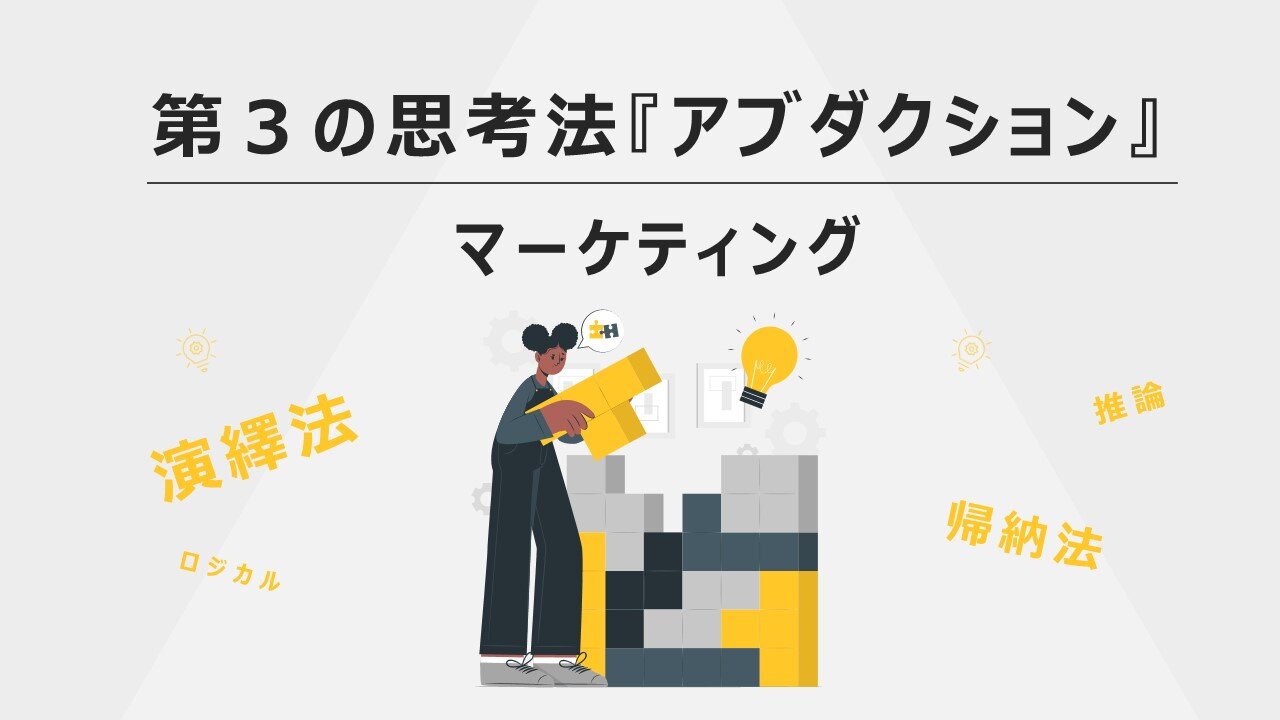
This article systematizes various approaches into "inductive" and "deductive" methods, and explains "Abduction Marketing" as a new concept that does not belong to either category.
At the end of this article, we also explain abduction reasoning utilizing the massive corporate database independently built by our company, uSonar. Please read until the end.
Recommended Articles

Generally, the term "inductive" refers to the process of drawing general conclusions based on specific events or observations.
In B2B marketing, developing account strategies through inductive reasoning is said to provide high flexibility when new customer segments or demands emerge. It excels at evaluating new data and information to adapt strategies immediately.
A concrete example of identifying patterns and trends from case studies and data is the approach of deriving common needs or customer characteristics based on existing customer use cases.
Integrating the information held by sales and marketing teams, and analyzing success stories of customers with high loyalty and LTV to derive common insights for targeting and lead scoring, is an approach practiced by many B2B companies.
Inductively extracting companies to approach next by aligning facts is utilized not only for patterning and presenting solutions that have been requested by existing customers, but also for discovering new value propositions.
☆-☆-☆ Body Content Ends Here ☆-☆-☆Generally, the term "deductive" refers to the process of applying general principles to specific situations.
In B2B marketing, formulating account strategies through deductive reasoning allows companies to leverage existing principles and information as a starting point. This enables more efficient use of internal resources while facilitating the promotion of universal value that is highly reliable and independent of specific environments or conditions.
A concrete example of applying general information to specific cases is the analysis of general market trends within a particular industry.
Identifying target businesses or companies based on industry trend reports and economic data is considered effective when formulating large-scale promotional activities or Go-To-Market Strategies for new services.
Deductively identifying specific customer segments from known public information is an approach that can be practiced even without a pre-existing knowledge base regarding potential industries, and it is utilized to expand the customer base.
"Abduction" is a form of inference with origins in philosophy and logic. It was proposed in 19th-century America as a term referring to the "inferential process of forming the most plausible hypothesis from incomplete information."
It is used to derive the most compelling hypothesis or explanation in situations where uncertainty or incomplete information exists. It is generally used in fields such as scientific hypothesis formation, diagnostic medicine, and Artificial Intelligence (AI).
In the fields of AI and machine learning, in particular, its utility is highly valued in areas such as pattern recognition and decision-making support.
Abduction is said to be a mindset that provides particular value in business environments characterized by high VUCA (Volatility, Uncertainty, Complexity, and Ambiguity).
Specifically, it is said to follow the process below.
Specific events or information are measured.
In many cases, this information is incomplete and ambiguous.
Based on the measured information, facts behind the events or applicable trends and patterns are generated as hypotheses.
The generated hypotheses are evaluated according to specific criteria.
Evaluation criteria include the simplicity of the hypothesis, consistency with known information, and the degree to which the event can be explained.
The most plausible hypothesis is adopted and utilized as the final conclusion.
Abduction is a method for deriving new ideas and strategies in complex and ambiguous situations. It serves as a powerful method for building competitive advantages while flexibly indicating appropriate directions when formulating sales and marketing strategies in the VUCA era.
"Abduction" is utilized to detect non-generalized trends and patterns in the process of making the most effective decisions based on collected information. In B2B marketing, the following applications can be expected.
When collecting new lead information (potential customers), the data may be incomplete, with only partial contact information provided.
By identifying information such as industry, region, and job title from the provided data, and adding context regarding interests or interactions with competitors, you can score the lead's level of interest.
Suppose there is a service attempting to enter a new market. If data regarding market trends and movements is insufficient, you can infer the TAM for the new market based on analysis results derived from known information about similar or related markets, allowing you to formulate an appropriate approach.
Furthermore, by acquiring and adding segment data regarding customer behavior and interests from external sources as analysis elements, it is possible to discover potential customer needs and market trends that could not be found through analysis using conventional data alone.
When you want to explore your company's competitive advantage in a situation where complete information about competitors is unavailable, you can predict the messaging and marketing strategies used in their product or service proposals by collecting and analyzing website articles and social media activity.
Additionally, by listing customer companies interacting with competitors using intent data, it is possible to infer the overall picture of the industries and sales strategies that competitors are focusing on.
To understand the background and needs of customer companies, a vast amount of information is required. Due to the influence of the dark funnel, it is considered difficult for many B2B companies to collect all customer behavior data.
Therefore, you can predict whether there are similarities in the behavior of other customers based on behavioral data and feedback from high-value customers acquired in the past.
You can hypothesize a more effective customer journey, formulate the next steps to take, and build a more personalized marketing approach.
Through Abduction Marketing, you can derive useful insights in situations with high uncertainty, turn instability into opportunities, find creative solutions to complex problems, and transform ambiguity into clear strategies.
However, because abduction is an inference based on hypotheses, its accuracy is limited. Therefore, by using it in combination with data held in corporate information databases, more highly accurate inferences become possible.
>> Click Here for Details on uSonar, Equipped with Japan's Leading Corporate Database
All the approaches introduced in this article are useful.
An inductive approach allows you to explore new customer segments and respond flexibly to market changes.
A deductive approach enables efficient strategies based on established principles and plans.
It is important to use both approaches according to the situation and, at times, combine them to make strategic decisions.
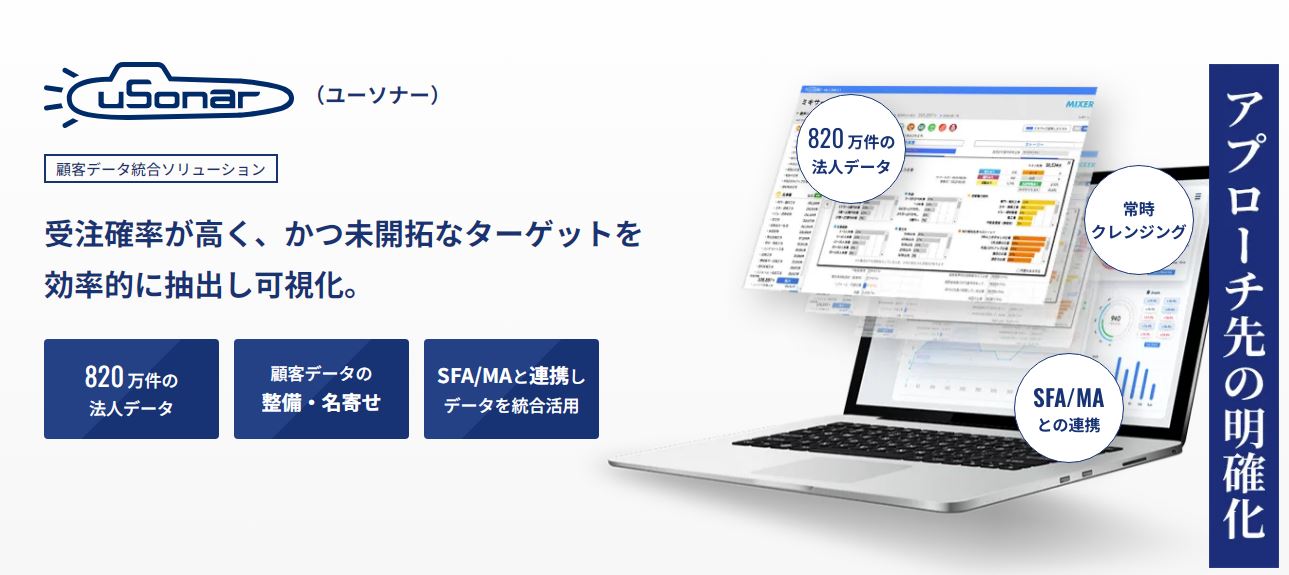
Our customer data integration solution, uSonar, provides factual data held by companies.
It is possible to execute an inductive approach by realizing data integration across sales and marketing organizations, and a deductive approach based on industry trends, all on a single platform.
In addition, we provide data such as tools used by customers and behavioral trends on the web, allowing you to visualize characteristics of customers that were previously completely unexpected.
By using such data integrally for machine learning, we also provide functions for planning Abduction Marketing, making it possible to assign match rates and priorities to your company and gain insights into the next best approach.
For more details, please feel free to contact us via this page.
Author

uSonar Editorial Department
MX Group, Editor-in-Chief
This is the uSonar Editorial Department.
We primarily provide information on data utilization and digital technology useful for considering future business operations, aimed at companies engaged in B2B business.
uSonar is utilized by various companies
across all industries and sectors.
ITreview Grid Award 2026 Summer
Leader in 6 Categories

With uSonar,
we can guide your company toward solving its challenges!
Case Studies and Sample Reports
Download