Generated at: 2026-11-17 11:43:25

uSonar Utilization, Corporate Attraction, Approach List

Kobe City Hall Implements uSonar for Corporate Attraction

— Realizing Candidate Company Exploration via "AI List" and Information Gathering via "uBrain" —

Kobe City Hall

Local Government

INTERVIEWEE

  • Mayumi Aso, Section Chief, Corporate Location Division, Economic and Tourism Bureau
  • Chika Harada, Corporate Location Division, Economic and Tourism Bureau

Kobe is a government-designated city. The Corporate Location Division of the Economic and Tourism Bureau is committed to creating new investment and employment opportunities by attracting companies from outside the city and supporting the growth of local businesses. As the business environment evolves, the division implemented uSonar in June 2026 to advance more strategic corporate attraction activities. We interviewed them about the background of this implementation, their current usage, and their future vision for sustainable urban development and corporate attraction.

  • Challenges Before Implementation

    • Signs of corporate relocation and investment were difficult to identify, leading to corporate attraction activities that relied heavily on individual experience and intuition.
    • To obtain company lists, it was necessary to consult with database providers, request quotes, obtain internal approval, and process orders each time, preventing immediate research.
  • Key Reasons for Implementation

    • When searching for companies that meet specific criteria, staff can extract and research data in real time.
    • Use the AI List feature to immediately explore target groups similar to companies with which you already have a connection.
    • Expectations for features that provide insight into current corporate activities, such as Live Access and Interest Sign.
  • Results Achieved

    • Expanded the scope of information gathering by discovering companies and related data that were previously inaccessible.
    • Streamlined the organization of information for multiple companies when preparing for research or meetings focused on growth industries.
    • Utilize recommended actions from uBrain as a resource for developing outreach strategies, such as proposing subsidy programs.

Challenges Before Implementation

Opaque signs of relocation and investment. Target exploration relied heavily on experience and external outsourcing.

First, could you please explain the role of the Corporate Location Division?

Aso

The Corporate Location Division is responsible for attracting companies from outside the city, supporting capital investment and business expansion for local companies, and managing subsidy programs for businesses. Rather than focusing on factories or industrial parks, our primary responsibility is attracting companies looking to establish offices in urban buildings, such as headquarters functions or sales bases.
For example, we prioritize "urban creative industries" such as information and communications, animation and content, and design. Our goal is not simply to bring companies here; it is to create a sustainable city that generates new investment and employment in Kobe and remains a preferred choice for businesses.

How have you approached companies in the past?

Harada

Broadly speaking, we have used three methods: sending out investment intention surveys (questionnaires), exhibiting at trade shows, and making phone calls. We exhibit at trade shows about three to four times a year, mainly in the Tokyo area. We promote expansion into Kobe at DX-related exhibitions where IT companies gather. Questionnaires are an important touchpoint for understanding companies' relocation intentions and interest in our subsidy programs.
On the other hand, the response rate to phone calls has been declining since around the year before last. Outsourcing this can cost several million yen per project, so currently, our staff only makes individual calls to companies they identify as high-potential targets.

What challenges did you face when searching for target companies?

Harada

Previously, we would consult with major corporate database providers as needed and purchase lists of company data that met our criteria. Each time we made a purchase, we had to obtain quotes, process internal approvals, and place an order. The back-and-forth communication to refine the requirements for the data also took time, and it could take several days or more to obtain the information we needed.
Since it is difficult to see from the outside when a company is considering relocating or establishing a new base, the challenge was that it was difficult to narrow down candidates or search for them in a timely manner while adjusting criteria ourselves when needed.

Are there any difficulties unique to corporate attraction?
Aso

The timing of corporate activity varies significantly. In recent years, securing talent has become difficult, and there are cases where the opening of new locations is delayed beyond the initial schedule. That is precisely why I feel it is important not to just create a corporate list once and be done with it, but to capture "companies that are active now" in real time.
Furthermore, it is not simply a matter of attracting any company. For example, for companies within the prefecture, the vision is for them to maintain their headquarters while establishing a base in Kobe for recruitment and growth. We aim to attract businesses in a way that enhances the vitality of each municipality within the prefecture while simultaneously allowing them to utilize Kobe as a place for corporate growth.

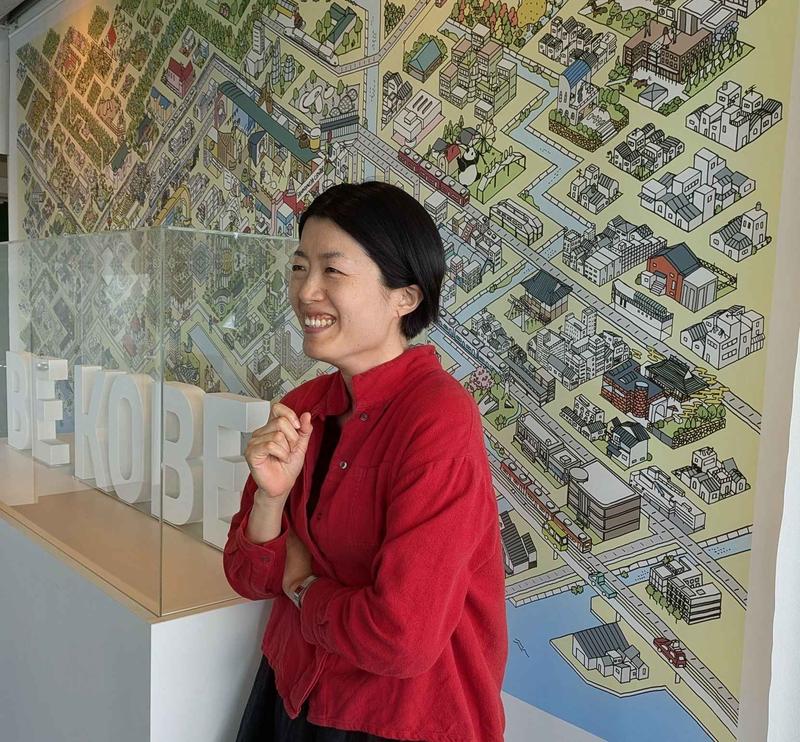
Kobe 2.jpg

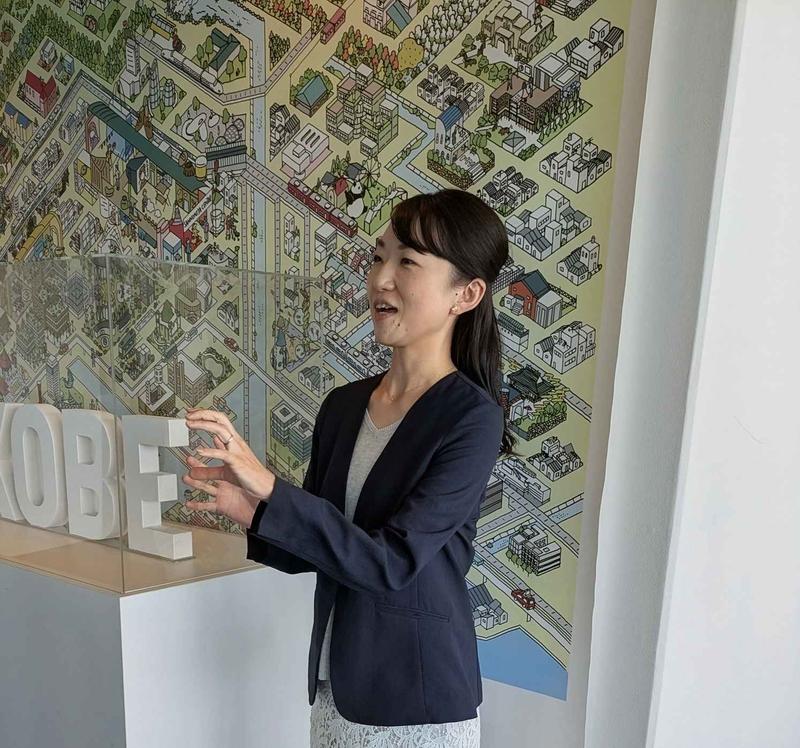
Ms. Chika Harada, Corporate Location Division, Economic and Tourism Bureau


Deciding Factors for Implementation

The ability for staff to conduct research immediately whenever needed. Expectations for AI and corporate trend data.

Could you tell us the background behind your consideration of uSonar?

Aso

There is a movement across the entire Kobe City Government to utilize AI in policies and measures. In the Corporate Location Division, we also wanted to efficiently collect business information using tools like AI to lead to more effective corporate attraction. Previously, we relied heavily on the experience and expertise of our staff, but we wanted to create an environment where we could add a corporate database that shows real-time movements, allowing us to extract the companies we want to approach based on solid evidence.

What did you prioritize during your comparative evaluation?

Harada

The primary benefit is that staff can instantly access corporate information whenever they need it. We wanted to quickly search for companies that meet our criteria, not only by sales scale or industry, but also by considering factors such as corporate growth, investment trends, and the potential for office relocation. We also had high expectations for the "AI List Function" in PLANSonar, which allows us to find companies similar to those that have already expanded into Kobe or those that provided positive responses to our surveys.

What was the final deciding factor?

Aso

In addition to being able to acquire corporate information in real time, the deciding factor was the potential to identify promising companies by grasping their interest trends through features like Live Access and Interest Signals. To be honest, if we look solely at the cost of collecting corporate information, it has increased compared to before.
Nevertheless, we can obtain information exactly when we need it and even observe current corporate trends. We believe the value and convenience of this outweigh the costs.

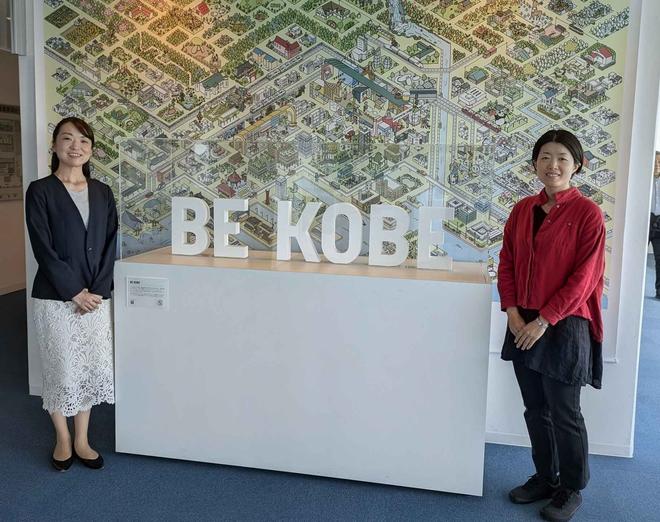
Kobe 3.jpg

Mayumi Aso, Section Chief, Corporate Location Division, Economic and Tourism Bureau


Results Achieved

It is not just about saving time. It has expanded the scope of "information and insights that were previously unattainable."

How did you first utilize the system after implementation?

Aso

For the investment intention survey conducted in July 2026, we sent questionnaires to approximately 3,000 companies. For the extraction criteria, we used multiple perspectives from the "Story" feature—a collection of corporate attributes—such as sales growth, potential for office relocation, occupancy in buildings built under old seismic standards, health management certifications, and connections between executives and Hyogo Prefecture.
Although the response rate was lower than the previous year, we have the impression that the proportion of responding companies interested in site relocation or subsidy programs has increased compared to last year. While still under verification, we feel there is potential to improve the precision of our target company selection.

What changes have you experienced in information gathering?

Harada

While we have not yet reached the stage of measuring quantitative results, I feel that the scope of corporate information we can gather has expanded significantly. When I need to organize multiple companies in a short amount of time, it has become easier to grasp not only company overviews but also related companies and business sectors.
I also frequently use it when creating internal presentation materials or researching a company before a visit. Beyond just saving time, the most significant benefit at this point is being able to obtain information and insights that were previously unavailable.

Do you have any specific examples of discovering new companies?

Harada

Recently, I researched the industrial concentration of "Next-Generation Air Mobility" in the Kansai region, prompted by newspaper articles on the 17 growth sectors promoted by the national government. I used PLANSonar and GuideSonar to explore whether there were companies in Kobe City that manufacture related parts, or if there were potential companies outside the city that could be recruited.
By also using AI tools introduced by the city office, such as Copilot, I was able to find companies that we had not previously identified. I do not rely solely on the AI results; rather, I use them as a reference while evaluating their compatibility with Kobe City and their connections to local businesses.

How are you using the AI assist function "u-Nou" in GuideSonar?
Harada

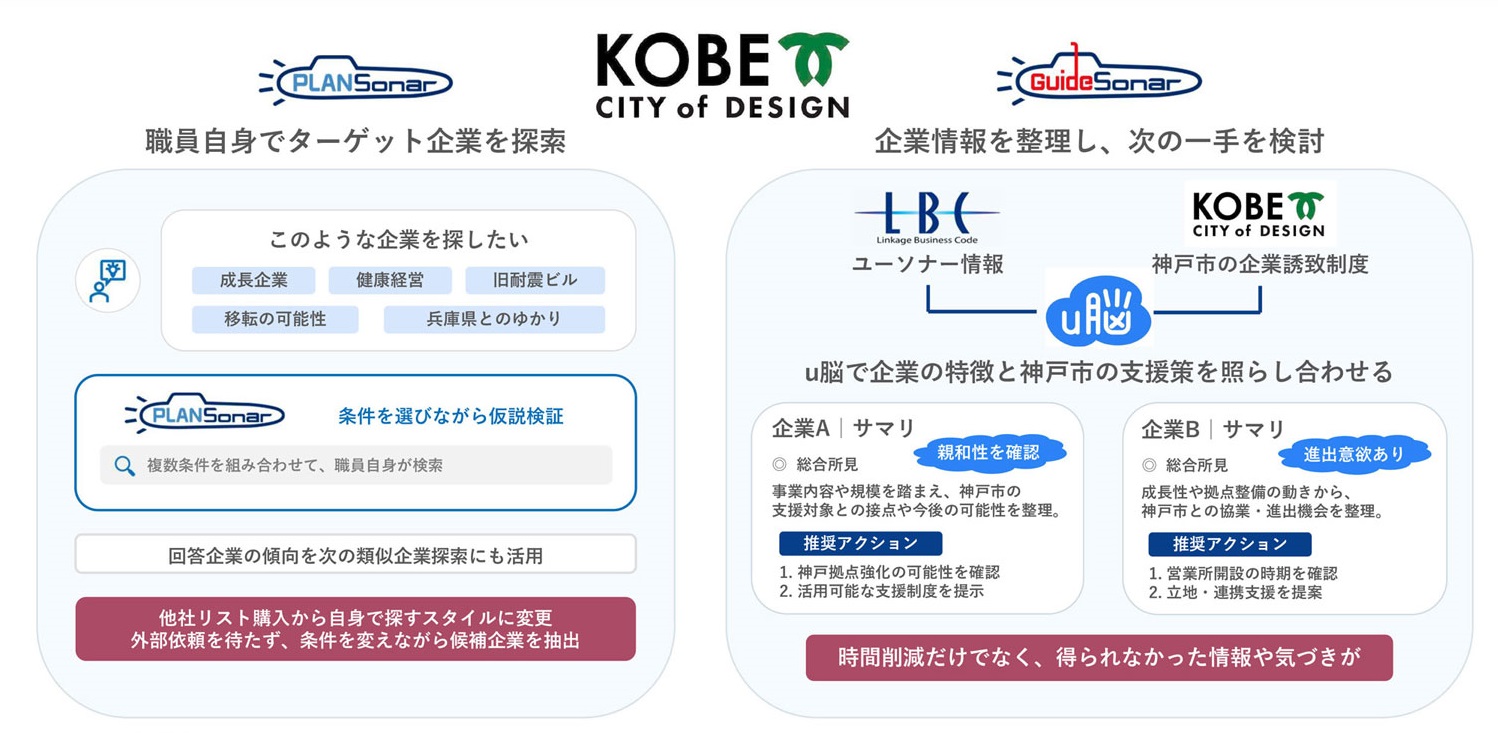
It is convenient that information is clearly summarized on a single page when searching for a company name. I have registered Kobe City's regional characteristics and subsidy programs, and I also refer to the "Recommended Actions" provided by u-Nou.
For example, for companies considering expansion, I get the impression that it suggests content we can actually propose, such as office rent subsidies or programs related to building acquisition.
In the future, when we approach companies that show activity through Live Access or Interest Signals, it will likely serve as useful material for determining the best angle for our outreach.

Kobe City Hall.jpg

Kobe City Hall, Hyogo Prefecture: uSonar Implementation and Usage Case - Data Integration Diagram


Future Outlook

Capturing Active Companies and Identifying Businesses with High Affinity for Kobe

How do you intend to utilize these tools in the future?

Harada

Based on the companies that responded to our summer 2026 survey indicating potential relocation or interest in subsidy programs, we are using the AI list function to identify similar businesses. For the winter survey, we aim to use those results to explore new outreach opportunities. Next fiscal year, we plan to combine our staff's experience and expertise with corporate data, utilizing tools like Interest Sign to fully launch initiatives to capture companies that are currently active.

What kind of corporate attraction are you aiming for by utilizing corporate data?

Aso

Since our attraction efforts were originally triggered by the national policy to correct the over-concentration in Tokyo, we aim to enhance the sustainability of the entire region by encouraging companies in the Tokyo metropolitan area to expand into Kobe and by helping local companies grow by establishing bases in Kobe as well.
To that end, we look forward to analytical functions that make it easier to identify corporate growth and investment trends, as well as more accurate corporate recommendations. If information on commercial real estate in the Kobe area is also enhanced, it will become even easier to make proposals that connect corporate movements with available facilities.

Comments from Daigo Horie, Manager, Corporate Attraction Division, Economic and Tourism Bureau, Kobe City

Our division is committed to attracting companies from outside the city and promoting investment within the city, with the goal of further revitalizing the Kobe economy, creating jobs, and ensuring the sustainable growth of the city. As the environment and needs surrounding companies diversify, I believe it is crucial to grasp a wide range of real-time corporate movements, evaluate targets, and develop hypotheses to approach them strategically without missing the right timing.
The introduction of uSonar has made it easy to access corporate information, simplifying the process of searching for target companies by combining various conditions and verifying our hypotheses. This has allowed us to examine which companies we should approach from multiple perspectives, leading to improvements in our staff's understanding of companies and the quality of our policy considerations.
Moving forward, we intend to further advance our data-driven corporate analysis and target setting, while conducting repeated simulations with diverse criteria to discover companies with high affinity for Kobe City. Furthermore, by accumulating the knowledge gained through our corporate attraction activities and applying it not only to attraction efforts but also to the consideration of industrial promotion policies, we will strive to promote more effective regional economic policies.


About Kobe City Hall

Kobe is one of Japan's leading ordinance-designated cities and serves as the prefectural capital of Hyogo Prefecture. The city is composed of nine wards, with a population of approximately 1.49 million and a workforce of about 21,000 employees. The initial general account budget for fiscal year 2026 is approximately 977.8 billion yen. Guided by the civic pride message "BE KOBE," which was established 20 years after the Great Hanshin-Awaji Earthquake, the city is working with its citizens to promote sustainable urban development.

詳しくはこちら:https://www.city.kobe.lg.jp/
Article Publication Date: November 16, 2026

*Our service and feature names are current as of the time of the interview.

Consult with uSonar

You may stop receiving information regarding services and events at any time. Please review our Privacy Statement for our company policies.

Other Case Studies

For Urgent Inquiries, Please Call Us03-5388-7000Business Hours: 10:00 AM - 5:00 PM (Closed on Weekends and Holidays)

The Definitive Solution for Sales DX Through Data Utilization

Service Brochure

uSonar in 5 Minutes

Understand uSonar in 5 Minutes

Download Brochure