Generated at: 2026-11-12 18:45:26

Salesforce Utilization: Group-Wide Customer Data MDM

Panasonic Electric Works Implements uSonar to Achieve a Master of Masters for Customer Data

— High-Quality Customer Data Infrastructure Supporting Group-Wide SFA Integration —

Panasonic Electric Works Co., Ltd.

Electrical Equipment and Housing Equipment

INTERVIEWEE

  • Mr. Hisanori Tahara, Manager, System Development Group, Business Architect Center, Marketing Division
  • Ms. Hana Fujii, Digital Marketing Group, Business Architect Center, Marketing Division

Panasonic Electric Works Co., Ltd. (hereinafter Panasonic EW) oversees the electrical construction materials and housing equipment sector of the Panasonic Group. Given that numerous business divisions and consolidated subsidiaries are involved, Panasonic EW prioritizes the accurate and unique management of client and facility information, as well as the cross-organizational utilization of project data, as a cornerstone of its management and sales activities. In November 2023, Panasonic EW implemented the uSonar corporate database as the 'Master of Masters'—the foundational data for its data utilization strategy. The company is successfully developing and operating the 'Construction Customer Database (CCD),' which is integrated with Salesforce. We interviewed them regarding their challenges prior to implementation, the reasons for choosing uSonar, the results achieved after implementation, and their future outlook.

  • Challenges Prior to Implementation

    • Each company managed client and facility master data using different rules, leading to data inconsistencies across the organization.
    • The presence of duplicate, incomplete, and unnecessary records created challenges for operations, analysis, and data governance.
    • A 'Master of Masters' was required to uniquely identify clients and enable shared use across consolidated subsidiaries.
  • Reasons for Choosing uSonar

    • Centralize customer data at the company and office level using LBC as a common key.
    • Data structure and quality capable of supporting Salesforce's parent-child hierarchy operations.
    • uSonar's data quality, logic consistency, approach to master data management, and the comprehensiveness of its corporate database.
  • Results Achieved

    • The incomplete customer data record rate decreased from 10% (20,093 records) to less than 1%.
    • The number of duplicate records, which exceeded 2% of the total (4,985 records), was reduced to zero.
    • The ratio of valid and accurate data improved from 84% to 99%.
    • Reduced the time required for new client screening processes by 70% to 80%.
    • Shared project details, proposed amounts, negotiation history, progress, and reasons for lost deals across the Panasonic EW Group, fostering a culture of efficient sales operations.

Challenges Before Implementation

Managing client and facility information with inconsistent rules across companies. Data fragmentation acts as a barrier to cross-organizational utilization.

Panasonic Electric Works comprises dozens of group companies in Japan alone, with approximately 35,000 employees and consolidated sales of approximately 1.1606 trillion yen (fiscal year 2025). Could you please start by telling us about your company's business and your roles in this initiative?
Tahara

Panasonic Electric Works develops a wide range of businesses related to living environments and social infrastructure, such as electrical construction materials and housing equipment. Our department, the Business Architect Center within the Marketing Division, is responsible for developing the data infrastructure that supports Panasonic Electric Works' overall sales and marketing activities, as well as planning and operating business platforms centered on Salesforce.
In particular, we are consolidating various systems around our construction-related customer database, known as the "CCD." We aim to share information on clients, facilities, and eventually key personnel across the entire company, enabling the visualization of project progress and customer relationships.

1.jpg

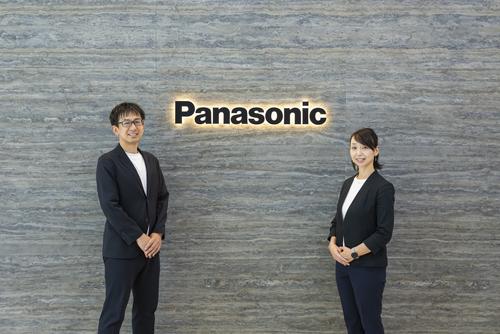
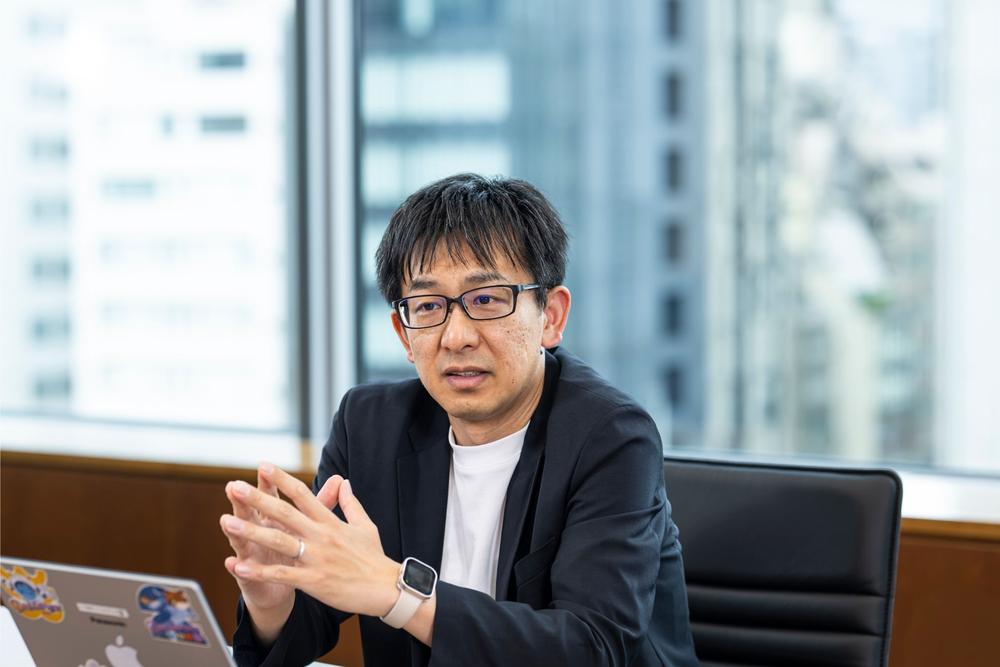
Mr. Hisanori Tahara, Manager, System Development Group, Business Architect Center, Marketing Division, Panasonic Electric Works Co., Ltd.


What challenges did you face before implementing uSonar?

Tahara

The major challenge was that each company managed and operated its master data using different rules. Even for the same enterprise, there were inconsistencies in data across companies due to differences in notation, granularity, and the interpretation of parent-child relationships. Information on clients and facilities is used for various purposes, including sales activities, project management, business analysis, and governance.
However, as long as duplicates and incomplete records remain, accurate analysis and cross-company information sharing become difficult. We needed a common key to uniquely identify each client.

So, you took on the challenge of organizing your master data. Many companies recognize the necessity of this, but we often hear of cases where implementation and operation are difficult and ultimately fail. What aspects did you find particularly challenging?

Tahara

There are many decisions to be made, such as the level of granularity for management, the definition of notation rules, and how to ensure consistency with existing core system masters. Furthermore, master data maintenance is not a one-time task. It requires an operational philosophy that continuously reduces unnecessary, duplicate, and incomplete data as registrations and updates occur daily.
Therefore, there were limitations to creating rules solely within the company. We concluded that we needed a mechanism to centralize master management operations by integrating with external corporate and location information databases, allowing for constant, automated information updates.

Key Factors for Implementation

Adopting LBC as the "Master of Masters" as a common key to "uniquely identify business partners"

Could you tell us the background behind adopting uSonar's LBC?

Tahara

In November 2023, we implemented uSonar as the "Master of Masters," which serves as the foundation for our customer master. Our company has a unique approach to operating Salesforce, utilizing a structure that includes parent-child relationships. We were searching for a master that could support this structure.

The primary objective of the "Master of Masters" is to uniquely identify business partners. We decided to utilize LBC's corporate and location information, which offers extensive corporate coverage, as a common key to integrate customer data across our consolidated subsidiaries.
By doing this, we aimed to enable the mutual linking and sharing of projects and transaction statuses at both the corporate and office levels.

What were the points that led you to evaluate uSonar highly?

Tahara

The high quality of the data and the fact that the data structure logic is consistent and well-defined. Master data should not simply be changed flexibly to meet every request from the field. Rather, it is important that the rules and underlying concepts remain consistent.
Of course, we made various requests regarding the data during the implementation process. Among those, there were some very in-depth discussions, but the fact that uSonar had a clear philosophy was actually a point we highly valued when designing our operations.

How has your system configuration changed after the implementation?

Fujii

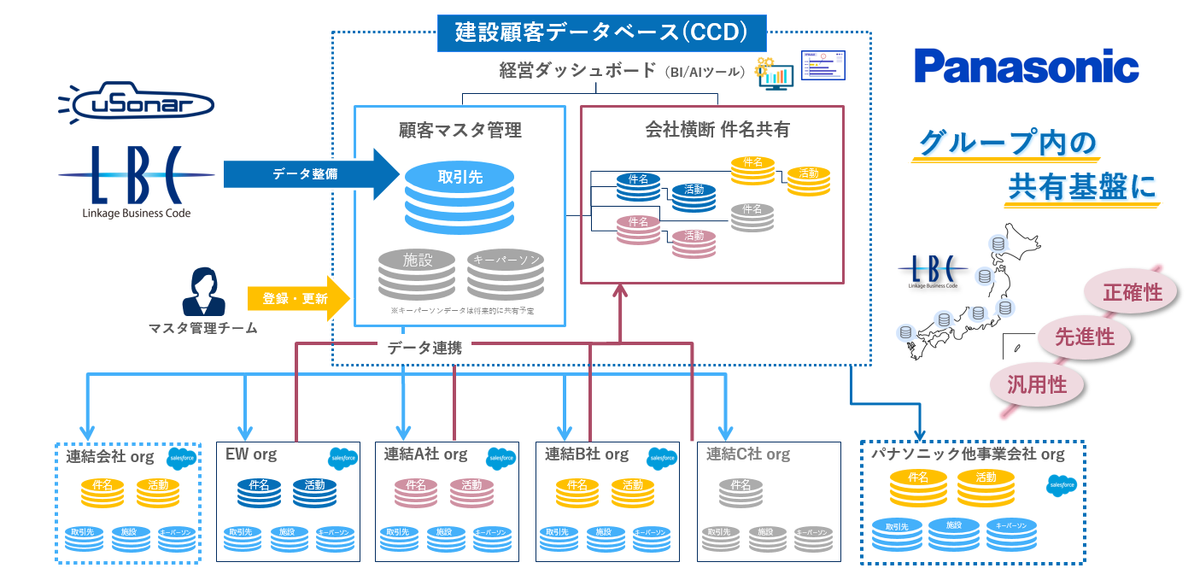
Previously, Panasonic EW and its consolidated subsidiaries managed data separately, with individual sales users handling business card and facility information registration. Currently, CCD has transitioned to a structure consisting of a "Master Org" that governs all master data and a "Multi Org" utilized by each company. We have consolidated client and facility master data within the CCD Org and integrated it with uSonar's LBC.

Registration and updates are managed by the Master Management Team, with data integrated and distributed to each company's Salesforce environment via MuleSoft (a data integration tool). Allowing individual sales users in the field to freely create and update client records can lead to data inconsistencies.
For this reason, we have centralized client creation and updates within CCD, ensuring they are always linked to LBC via SideSonar. Furthermore, by integrating Quick Search into the user application screen, we have shifted to an operational model that ensures accurate information is linked from the moment of application.

2.jpg

Ms. Hana Fujii, Digital Marketing Group, Business Architect Center, Marketing Division, Panasonic Electric Works Co., Ltd.


* Quick Search: A feature that improves accuracy during data registration. By entering only a portion of information such as a company name or phone number, it is possible to retrieve and reflect accurate corporate information from LBC.

Results Achieved

Duplicate Records Reduced to Zero. The Rate of Valid and Accurate Data Has Improved to an Impressive 99%

What changes have you observed in data quality since the implementation?

Fujii

In maintaining our client master, we have continuously reduced duplicate, incomplete, and unnecessary records. As of October 2022, we had approximately 210,000 client records, of which 2% (4,985 records) were duplicates, 10% (20,093 records) were incomplete, and the valid and accurate data rate was 84%.
Following the integration with uSonar, our client records now total approximately 176,000, and we have succeeded in reducing duplicate records to zero. Incomplete records have also been virtually eliminated, leaving only minor variations in naming. The valid and accurate data rate has increased to 99%.
As a master foundation for correctly executing operations, analysis, and governance, we have been able to achieve data with high precision and freshness.

What effects have been seen in the practical operations of each department?
Fujii

For example, we are seeing results even in scenarios where new business partners are registered. We changed our operations so that field staff are no longer required to manually enter new business partners in Salesforce, which prevents duplicate registrations. Instead of creating new customer records, sales representatives simply verify the link on the screen and associate it with the correct existing business partner. We make extensive use of Quick Search in the background, and I feel that the operational time spent checking for new business partners has been reduced by approximately 70% to 80%.
The system's ability to identify valid applications that do not require manual checking has led to the automation of our application workflow, significantly reducing the lead time for processing applications. From a user perspective, tasks that used to take one to two days are now completed in about 30 minutes, which we believe has greatly improved convenience.

3.jpg

Panasonic Electric Works Co., Ltd.
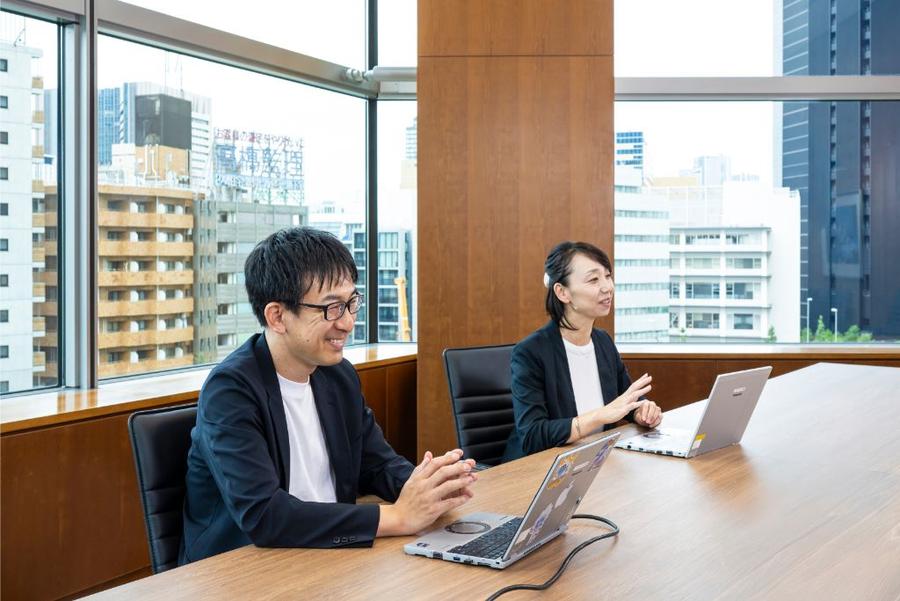
Marketing Division, Business Architect Center, System Development Group, Manager, Mr. Hisanori Tahara
Marketing Division, Business Architect Center, Digital Marketing Group, Ms. Hana Fujii


What changes have you seen in terms of sharing customer data across the company?

Tahara

By centralizing the business partner master data under the Panasonic EW Group, the sharing and utilization of customer data have become seamless. Regardless of whether there is an active transaction, we can now share project details at both the corporate and office levels using LBC as the key.
For example, we can now view proposed amounts, negotiation history, discount rates, project status, and reasons for lost deals within Salesforce. Since updates to corporate information are supported based on LBC data, we can maintain the integrity of project information while accounting for differences between new and old company names.

What has been the response from inside and outside the company?
Tahara

We participated in the Salesforce Utilization Champion Tournament and received significant attention, and it seems our initiative was highly regarded for its innovation, accuracy, and versatility. Discussions have begun regarding its use as a shared platform within the Panasonic Group. Based on the Construction Customer Database (CCD), we have started collaboration with three consolidated engineering companies, and we are now looking into expanding this to our consolidated product sales companies and other business units in the future.

Furthermore, we have received interest as an advanced case study of data utilization in a large enterprise, including inquiries and site visits from other industries regarding our internal and external Salesforce utilization initiatives.
While many companies envision the centralized integrated management and utilization of data within group companies, it is a difficult area to establish in actual operations. We hope to continue sharing the importance of persistently bringing systems to a state where they can be operated stably. We would be pleased if this leads to greater vitality and improved productivity for Japanese companies.

Chart Capture 0918.PNG

Panasonic Electric Works Co., Ltd. uSonar Implementation and Utilization Case: Data Integration Diagram

Future Outlook

Evolving CCD into a Group-Wide Customer Data Platform: Aiming for Expansion with a Vision for BI and AI Integration

What are your future goals for utilizing this system?
Tahara

Moving forward, we will use CCD as a foundation to further promote cross-company data sharing. We aim to integrate information on business partners, facilities, and key personnel across consolidated companies, making it accessible for use in management dashboards and BI/AI tools.
The Panasonic Group values a culture of autonomy for each business company and division. We believe that by maintaining a common foundation for customer data while leveraging that strength, we can generate greater value across the entire group.

4.jpg

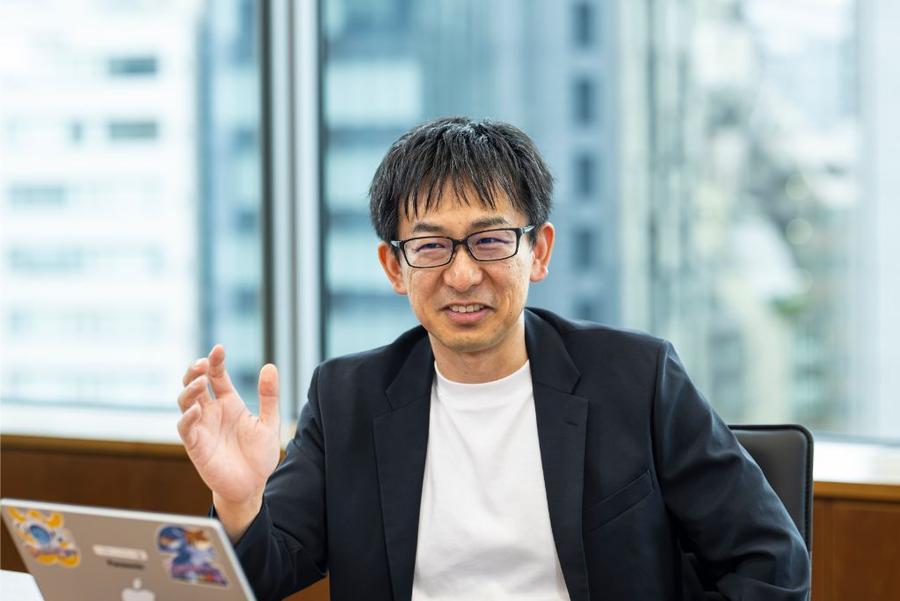
Mr. Hisanori Tahara, Manager, System Development Group, Business Architect Center, Marketing Division, Panasonic Electric Works Co., Ltd.


What are your expectations for uSonar and LBC?

Tahara

Now that we have successfully organized our master data, we believe the possibilities for AI utilization are expanding, such as summarizing transaction statuses and project details, and verifying consistency with sales proposals. We look forward to uSonar further enhancing the quality of LBC data and evolving its data provision and integration capabilities with a focus on AI and agent utilization.
Having an accurate customer master is the prerequisite for realizing data utilization that supports sales activities and management decision-making. We look forward to continuing our partnership in building that foundation.

Thank you very much for sharing these specific insights with us today.

About Panasonic Electric Works Co., Ltd.

Within the Panasonic Group, the company develops a wide range of businesses that support daily life and social infrastructure, including electrical construction materials, housing equipment, and energy management. It provides products and solutions to a diverse range of customers, including corporations, government agencies, and construction-related companies. The company reports consolidated net sales of 1.1606 trillion yen (fiscal year 2025) and has approximately 35,000 employees. The group consists of dozens of companies in Japan alone. The company changed to its current name on April 1, 2026.

詳しくはこちら:https://panasonic.co.jp/ew/company/

* Service and feature names mentioned are current as of the time of the interview.

Article Publication Date: September 25, 2026
Consult with uSonar

You may unsubscribe from information regarding our services and events at any time. Please review our Privacy Statement for details on our company policies: Privacy Statement.

Other Case Studies

For Urgent Inquiries, Please Call Us03-5388-7000Business Hours: 10:00 AM - 5:00 PM (Closed on Weekends and Holidays)

The Definitive Solution for Sales DX Through Data Utilization

Service Brochure

Understand uSonar in 5 Minutes

uSonar in 5 Minutes

Download Brochure