




- Data Utilization
High Data Quality Is Essential for Streamlining Corporate Activities Using AI
Use Cases by Objective
New Approach Lists
Group Strategy

Digital
Marketing

Client Information Registration

Data Cleansing
Corporate Attribute Analysis

SFA/MA Activation

Business Card Data Integration

Credit and Client Screening

Use Cases by Department
Sales Department

Inside Sales
Department

Marketing &
Corporate Planning Department

IT Department

Administrative Department

Use Cases by Tool
Meeting Sonar
Last Updated: February 14, 2025
Click Here to Learn More About Data Utilization ▶
What Is the Method of Data Cleansing
Utilizing External Data?
In the digital age, the data held by companies is vast and diversified. However, because this data is dispersed across different systems and locations, a significant challenge lies in effectively utilizing it. One approach to resolving this situation is Data Federation.
In this article, we explain what Data Federation is, its business benefits, its challenges, and the implementation process.
Recommended Articles
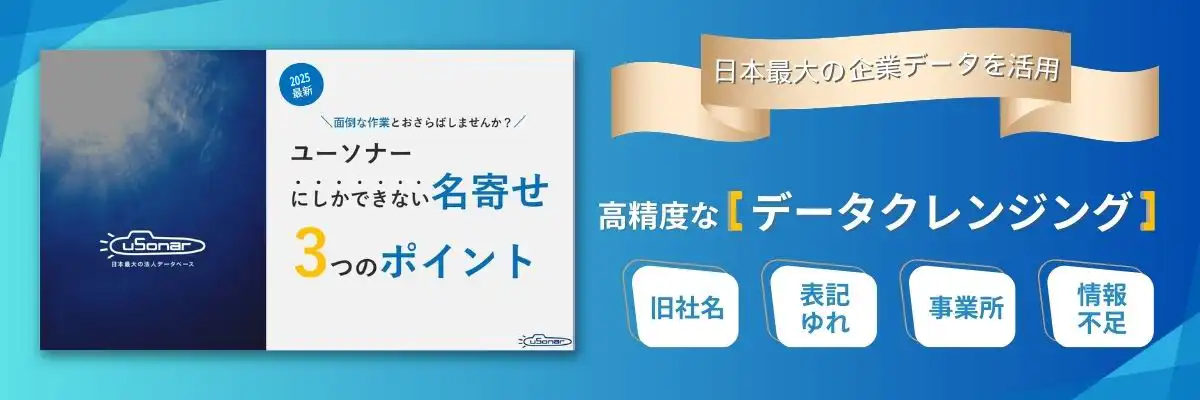
Data Federation refers to a technology or methodology that enables the use of data by providing a virtual environment where data can be viewed under common usage rules, without integrating data stored in different systems or in different locations within the same system. A key feature is the ability to access various data sources while they remain distributed, without the need to centralize them, allowing them to be treated as if they were integrated.
An example of Data Federation is visualizing information stored in CRMs, ERPs, and data lakes through a unified dashboard while keeping the data in its original location.
By utilizing Data Federation, you can achieve the following business benefits:
Data Federation enables the acquisition of the latest information in near real-time. For example, creating a unified viewing environment for sales data across different regions helps in instantly grasping sales trends.
While centralizing data requires extensive migration work, Data Federation eliminates the need for such tasks, thereby reducing the system resources and time costs involved.
Data federation enables data integration while utilizing existing storage and applications, allowing you to realize new data utilization methods while minimizing the impact on your current systems.
With data federation, data is utilized while remaining in its original location, enabling integration while maintaining existing security policies. Since there is no need to establish new governance rules, you can move to implementation without excessive delays.
Displaying different data sources in a unified environment promotes interdepartmental collaboration and the discovery of new business insights. For example, combining marketing data with sales data allows for effective campaign design.
While data federation offers many benefits, it also presents the following challenges.
Advanced technology is required to handle data sources stored in different formats and protocols in a unified manner. For example, there is a high level of difficulty when simultaneously handling SQL databases and unstructured data such as JSON or log data.
Because you are building an environment that requires real-time access, measures to improve processing speed are necessary when dealing with large volumes of data or insufficient network bandwidth.
When accessing multiple data sources simultaneously, it is necessary to apply appropriate security and privacy measures suitable for each specific data set.
To succeed with data federation, companies need the right tools and skilled personnel, yet many organizations currently face a shortage of these resources.
Data Federation is carried out through the following process.
Identify existing data sources such as CRM, ERP, and data lakes.
Connect data sources using APIs and connectors. Establish access permissions and authentication methods to ensure security.
Aggregate necessary data from each data source to create a unified virtual view.
Standardize data from different formats to ensure it can be utilized uniformly.
Track usage status and monitor performance and errors to drive improvements.
The following roles are required to ensure the success of Data Federation.
Responsible for formulating common rules between data sources and designing connection and unification methods.
Executes data connections, transformations, and the implementation of the unified viewing environment.
Manages the establishment of authentication environments and security measures for data access.
Extracts insights based on integrated data and proposes methods for business utilization.
The roles described above are merely examples; stakeholders collaborate to define data usage requirements and participate in actual operations.
Data federation is an innovative method for companies to utilize distributed data efficiently and flexibly. However, its implementation comes with challenges. It requires appropriate technology selection, process design, and the cooperation of a team with specialized skills.
Our customer data integration solution, uSonar, achieves the integration of customer information by providing a unique code system. It enables the streamlining of the process of establishing common data usage rules, which is necessary when promoting data federation.
Furthermore, by combining our unique data, provided in conjunction with the uSonar code system, with your internal data, you can identify and correct duplicate or inaccurate information, allowing you to maintain the latest data for your target accounts. By building a unified foundation for customer information, we enable high-precision list generation through the analysis and forecasting of customer trends.
For more details, please feel free to contact us via this page.
Author

uSonar Editorial Department
MX Group Editor-in-Chief
We are the uSonar Editorial Department.
We provide information on data utilization and digital technologies useful for companies primarily engaged in B2B operations to consider the future of their business practices.
uSonar is utilized by various companies
across all industries and sectors.
ITreview Grid Award 2026 Summer
Leader in 6 Categories
With uSonar,
we will guide your company toward solving its challenges!
Case Studies and Sample Reports
Download