- Data Utilization
High Data Quality Is Essential for Streamlining Corporate Activities Using AI
Last Updated: February 14, 2025
Click Here to Learn More About Data Utilization ▶
Methods for Data Cleansing
Using External Data
In B2B business, it is common for vast amounts of data to be scattered across and outside the organization, often remaining underutilized. Data Orchestration is the key to improving this situation and transforming data into business value.
This article explains what Data Orchestration is, its benefits and challenges, and the processes and roles required to implement it.
Recommended Articles
Data orchestration is the process of centrally managing, integrating, organizing, and utilizing data that is dispersed across different systems and platforms. The most significant difference from traditional approaches is that it is a framework built on the premise of automating the collection, transformation, storage, and delivery of data.
For example, if CRM data from the sales department, advertising data from the marketing department, and ticket data from the customer support department are stored in separate systems, data orchestration automatically and continuously integrates these to create a consistent customer database.
This allows for the centralized control of the customer experience across all phases of service introduction, implementation, and improvement, which is the primary reason for adopting data orchestration to enhance data reliability and operational efficiency within an enterprise.
Implementing data orchestration for enterprise data is said to provide the following business benefits.
Because data is integrated through standardization, deduplication, and cleansing, it is possible to improve data accuracy while reducing redundant data processing and management costs, thereby optimizing resources. Furthermore, it ensures data reliability by providing all stakeholders with a common understanding based on the same data.
Data becomes available in a timely manner, supporting faster decision-making than ever before. For example, by utilizing dashboards, decision-makers can view highly real-time data, enabling the construction of a framework that responds immediately to market changes.
In marketing and customer service, it becomes possible to perform customer segmentation and provide individualized support based on integrated data. Additionally, for new business negotiations, it becomes possible to instantly identify similarities and characteristic information with existing customers, thereby comprehensively enhancing the quality of business negotiations.
While data orchestration offers many benefits, its implementation is accompanied by several challenges.
Integrating data stored across multiple systems requires addressing different formats and data structures. It is necessary to define the data that will serve as the integration key and the data items to be maintained within the integrated environment.
To ensure the accuracy and consistency of collected data, continuous cleansing and monitoring are required, which may necessitate the expenditure of human resources in addition to rule-based processing.
During the data integration process, it is essential to ensure thorough privacy protection and security measures. If your company's data utilization policy is not fully established, you will need to invest more time in building the necessary framework and systems.
Data orchestration requires the implementation of specialized tools and infrastructure, as well as engineering resources, which may result in high initial investment costs.
Data orchestration is executed through the following processes.
Identify data sources such as CRM, ERP, marketing tools, and IoT devices.
Utilize APIs and ETL tools to collect distributed data.
Standardize different formats and data structures to ensure consistency.
Convert data into formats and schemas suitable for business applications.
Store the integrated data in a data lake or data warehouse.
Provide the necessary data to BI tools and CRM systems in real time.
To ensure the success of data orchestration, the following roles are required.
Designs the overall data flow and establishes the technical foundation for generating integration keys and managing integration processes.
Responsible for data collection, transformation, and integration, as well as implementing necessary tools and scripts.
Analyzes integrated data to extract actionable business insights.
Manages internal data security policies and ensures compliance with legal regulations.
As the representative of the department utilizing the data, they lead the requirement definition for the data utilization environment and establish a feedback loop with the development team after the environment is built.
Data orchestration is a critical methodology for dramatically enhancing a company's data utilization capabilities. Success requires the selection of appropriate tools, robust process design, and the establishment of a collaborative team structure. The key to integrating dispersed data and generating valuable insights lies in building a shared understanding and common rules for integrated data. In other words, the selection of integration keys and the formulation of integration processes are essential elements for realizing effective data orchestration.
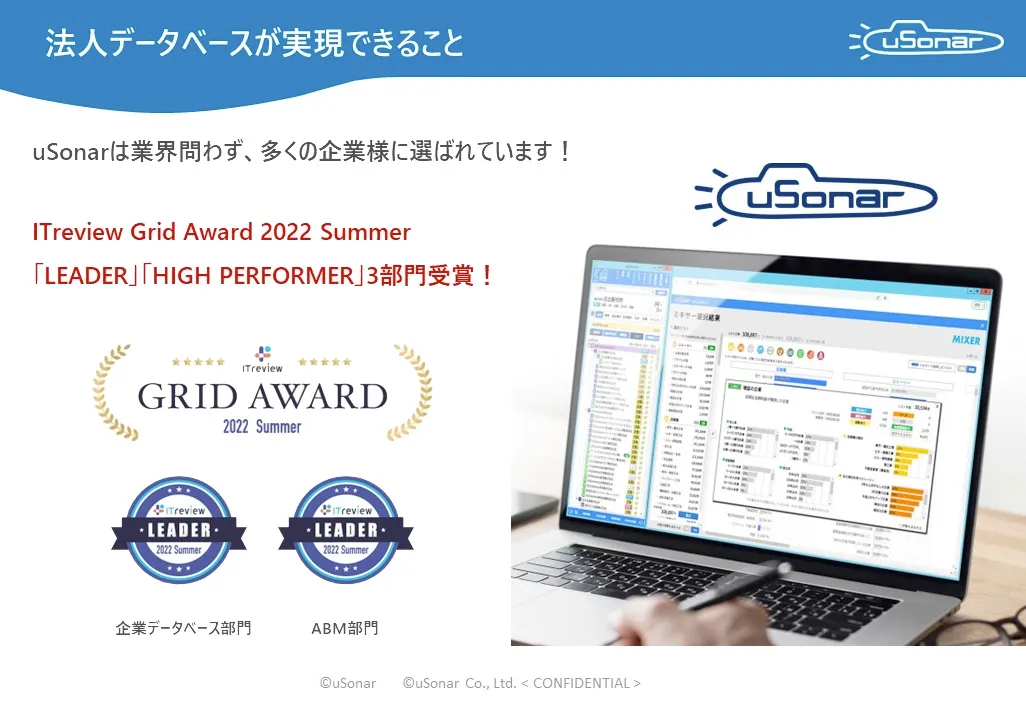
Our customer data integration solution, uSonar, enables the construction of the integrated data necessary for efficient data utilization, providing a faster and more cost-effective approach than traditional methods. By managing customer information through our proprietary LBC code system and leveraging our uniquely collected corporate data, you can continuously acquire high-precision, up-to-date external information.
For further details, please feel free to contact us via this page.
About the Author
uSonar Editorial Department
MX Group, Editor-in-Chief
We are the uSonar Editorial Department.
We provide information on data utilization and digital technologies useful for companies primarily in the B2B sector to rethink their future business operations.
uSonar is utilized by a wide range of companies across various industries and sectors.
ITreview Grid Award 2026 Summer
Leader in 6 Categories
With uSonar,
we can guide your company toward solving its challenges!
Case Studies and Sample Reports
Download