





- ABM
What Is ABM? A Comprehensive Guide to Implementation and Strategies for Success!

Use Cases by Objective
New Approach Lists

Group Strategy

Digital
Marketing

Client Information Registration

Data Cleansing

Corporate Attribute Analysis

SFA/MA Activation

Business Card Data Integration

Credit and Client Screening

Use Cases by Department
Sales Department

Inside Sales
Department

Marketing &
Corporate Planning Department

IT Department

Administrative Department

Use Cases by Tool
Meeting Sonar
Last Updated: May 23, 2024

Click Here to Learn More About ABM ▶
ABM Practice: The Complete Guide
Download the Free Ebook
Account-Based Marketing (ABM) emphasizes selecting targets at the corporate level and narrowing down priority target companies. While ABM has long been recognized for its effectiveness in streamlining corporate activities, the concept of Buying Group Marketing (BGM) has recently gained attention as a way to drive even more efficient business operations.
This article explains the origins of BGM, which is expected to deliver more comprehensive and effective results, while also discussing its features, benefits, and differences from ABM.
Recommended Articles
In ABM, by defining accounts with high potential or high added value as "priority customers to target," it is possible to achieve higher precision in targeting and personalization than with conventional marketing methods. Specifically, the following transformations have been brought to B2B marketing.
Because ABM focuses on key customers and prospects, it enables the optimization of internal resources and the formulation of highly precise communication plans. This improves the cost-effectiveness of corporate activities and enhances overall results.
ABM provides personalized messages and content tailored to the individual needs and challenges of each customer. Unlike traditional methods that apply a uniform approach to untargeted groups of companies, building relationships through approaches that respond to customer interests and requirements leads to improved customer satisfaction and sustainable revenue growth.
By combining these elements, ABM has been established as a means to achieve more effective and efficient customer acquisition and relationship building in B2B marketing.
ただしABMにも以下のような限界があり、これまでもさまざまな有識者が指摘をしてきました。Because ABM selectively targets key accounts and high-priority prospects, it may come at the expense of approaching other customer segments when resources are limited.
Since ABM emphasizes a personalized approach to customers, it is not well-suited for large-scale campaigns. Consequently, businesses requiring a large customer base may encounter challenges.
The success of ABM requires detailed customer data, yet challenges often exist regarding the quality and availability of such data. While this can be resolved by leveraging corporate databases, smaller industries or emerging companies may find themselves compelled to prepare their own data.
Despite these criticisms, it is widely acknowledged that ABM is effective in building customer relationships and improving customer satisfaction, making it one of the most important strategies in B2B marketing.
BGM has begun to be proposed as a methodology to further evolve ABM while overcoming the limitations that have been pointed out.
As the name implies, Buying Group Marketing is a B2B marketing methodology that focuses on multiple decision-makers and stakeholders. It emphasizes the importance of building relationships with customers while facilitating decision-making within the group. It is gaining attention as a cutting-edge marketing framework that enables practical and tactical approaches to engaging with potential buyers.
BGM maintains the seamless collaboration between sales and marketing teams that ABM has been valued for, while providing a better experience for every stakeholder throughout the buying journey. This creates a broader impact, streamlines corporate activities, and maximizes profitability and results.
When evaluating BGM from the perspective of how it differs from ABM, the primary distinction lies in the size of the target audience.
While ABM uses various data points to narrow down target industries and job functions to focus on specific companies or departments, BGM focuses on all members of the group involved in purchasing and decision-making. This allows for a broader impact while simultaneously clarifying the customer persona. Because individual customer personas are more refined, BGM is also said to enhance the effectiveness of personalized approaches.
There are also differences in the customer acquisition process. ABM is a strategic approach where marketing and sales teams collaborate to target specific companies, customizing activities to match the potential needs and characteristics of each target firm. BGM emphasizes a nuanced approach focused on understanding the collaborative relationships and decision-making processes of multiple stakeholders or the entire buying group within an organization.
As described, there are significant differences between ABM and BGM regarding the size of the target audience and the methods used to build consensus with customers.
The changes brought about by BGM are summarized below.
In recent years, B2B purchasing processes have shifted toward group or team-based decision-making. To increase the overall purchasing intent of customers, BGM employs approaches designed to gain support from the multiple decision-makers and influencers present within each group or team.
In BGM, customers share information internally throughout the purchasing process. Because the needs and challenges of multiple stakeholders interact with one another, more nuanced customer engagement is required.
The primary advantage of BGM is that these changes enable you to obtain valuable and specific information to align your solutions with customer challenges.
Another advantage of BGM is the ability to form broad connections across the entire account. Previously, there was a risk of losing business if a single advocate left their position; however, by securing engagement with key decision-makers, you can facilitate continuous relationship maintenance with the entire customer organization and positively impact profitability.
You do not need to force your company's strengths into a one-size-fits-all message; instead, you can conduct activities that address the diverse needs and perspectives across various customer organizations.
By providing information and value propositions to multiple decision-makers and influencers, you can more precisely lead the direction of consensus-building within the customer organization.
Through activities such as engaging with multiple stakeholders and aggregating and meeting individual expectations and needs, you demonstrate a form of leadership that deepens trust with the customer.
In summary, BGM can deliver unprecedented results as a method for building more granular, personalized marketing strategies while promoting revenue growth and customer satisfaction.
To implement BGM effectively, it is essential to understand the challenges and business requirements of individual groups and teams within the customer organization and to provide highly relevant information aligned with the stages of the buying journey.
The following are considered the generally accepted steps for implementing BGM.
Research characteristics such as industry, region, and company size to identify groups of companies interested in your products or services, and pinpoint the relevant groups or teams.
Connect with leaders and members belonging to the buying groups of target companies. For example, approach members within the buying group through event participation or networking to introduce your products or services.
Create an environment conducive to purchasing your products or services by offering special purchasing terms or incentives tailored to the needs of individual groups or teams.
Gain trust by providing value tailored to members of the buying group, such as sharing market research results or offering highly relevant white papers.
It is also important to include necessary training and support for each group or team in your proposal.
Even after your company's products or services are implemented, maintaining regular communication with members of the customer's buying group and providing excellent customer service and ongoing support allows you to continuously understand the needs of individual groups and teams, enabling you to make new proposals.
To implement BGM effectively, companies must first gain a deeper understanding of their target audience. This requires sharing more specific data internally and developing meticulous pipeline plans.
そのためには、自社の販売プロセスのフェーズごとにBGMを導入するという考え方があります。Focus on increasing awareness and understanding the needs of target accounts.
Examples include utilizing social media advertising and using landing pages to attract potential customers.
Exchange the information necessary to effectively engage the buying group. Collect the information required to advance your company's negotiations favorably against competitors and provide the information needed by members within the buying group.
Emphasize to members of the buying group that you can address the pain points of each group and team, and present compelling content to facilitate conversations that lead to closing the deal.
Formulating marketing and sales alignment plans at a level that allows for practical implementation in the field, rather than just strategic planning, leads to higher BGM success rates and increased efficiency in customer acquisition.
The Forrester Buying Groups Manifesto begins by stating that "B2B buyers are buying groups." This concept has become firmly established as the business environment has evolved.
Furthermore, according to a Gartner report, the average B2B buying group consists of five to 11 people, with 66% of purchases involving six or more individuals.
To achieve BGM, marketing and sales teams must understand the needs of the entire buying group rather than individual buyers. Formulating a marketing strategy that focuses too heavily on individual leads may result in a failure to detect the needs expressed by other members of the buying group involved in the subsequent sales process, potentially leading to lost opportunities and reduced sales efficiency. By shifting to an approach that focuses on the entire buying group, you can achieve more effective collaboration between marketing and sales.
With the advancement of digital technology, tools and platforms for implementing BGM have been developed, making it possible to efficiently target buying groups and multiple decision-makers.
Our customer data integration solution, "uSonar," includes a vast corporate database that allows you to visualize not only attribute information at the company and office level but also rising market needs and the areas in which companies are increasing their investments. By integrating uSonar data with CRM and SFA tools, many of our clients use it to identify buying groups and formulate actions that lead to stronger customer engagement.
uSonar enables the construction of a customer-centric analysis environment and the streamlining of sales and marketing strategy development, all based on a single integrated database.
For more details, please feel free to contact us via this page.
Author of This Article

uSonar Editorial Department
MX Group, Editor-in-Chief
We are the uSonar Editorial Department.
We provide information on data utilization and digital technologies useful for companies primarily engaged in B2B operations to rethink their future business practices.
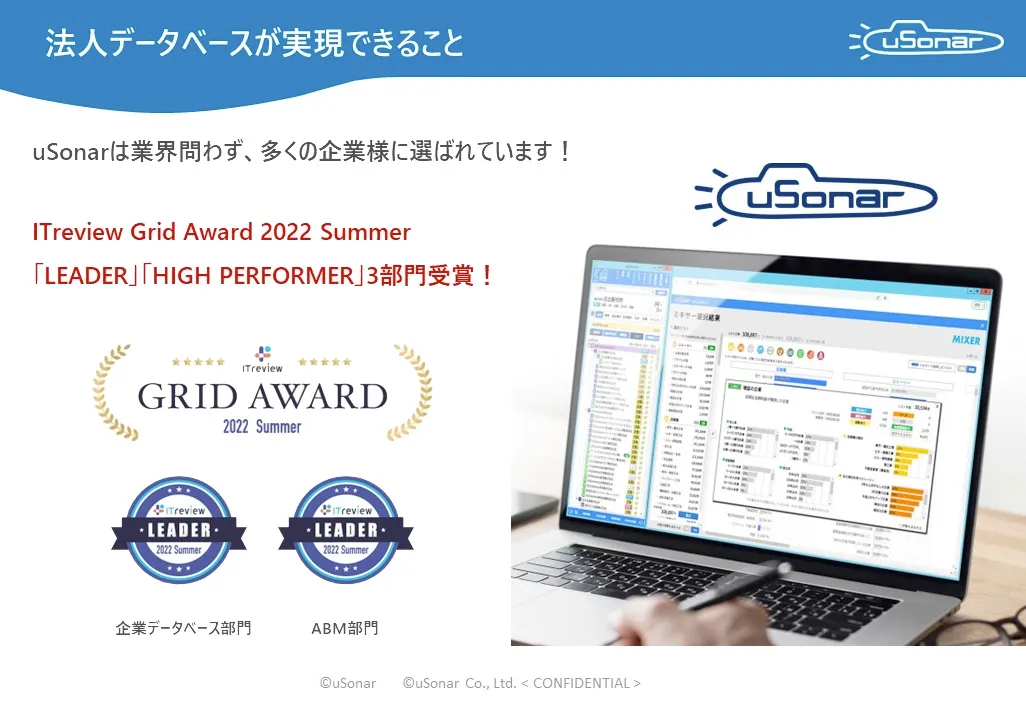
uSonar is utilized by various companies
across all industries and sectors.
ITreview Grid Award 2026 Summer
Leader in 6 Categories

With uSonar,
we can help solve your company's challenges!
Case Studies and Sample Reports
Available for Download