- Market Analysis
Calculating TAM with AI-Driven Approaches

Updated: September 21, 2023
Industry research is a critical task within a company's marketing activities. Conducting thorough industry research is essential for the strategic processes involved in planning marketing initiatives, as well as for determining specific budgets and target metrics in corporate planning. This article explains the methods and key points of industry research, as well as important factors for generating effective strategies.
Table of Contents
1Premise: The Role of Industry Research in Marketing Strategy
2Methods for Conducting Industry Research
2-1Researching via the Internet
2-2Visiting Various Booths at Trade Shows
2-3Subscribing to Industry Newspapers and Trade Journals
2-4Outsource to a Specialized Firm
3Key Points for Industry Research
3-2Gather Extensive Information
3-3Ensure Accuracy of Collected Information
3-4Convert Collected Information into Data for Analysis
5Why uSonar Is Ideal for Specific Corporate Research
6-1Effective Industry Research Leads to Increased Corporate Sales
Recommended Articles

Before explaining industry research, let us align on the definition used in this blog. Marketing generally proceeds in three stages: 1) Environmental analysis, 2) Strategy design based on that analysis, and 3) Execution of specific tactics and measures. Industry research falls under environmental analysis. A representative method for environmental analysis is the 3C framework, which involves analyzing the market, competitors, and the company itself. Within this, industry research corresponds to the "market" component.
In other words, industry research can be defined as grasping the market conditions and trends of a specific industry, with the premise of comparing this information against data on competitors and one's own company.
So, what methods are available for conducting industry research, or in other words, for grasping the current market conditions and trends of a specific industry? Here are a few examples.
One method is to conduct keyword searches using search engines such as Google.
If you want to gain comprehensive information, the quickest method is to search for industry associations within your target sector. By performing a Google search for "[Industry Name] Industry Association," you will likely find several representative organizations for major industries. On the websites of these associations, focus on checking the latest news, market size, and employment statistics. Since these sites contain vast amounts of information, much of which may be irrelevant to market trends, it is important to narrow your focus to conduct your research efficiently.
If you want to determine market size, you can search using terms such as "[Industry Name] Market Size Trends." This method may yield multiple, differing figures; however, you should prioritize government statistics whenever possible. Being able to state, "We are referencing this reliable source," is the key to enhancing the credibility of your industry research.
Trade shows are venues where industry stakeholders gather in one place. Each booth showcases the latest technologies, new products, and services, allowing you to conduct industry research on-site. By gaining insights into the strategies and product lineups of various companies, you can identify your own company's strengths and points of differentiation. Furthermore, since you can see services that are difficult to understand through online information alone, you can directly verify physical qualities, sizes, and specific functions, enabling you to gather detailed information.
To conduct effective industry research at a trade show, it is crucial to gather information about the exhibiting companies in advance. Thorough preparation is necessary to ensure you can conduct your research efficiently within a limited timeframe.
Another method for conducting industry research is to subscribe to industry newspapers and trade journals to stay informed about the latest topics and trends. By obtaining information on key industry players, competitor activities, and new product releases, you can develop effective marketing strategies. This also allows you to stay updated on industry developments, ensuring you do not miss critical information. Depending on your needs, you can choose between print editions or online subscriptions.
You may also choose to outsource your industry research to a specialized firm. By engaging a company with extensive research experience and professional expertise, you can reduce the operational burden and time costs associated with industry research. Since each firm has different areas of expertise, it is important to verify in advance whether a firm aligns with your specific objectives and requirements. You must also account for the associated costs to ensure you can obtain the necessary information within your budget. Additionally, there is a risk that outsourcing may not yield the expected results. It is important to balance outsourcing with internal research efforts and utilize these services strategically based on your specific situation.
We introduce key points for obtaining comprehensive results in industry research.
When conducting industry research, it is important not only to collect information on a specific industry but also to examine market size and fluctuations, as well as to grasp market trends. By performing such market research, you can analyze the demand and competitive landscape for specific products and services within that industry. Understanding the current state of the industry leads to identifying which market segmentations are most attractive.
A fundamental prerequisite for industry research is having access to a wealth of information. Having abundant data—such as market statistics, competitor information, the latest trends, and insights that allow for the prediction of future market directions—leads to the development of precise strategies. Furthermore, since it is necessary to formulate and examine hypotheses based on the collected information, you must maintain a broad perspective by cross-referencing multiple data points and utilizing various information sources.
When conducting industry research, it is essential to avoid relying solely on subjectivity or speculation. You must exercise caution to ensure the reliability of information, verify sources, and avoid biased data. It is important to exclude information based on subjective opinions or conjectures and to conduct research based on highly reliable data. Additionally, be aware of outdated information; you must conduct research using media that is constantly updated with the latest information.
Industry research cannot be effectively utilized for marketing activities if it ends with mere information gathering. To thoroughly analyze the information you have collected, it is essential to convert it into data, such as by organizing it into a format that is easily accessible to the entire team. By establishing a system that allows for internal sharing, you can develop strategies more efficiently.
While industry research is essential for understanding overall trends and market conditions, a significant challenge lies in the difficulty of implementing appropriate strategies without a deep understanding of the unique characteristics and strengths of individual companies within the same sector. Often, detailed information about specific companies is not publicly available, even though each firm targets different markets and customer segments. To conduct effective industry research and execute successful strategies, it is crucial to identify the unique elements of each company, develop strategies that differentiate them from competitors based on those characteristics, secure a competitive position in the market, and deploy initiatives that maximize one's own strengths. To understand the characteristics of individual companies, it is necessary to perform internal analysis of the companies themselves. Furthermore, in emerging markets or specialized fields, information sources may be limited, which can hinder the progress of industry research.
However, comprehensively researching companies within a specific industry is surprisingly difficult. In particular, to gain a comprehensive understanding that includes mid-sized and small-to-medium enterprises, you may need to scrutinize vast information sources or even consider purchasing data from multiple sources.
Our customer data integration solution, uSonar, is equipped with a corporate database that covers almost all business locations in Japan, allowing you to list all constituent companies. Since industry information is also provided, you can freely filter by specific sectors. Over 100 information items will help you achieve results that go beyond simple industry research.
After conducting industry research, let us verify the information of specific companies.
By conducting industry research and advancing appropriate measures, you can improve your company's products and services, which in turn leads to higher customer satisfaction. Increasing customer satisfaction is a vital element for boosting corporate revenue. By utilizing a corporate database to visualize the characteristics of each company, you should go beyond simple information gathering on industry trends and market movements; instead, conduct industry research that incorporates thorough internal analysis.
About the Author

uSonar Editorial Department
MX Group, Editor-in-Chief
This is the uSonar Editorial Department.
We provide information on data utilization and digital technology useful for considering future business operations, primarily for companies engaged in B2B business.
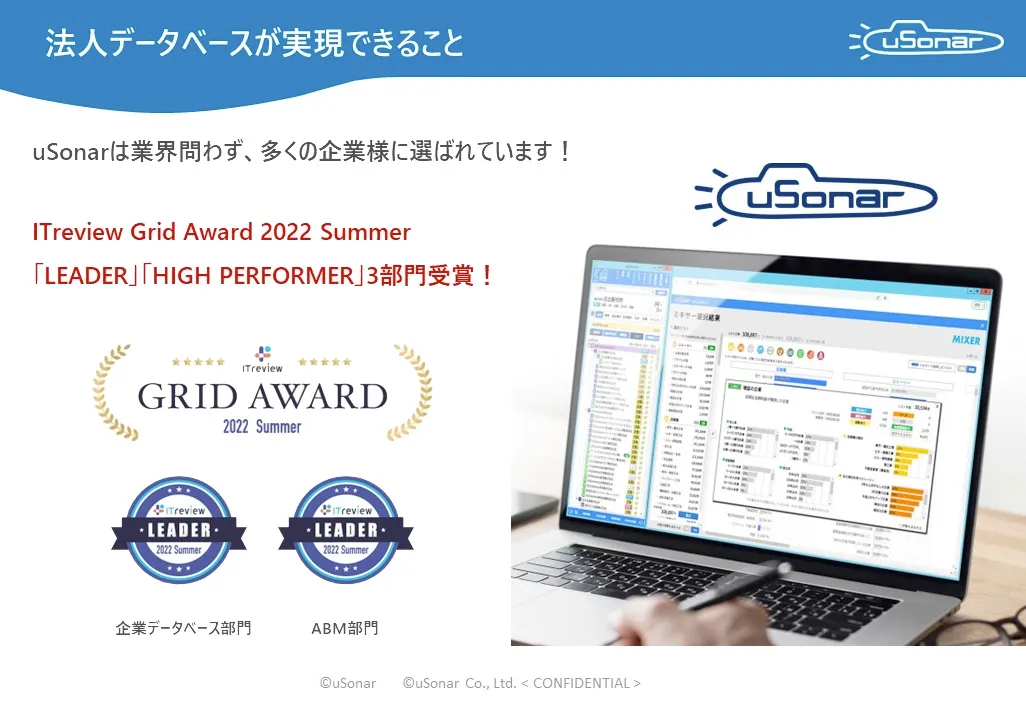
uSonar is utilized by a wide range of companies across various industries and sectors.
ITreview Grid Award 2026 Summer
Leader in 6 Categories

With uSonar,
we can guide your company toward solving its challenges!
Case Studies and Sample Reports
Download