





- CRM/SFA/MA
What Can SFA Do? An Explanation of 5 Essential Functions (With Case Studies)

Use Cases by Objective
New Approach Lists

Group Strategy

Digital
Marketing

Client Information Registration

Data Cleansing
Corporate Attribute Analysis

SFA/MA Activation

Business Card Data Integration

Credit and Client Screening

Use Cases by Department
Sales Department

Inside Sales
Department

Marketing &
Corporate Planning Department

IT Department

Administrative Department

Use Cases by Tool
Meeting Sonar
Last Updated: May 30, 2024
Click Here to Learn More About SFA/CRM ▶
How to Increase Your Order Win Rate
by 1.5x Using Salesforce?
While there are various CRM and SFA tools available domestically and internationally for customer and opportunity management, the Sales Cloud (hereinafter referred to as Sales Cloud), a sales force automation (SFA) tool provided by Salesforce, holds the largest market share globally.
However, you may be wondering what features Sales Cloud offers and whether it can resolve the specific challenges your company is facing.
Therefore, this article explains the basics of Sales Cloud, its functional aspects, the benefits gained after implementation, and the costs associated with its adoption.
Table of Contents
1What Are the Features and Benefits of Sales Cloud?
1-2Costs of Implementing Sales Cloud
2Three Things You Can Achieve by Implementing Sales Cloud
2-11. Visualization and Understanding of Sales Opportunity Status
2-22. Improvement of Sales Quality
2-33. Strengthening Interdepartmental Collaboration
3Characteristics of Companies Suited for Sales Cloud Implementation
4Sales Cloud Implementation Procedures
Recommended Articles
The core features of the Sales Cloud are as follows.
|
Features |
Feature Overview |
| Management |
• Lead Management • Existing Customer Management • Opportunity Management |
|
Forecasting and Analytics |
• Sales Forecasting • Opportunity Scoring |
|
Support |
• Business Automation • Process Development • Cross-Device Functionality • Workflow and Approval System Construction |
While there are many other features, the core functionality is divided into three main areas: Management, Forecasting and Analysis, and Support.
Among the many CRM options available, Sales Cloud is a tool that emphasizes Sales Management. By optimizing your sales structure after implementation, you can increase your win rate and drive revenue growth.
Sales Cloud is positioned strictly as a Sales Management tool. While it can be used to analyze existing customers, you must utilize a corporate database to collect information for analyzing prospective customers.
Therefore, for more strategic analysis, we recommend using it in conjunction with tools that can collect corporate data and business information.
The Sales Cloud pricing structure varies based on the number of users and the specific features utilized. Below is a list of the Sales Cloud pricing plans and their corresponding features.
|
Plan |
Cost |
Number of Users |
Available Features |
| Essentials |
3,000 JPY/Month |
Up to 10 Users |
• Customer Management • Mobile Support • Reporting Features - Cross-sell and Upsell Management - Process Customization and Automation - Integration with Other Applications |
|
Professional |
9,000 JPY/Month |
- |
- Essentials Features - Sales Forecasting - Opportunity Scoring |
|
Enterprise |
18,000 JPY/Month |
- |
- Professional Features - Opportunity Scoring |
|
Unlimited |
36,000 JPY/Month |
- |
- All Features |
For details, please check the Sales Cloud pricing page.
Reference: How to Choose the Optimal Salesforce EditionBy using Sales Cloud, you can visualize and understand the status of deals both inside and outside the company.
This allows you to not only check detailed customer information while on the go, but also to understand past deal history and progress, enabling you to provide optimal proposals tailored to the customer's current situation.
Furthermore, since the deal status for each sales representative can be tracked within the organization, it is possible to prevent omissions in deal management and customer follow-ups.
The Sales Cloud allows you to accumulate past sales information and activity history. By building a knowledge base of patterns for lost and won deals, you can reference past successes and failures when approaching new customers, enabling you to refine your sales pitch and create more effective sales materials.
Furthermore, because you can view the sales pitches and prepared materials of top performers, even new sales representatives can maintain a high standard of service, leading to an improvement in the overall sales quality of the department.
Beyond improving the quality of individual sales representatives, analyzing patterns of lost and won deals enables "deal scoring." This allows for more efficient sales operations, such as focusing efforts exclusively on customers with a higher probability of conversion.
The Sales Cloud centralizes customer information, deal status, and appointment data, which helps to strengthen collaboration across departments.
Collaboration is particularly effective between the marketing department and the sales team that handles direct customer negotiations. By assigning the most appropriate sales representative—based on their track record with specific industries and business types—to leads generated through marketing efforts, you can build a sales structure with a higher win rate.
Many companies struggle with the alignment between their marketing and sales departments. By implementing the Sales Cloud, you can enhance internal collaboration, ultimately driving revenue growth as a natural extension of your customer acquisition efforts.
The characteristics of companies that are well-suited for the implementation of the Sales Cloud are as follows.
Sales Cloud is a tool that helps improve sales performance. Generally, companies facing challenges in their sales operations will experience the most significant benefits from its implementation.
Among these, companies where information is siloed across departments or branches, leading to inefficient lead handoffs, or those relying heavily on individual top salespeople, will likely see even greater results from the implementation.
Understanding the basic structure and completing service training are essential before implementing Sales Cloud. The specific implementation steps are as follows.
Salesforce provides various product demo videos to help you visualize how the products are used. First, please view the Demo Videos before considering implementation.
Once implementation is decided, apply for a 30-day free trial to input your company's specific workflows and sales information for customization.
While immediate results may not be apparent, please consider a formal contract after verifying the user experience.
After signing the formal contract, conduct training for employees to ensure the platform is adopted as an internal tool. Appointing a dedicated administrator is key to smooth operations.
A key consideration when implementing a Sales Cloud is the necessity of training to encourage proper customer data maintenance and accurate data entry by sales representatives.
Sales Cloud is fundamentally a tool for managing existing customer information; if the quality of data entry is low, it cannot lead to accurate analysis or improved sales efficiency.
Therefore, Data Consolidation and data cleansing are required to resolve data duplication and errors, and it is necessary to create manuals and conduct training to ensure accurate information is entered.
Please note that if the environment is not properly established, accurate analysis will not be possible, making it difficult to achieve the intended benefits of the implementation.
In this article, we explained the features, benefits, functions, and implementation costs of Sales Cloud, which is operated and provided by Salesforce.com. Sales Cloud boasts a top-tier market share among Sales Force Automation (SFA) tools and is highly effective for grasping the status of existing customers and business prospects.
While it is a tool that can be used to analyze existing customers and associated companies, if you wish to conduct more strategic analysis, it is necessary to integrate with corporate databases and perform data maintenance to resolve data duplication and errors.
Our customer data integration solution, uSonar, provides a comprehensive corporate database covering Japan and offers services that can be utilized for analyzing prospective customers with whom you have not yet established contact.
Furthermore, it is equipped with data consolidation and data cleansing functions, making it possible to utilize pre-maintained data for prospective customers.
You can download the service materials for uSonar for free from the page below. The materials include case studies and information on the expected benefits, so please take a look.
About the Author

uSonar Editorial Department
MX Group, Editor-in-Chief
We are the uSonar Editorial Department.
We provide information on data utilization and digital technologies useful for B2B companies to rethink their future business operations.
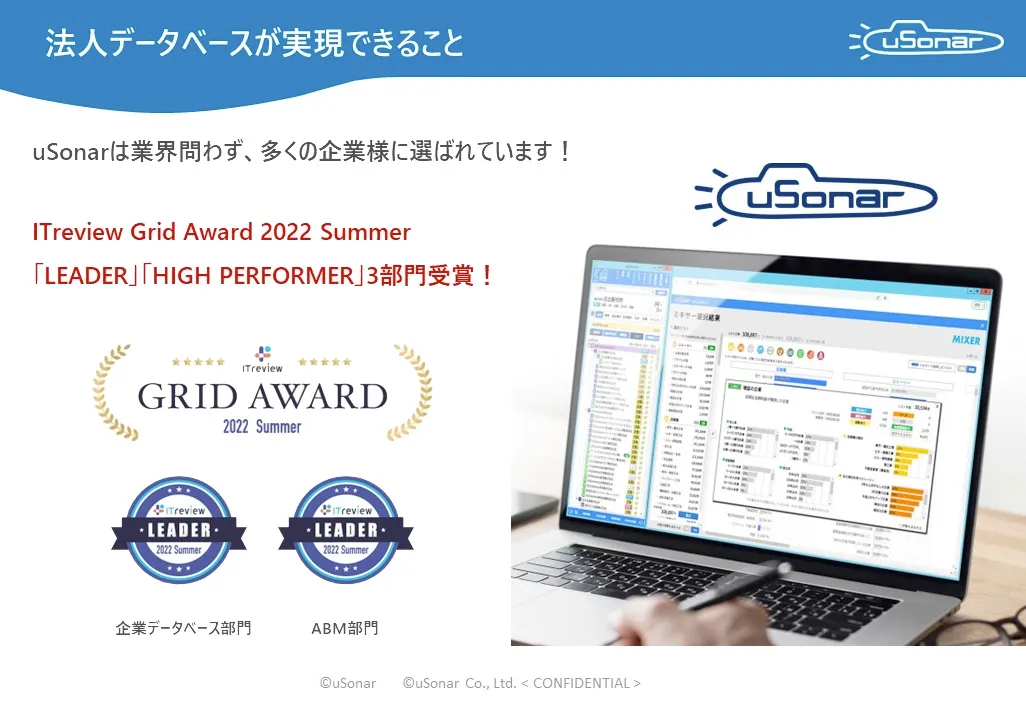
uSonar is utilized by various companies
across a wide range of industries and sectors.
ITreview Grid Award 2026 Summer
Leader in 6 Categories

uSonar Can Help Solve Your Business Challenges!
Case Studies and Sample Reports Available for
Download