- Industry Report
Construction and Engineering Industry Detailed Report | Introducing a List of Major Companies and Industry Characteristics
Last Updated: July 31, 2023
Recommended Articles
The Japanese solar power industry is a critical sector dedicated to promoting environmentally friendly and sustainable energy supply, encompassing a full range of processes from equipment manufacturing to installation, operation, and maintenance. This industry collaborates with domestic and international companies, research institutions, and government agencies to develop high-efficiency solar cells, install large-scale solar power plants, and promote the adoption of solar power systems in individual homes and businesses. Since the Fukushima Daiichi Nuclear Power Plant accident in 2011, Japan has strengthened its utilization of renewable energy. As a result, according to the Energy White Paper by the Agency for Natural Resources and Energy, the cumulative installed capacity of solar power reached approximately 64.7 GW (gigawatts) by the end of 2020. Equipment costs have been steadily declining, and the adoption of residential rooftop solar power systems is also progressing. However, the industry faces various challenges, including improving efficiency, reducing costs, and developing energy storage systems that enable a stable supply of renewable energy.
☆-☆-☆ Body End ☆-☆-☆The Japanese solar power industry is gaining attention as a safe and clean energy source, particularly as a countermeasure against natural disasters such as earthquakes and tsunamis, alongside its distinct market trends. Since the Great East Japan Earthquake in 2011, the government has strengthened the promotion of renewable energy, leading to a dramatic increase in solar power adoption. As of 2022, it is reported that power generation from new energy sources accounts for approximately 12% of Japan's total power supply, indicating a growing share of renewable energy.
On the other hand, the Japanese solar power industry faces certain challenges. For instance, there are limitations in selecting suitable sites for power plants, as vast land areas appropriate for solar power—such as those in urban areas or mountainous regions—are not always readily available. Another issue is the instability of power supply. Because solar power generation fluctuates significantly depending on weather and time of day, there is a need for combinations with other energy sources and improvements in energy storage technology.
Technological advancement is also a hallmark of the Japanese solar power industry. Many companies and research institutions are engaged in technological development to improve efficiency and reduce costs. In the Innovative Solar Power Technology Research and Development project by the New Energy and Industrial Technology Development Organization (NEDO), solar cell energy conversion efficiency has reached a world-leading 44.4%, which is an exceptionally high level by international standards. Such technological development has the potential to further promote the widespread adoption of solar power.
From a policy perspective, the Japanese government is strongly promoting the adoption of renewable energy and the reduction of carbon emissions. The government has set a goal to achieve carbon neutrality by 2050 and is planning further expansion of solar power as a key means to that end. While this policy supports the growth of the entire industry, it also brings challenges such as the development and maintenance of power generation facilities and the training of technical personnel.
Furthermore, the Japanese solar power industry is notable for the increasing number of resident-participatory regional energy projects. In these projects, local residents participate in the operation of solar power plants and return the profits generated to the local community, aiming for the democratization of energy and the sustainable development of the region. These initiatives are helping to further unlock the potential of solar power.
☆-☆-☆ Body End ☆-☆-☆The Japanese solar power industry has grown since the Great East Japan Earthquake in 2011, alongside rising public awareness regarding renewable energy. In particular, the Feed-in Tariff (FIT) scheme introduced by the government served as a major incentive, making it easier for individuals and companies to install solar power plants. Under this system, the installed capacity of solar power equipment in Japan reached approximately 64.7 GW between 2012 and 2020.
However, because the burden of the FIT scheme has been reflected in electricity rates and purchase prices have been declining year by year, new investment has become difficult. According to announcements by the Ministry of Economy, Trade and Industry, the FIT purchase price has settled between 9.5 and 16 JPY/kWh as of 2023. This is lower than the initial purchase prices and represents a significant challenge for continuing capital investment in solar power.
Japan's topography and climate also affect the market environment of the solar power industry. In particular, the mountainous terrain and rainy climate make the installation and operation of solar power systems difficult. Furthermore, as Japan is an earthquake-prone country, additional costs are sometimes required to prevent damage to equipment.
On the other hand, technological progress and cost reduction are enhancing the competitiveness of solar power. As mentioned above, the energy conversion efficiency of solar cells is improving year by year, with some research laboratories achieving conversion efficiencies exceeding 40%. Additionally, capital investment costs are decreasing. According to the Renewable Energy Institute's "Analysis of Solar Power Cost Structure in Japan 2021," capital costs for solar cells have seen a decline to around 150,000 JPY per kW, compared to 2018 when many facilities exceeded 200,000 JPY per kW. This makes the adoption of solar power more affordable and promotes its widespread use.
Finally, there are challenges regarding the stability of power supply. Solar power generation fluctuates significantly depending on weather and time of day. To address this, the introduction of power storage systems and combinations with other types of renewable energy are required. However, the cost of power storage systems remains high, and their adoption is limited. By overcoming these challenges, solar power is expected to become a more stable power supply source, and its adoption is expected to progress further.
☆-☆-☆ Body End ☆-☆-☆The following are major companies extracted from the corporate master database LBC.
| Company Name | Headquarters Address |
|---|---|
| Kuwano Solar Power Co., Ltd. | 5-1-115 Nakamaekawa-cho, Tokushima-shi, Tokushima 770-0807 |
| Solar Power Chubu Co., Ltd. | 2-45 Kamishikawa-cho, Nakamura-ku, Nagoya-shi, Aichi 453-0835 |
| Tsukuba Solar Power Co., Ltd. | Numajiri Sangyo Bldg. 202, 783-12 Enokido, Tsukuba-shi, Ibaraki 305-0853 |
| Sun of Sun Company Co., Ltd. | 326-7 Minamihanagashima-cho, Miyazaki-shi, Miyazaki 880-0055 |
| AiNERGY Co., Ltd. | 3 Aza Furuyashiki, Tomikawa, Aizumisato-machi, Onuma-gun, Fukushima 969-6214 |
| Solar Power Technology Research Association | Kikai Shinko Kaikan 2F, 3-5-8 Shibakoen, Minato-ku, Tokyo 105-0011 |
| Ako Solar Power Co., Ltd. | 2-16-1 Kyobashi, Chuo-ku, Tokyo 104-0031 |
| Nio Solar Power Co., Ltd. | 15-1 Nioshin, Nio-cho, Mitoyo-shi, Kagawa 769-1406 |
| Iitate Madeina Renewable Energy Power Generation Co., Ltd. | 58 Aza Yamadazawa, Itamizawa, Iitate-mura, Soma-gun, Fukushima 960-1803 |
| Crea Solar Co., Ltd. | 2-18-14 Marunouchi, Naka-ku, Nagoya-shi, Aichi 460-0002 |
| Ishikawa Solar Power Plant Co., Ltd. | 211 Otsumaru-machi, Kanazawa-shi, Ishikawa 920-0807 |
| Japan Photovoltaic Energy Association | Shinbashi I-N Bldg. 8F, 2-12-17 Shinbashi, Minato-ku, Tokyo 105-0004 |
| Munakata Asty Solar Power Co., Ltd. | 1-10-1 Takasago, Chuo-ku, Fukuoka-shi, Fukuoka 810-0011 |
| Solar Power Plant Network (Specified Nonprofit Corporation) | Yushima Bldg. 602, 1-9-10 Yushima, Bunkyo-ku, Tokyo 113-0034 |
| Japan Solar Power Operators Federation | 1-6-13 Kyobashi, Chuo-ku, Tokyo 104-0031 |
| Japan Solar Power Safety and Security Association | 17-2 Nihonbashi Kabuto-cho, Chuo-ku, Tokyo 103-0026 |
| Japan Solar Power After-Maintenance Association | c/o System JD Co., Ltd., 3-8-33 Momochihama, Sawara-ku, Fukuoka-shi, Fukuoka 814-0001 |
| East Japan Solar Power (LLC) | 7-22-39 Nishi-Shinjuku, Shinjuku-ku, Tokyo 160-0023 |
| Ichigo Inc. | Imperial Hotel Tower 17F, 1-1-1 Uchisaiwaicho, Chiyoda-ku, Tokyo 100-0011 |
| ITOCHU ENEX CO., LTD. | Kasumigaseki Building 27F-29F, 3-2-5 Kasumigaseki, Chiyoda-ku, Tokyo 100-6028 |
| Sinanen Holdings Co., Ltd. | Sumitomo Fudosan Mita Twin Bldg. West 6F, 3-5-27 Mita, Minato-ku, Tokyo 108-6306 |
| SANIX INCORPORATED | Sanix Hakata Bldg. 6F, 2-1-23 Hakataekihigashi, Hakata-ku, Fukuoka-shi, Fukuoka 812-0013 |
| Okamoto Co., Ltd. | Hongo Dent Bldg., 3-27-12 Hongo, Bunkyo-ku, Tokyo 113-8710 |
| NTT FACILITIES, INC. | Granpark Tower, 3-4-1 Shibaura, Minato-ku, Tokyo 108-0023 |
| SHIKIBO LTD. | Shikishima Building, 3-2-6 Bingo-machi, Chuo-ku, Osaka-shi, Osaka 541-8516 |
| Takenaka Civil Engineering & Construction Co., Ltd. | 1-1-1 Shinsuna, Koto-ku, Tokyo 136-8570 |
| NAC Co., Ltd. | Shinjuku Center Building 42F, 1-25-1 Nishi-Shinjuku, Shinjuku-ku, Tokyo 163-0675 |
| Sumitomo Densetsu Co., Ltd. | 2-1-4 Awaza, Nishi-ku, Osaka-shi, Osaka 550-8550 |
| Fuji Kosan Co., Ltd. | Kanda Plaza Bldg. 3F, 13 Kanda-Higashimatsushita-cho, Chiyoda-ku, Tokyo 101-0042 |
| SHARP CORPORATION | 1 Takumi-cho, Sakai-ku, Sakai-shi, Osaka 590-8522 |
| Nittetsu Mining Co., Ltd. | Yusen Building 6F, 2-3-2 Marunouchi, Chiyoda-ku, Tokyo 100-8377 |
| Looop Inc. | Ueno Frontier Tower 15F, 22F, 3-24-6 Ueno, Taito-ku, Tokyo 110-0005 |
| Nippon Conveyor Co., Ltd. | Kanda Mitsubishi Bldg. 5F, 3-6-3 Kanda-Kajicho, Chiyoda-ku, Tokyo 101-0045 |
| Tohnichi Kyosan Cable, Ltd. | 1-1 Arakane, Ishioka-shi, Ibaraki 315-8511 |
| Broadband Tower, Inc. | Hibiya Park Front 9F, 2-1-6 Uchisaiwaicho, Chiyoda-ku, Tokyo 100-0011 |
| Yondenko Corporation | 2-3-9 Hananomiya-cho, Takamatsu-shi, Kagawa 761-8565 |
| Sojitz Planet Corporation | Iino Building, 2-1-1 Uchisaiwaicho, Chiyoda-ku, Tokyo 100-8691 |
| Kyocera Communication Systems Co., Ltd. | Kyocera Head Office Bldg., 6 Takeda Tobadono-cho, Fushimi-ku, Kyoto-shi, Kyoto 612-8450 |
| Tokyo Energy & Systems Inc. | 1-3-1 Nihonbashi-Kayabacho, Chuo-ku, Tokyo 103-0025 |
| Keiyo Gas Co., Ltd. | 2-8-8 Ichikawaminami, Ichikawa-shi, Chiba 272-8580 |
| RENOVA, Inc. | Kyobashi Edogrand 18F, 2-2-1 Kyobashi, Chuo-ku, Tokyo 104-0031 |
| West Holdings Corporation | Marunouchi Kitaguchi Building 20F, 1-6-5 Marunouchi, Chiyoda-ku, Tokyo 100-0005 |
| Paraca Inc. | Atago Green Hills MORI Tower 9F, 2-5-1 Atago, Minato-ku, Tokyo 105-6209 |
| Inter Action Corporation | Yokohama Kanazawa High-Tech Center Bldg. 14F, 1-1 Fukuura, Kanazawa-ku, Yokohama-shi, Kanagawa 236-0004 |
| Hokkai Electrical Construction Co., Inc. | 1-8-21 Kikusui 2-jo, Shiroishi-ku, Sapporo-shi, Hokkaido 003-0802 |
| Japan Material Co., Ltd. | Sanko Bldg. 3F, 3098-22 Oaza Nagai, Komono-cho, Mie-gun, Mie 510-1311 |
| Suntech Co., Ltd. | 3-13 Nibancho, Chiyoda-ku, Tokyo 102-8440 |
| Seiwa Chuo Holdings Co., Ltd. | 3-1-20 Kujominami, Nishi-ku, Osaka-shi, Osaka 550-0025 |
| Showa Denki Sangyo Co., Ltd. | 1154 Oaza Miwa Araya, Nagano-shi, Nagano 380-0804 |
| GRIMES Co., Ltd. | Tennoz First Tower 19F, 2-2-4 Higashishinagawa, Shinagawa-ku, Tokyo 140-0002 |
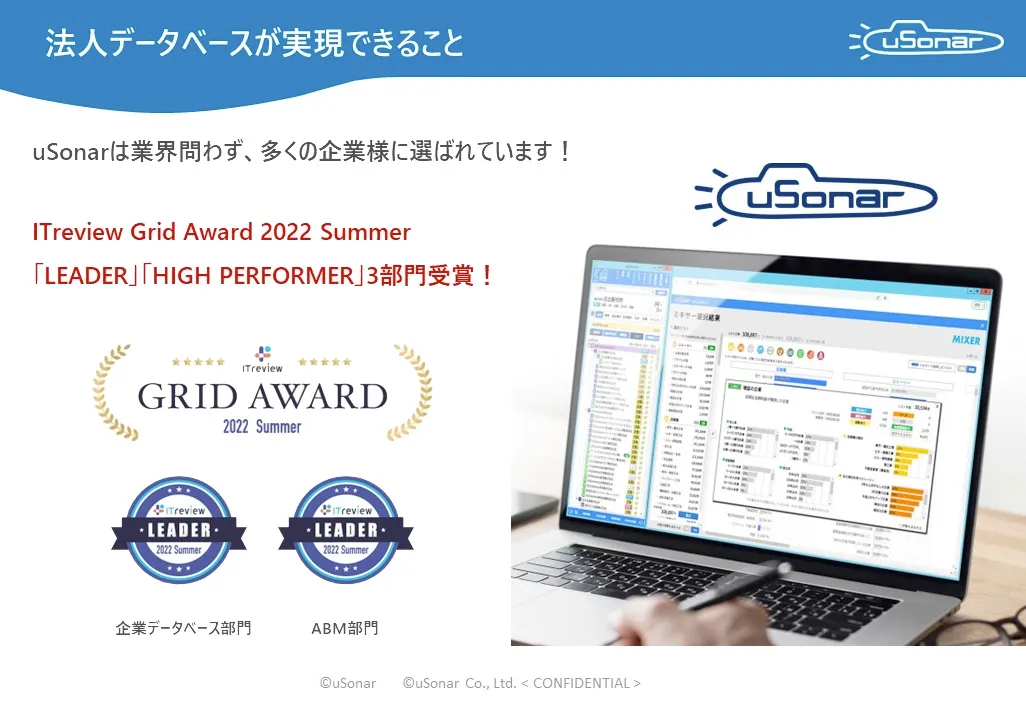
Corporate data can be collected from various sources, but collecting all of it through self-help efforts is an extremely labor-intensive task. uSonar, provided by our company, operates multiple databases in parallel to collect data from various sources on a daily basis, and we continue to update highly accurate, integrated, and enriched corporate data every day.
For more details, please contact uSonar.
Author of This Article

uSonar Editorial Department
MX Group, Editor-in-Chief
We are the uSonar Editorial Department.
We provide information on data utilization and digital technologies useful for rethinking future business operations, primarily for companies engaged in B2B business.
uSonar is utilized by various companies
across all industries and sectors.
ITreview Grid Award 2026 Summer
Leader in 6 Categories

With uSonar,
we can help solve your company's challenges!
Download Case Studies and Sample Reports