- Industry Report
Solar Power Generation Industry Detailed Report | An Overview of Major Companies and Industry Characteristics

Last Updated: July 31, 2023
Recommended Articles
The Japanese construction and engineering industry covers a wide range of sectors and plays a vital role in the nation's economic development and the strengthening of its social infrastructure. This industry handles the entire process from architectural design to construction, maintenance, and renovation, encompassing everything from large-scale infrastructure projects to small-scale residential construction. According to the Ministry of Land, Infrastructure, Transport and Tourism's report, "Current Situation Surrounding the Construction Industry," the total investment in the Japanese construction industry was estimated at approximately 58.5 trillion yen as of 2021. Furthermore, the industry employs approximately 4.85 million workers. The construction and engineering industry continues to evolve in response to natural disasters such as earthquakes and floods, as well as the impacts of population decline and urbanization. Additionally, the industry is strengthening its commitment to sustainability and environmental protection by promoting eco-efficient construction methods and the use of renewable energy.
☆-☆-☆ Body End ☆-☆-☆The Japanese construction and engineering industry provides a highly diverse range of services with a broad scope of impact. This industry handles projects ranging from small-scale renovations for homes and businesses to large-scale public infrastructure projects commissioned by national and local governments. Such projects include new building construction, the construction and maintenance of roads and bridges, urban planning, and environmental development. As mentioned above, as of 2021, the total investment in the Japanese construction industry reached approximately 58.5 trillion yen.
One characteristic of this industry is its labor-intensive nature. According to the Ministry of Health, Labour and Welfare's "Labor Statistics Handbook," the Japanese construction industry employs approximately 4.85 million workers, which accounts for about 7% of the total workforce. This figure includes workers with diverse skills and expertise, such as architects, engineers, craftsmen, and project managers.
The Japanese construction and engineering industry continues to operate consistently while addressing various domestic and international challenges. Measures against natural disasters such as earthquakes and typhoons are particularly critical issues, and the industry plays a vital role in recovery efforts and the promotion of disaster prevention measures. Additionally, with the declining population and aging society, the industry faces issues such as the maintenance and renewal of existing infrastructure and labor shortages.
Furthermore, the industry is constantly changing due to the rapid evolution of technology. New technologies such as AI, robotics, drones, and 3D printing are being introduced, contributing to the efficiency of construction processes, improved safety, and quality assurance. These technologies are utilized at every stage, including design, project management, construction, and maintenance and repair.
Finally, the Japanese construction and engineering industry places great importance on sustainability and environmental considerations. This is manifested in various ways, such as the use of eco-friendly building materials, energy-efficient design, and the utilization of renewable energy. The introduction of eco-efficient construction methods demonstrates that the entire industry is moving toward a sustainable future.
☆-☆-☆ Body End ☆-☆-☆The Japanese construction and engineering industry faces many fluctuations in the market environment. From a long-term perspective, the industry is confronted with the major challenges of population decline and advancing urbanization. Japan's total population was approximately 126 million in 2021, but it is projected to fall below 100 million by 2050. As a result, demand for housing and public facilities in rural areas is expected to decrease, while demand for high-rise buildings and complex facilities in urban areas is expected to rise.
Securing a workforce is also a major challenge. The construction industry is a labor-intensive sector that requires skilled workers, but the labor shortage is becoming increasingly serious due to the shrinking working-age population and aging demographics. In particular, the declining interest among the younger generation in pursuing careers in the construction industry is a problem, necessitating new talent acquisition strategies and improvements in productivity.
Meanwhile, natural disasters have a significant impact on the Japanese construction industry. Due to the frequent occurrence of earthquakes, typhoons, and floods, the construction industry must frequently engage in restoration work and disaster prevention measures. Consequently, technologies for disaster mitigation, design, and the construction of highly durable buildings have become critical issues.
Furthermore, the construction industry is being called upon to evolve technologically. The introduction of AI and robotics is progressing to improve safety and work efficiency at construction sites. There is also growing demand for sustainability, such as eco-friendly construction technologies and the use of renewable energy.
Finally, the Japanese construction industry is working to maintain and strengthen its international competitiveness. As demand for infrastructure grows around the world, Japanese construction companies are accelerating their overseas business expansion. Therefore, they are required to understand and adapt to overseas markets, develop new business models, and provide high-quality services.
☆-☆-☆ Body End ☆-☆-☆The following are major companies extracted from the corporate master database LBC.
| Company Name | Headquarters Address |
|---|---|
| Shimizu Corporation | 2-16-1 Kyobashi, Chuo-ku, Tokyo |
| Kajima Corporation | 1-3-1 Motoakasaka, Minato-ku, Tokyo |
| Tokyo Gas Co., Ltd. | 1-5-20 Kaigan, Minato-ku, Tokyo |
| Obayashi Corporation | Shinagawa Intercity Tower B, 2-15-2 Konan, Minato-ku, Tokyo |
| Taisei Corporation | Shinjuku Center Building, 1-25-1 Nishi-Shinjuku, Shinjuku-ku, Tokyo |
| Sekisui House, Ltd. | Umeda Sky Building Tower East, 1-1-88 Oyodonaka, Kita-ku, Osaka-shi, Osaka |
| Daiwa House Industry Co., Ltd. | Daiwa House Osaka Building, 3-3-5 Umeda, Kita-ku, Osaka-shi, Osaka |
| Osaka Gas Co., Ltd. | 4-1-2 Hiranomachi, Chuo-ku, Osaka-shi, Osaka |
| Takenaka Corporation | Mido Building 1F, 4-1-13 Honmachi, Chuo-ku, Osaka-shi, Osaka |
| Sumitomo Forestry Co., Ltd. | Keidanren Kaikan, 1-3-2 Otemachi, Chiyoda-ku, Tokyo |
| Haseko Corporation | 2-32-1 Shiba, Minato-ku, Tokyo |
| Hitachi Construction Machinery Co., Ltd. | Ueno East Tower, 2-16-1 Higashiueno, Taito-ku, Tokyo |
| ITOCHU ENEX CO., LTD. | Kasumigaseki Building 27F-29F, 3-2-5 Kasumigaseki, Chiyoda-ku, Tokyo |
| Sharp Corporation | 1 Takumi-cho, Sakai-ku, Sakai-shi, Osaka |
| MM Kenzai Corporation | Shiodome City Center 17F, 18F, 1-5-2 Higashishinbashi, Minato-ku, Tokyo |
| Tokyo Gas Network Co., Ltd. | 1-5-20 Kaigan, Minato-ku, Tokyo |
| YURTEC CORPORATION | 4-1-1 Tsutsujigaoka, Miyagino-ku, Sendai-shi, Miyagi |
| Internet Initiative Japan Inc. | Iidabashi Grand Bloom, 2-10-2 Fujimi, Chiyoda-ku, Tokyo |
| Toda Corporation | 2-8-5 Hatchobori, Chuo-ku, Tokyo |
| Sankyu Inc. | 6-5-23 Kachidoki, Chuo-ku, Tokyo |
| Sanki Engineering Co., Ltd. | St. Luke's Tower, 8-1 Akashi-cho, Chuo-ku, Tokyo |
| Daito Trust Construction Co., Ltd. | Shinagawa East One Tower 21F-24F, 2-16-1 Konan, Minato-ku, Tokyo |
| NEC Networks & System Integration Corporation | NEC Networks & System Integration Headquarters Building, 3-9-14 Shibaura, Minato-ku, Tokyo |
| KANDENKO CO., LTD. | 4-8-33 Shibaura, Minato-ku, Tokyo |
| Nishimatsu Construction Co., Ltd. | Toranomon Hills Business Tower 6F, 7F, 1-17-1 Toranomon, Minato-ku, Tokyo |
| Tama Home Co., Ltd. | Tama Home Headquarters Building, 3-22-9 Takanawa, Minato-ku, Tokyo |
| Takasago Thermal Engineering Co., Ltd. | Shinjuku Eastside Square 12F, 6-27-30 Shinjuku, Shinjuku-ku, Tokyo |
| Kumagai Gumi Co., Ltd. | 2-1 Tsukudo-cho, Shinjuku-ku, Tokyo |
| Penta-Ocean Construction Co., Ltd. | 2-2-8 Koraku, Bunkyo-ku, Tokyo |
| Nippon Densetsu Kogyo Co., Ltd. | NDK Daini Ikenohata Building, 1-2-23 Ikenohata, Taito-ku, Tokyo |
| Meidensha Corporation | ThinkPark Tower, 2-1-1 Osaki, Shinagawa-ku, Tokyo |
| EXEO Group, Inc. | 3-29-20 Shibuya, Shibuya-ku, Tokyo |
| SECOM CO., LTD. | 1-5-1 Jingumae, Shibuya-ku, Tokyo |
| AMADA CO., LTD. | 200 Ishida, Isehara-shi, Kanagawa |
| AMADA CO., LTD. | 200 Ishida, Isehara-shi, Kanagawa |
| Token Corporation | Token Headquarters Marunouchi Building, 2-1-33 Marunouchi, Naka-ku, Nagoya-shi, Aichi |
| TOENEC CORPORATION | 1-20-31 Sakae, Naka-ku, Nagoya-shi, Aichi |
| Rinnai Corporation | 2-26 Fukuzumi-cho, Nakagawa-ku, Nagoya-shi, Aichi |
| Joshin Denki Co., Ltd. | 1-6-5 Nipponbashinishi, Naniwa-ku, Osaka-shi, Osaka |
| Okumura Corporation | 2-2-2 Matsuzakicho, Abeno-ku, Osaka-shi, Osaka |
| Kinden Corporation | 2-3-41 Honjohigashi, Kita-ku, Osaka-shi, Osaka |
| Sekisui Chemical Co., Ltd. | Dojima Kanden Building, 2-4-4 Nishitenma, Kita-ku, Osaka-shi, Osaka |
| GLORY LTD. | 1-3-1 Shimoteno, Himeji-shi, Hyogo |
| Chudenko Corporation | Chudenko Heiwa Odori Building, 6-12 Koami-cho, Naka-ku, Hiroshima-shi, Hiroshima |
| Kyudenko Corporation | Kyudenko Headquarters Building, 1-23-35 Nanokawa, Minami-ku, Fukuoka-shi, Fukuoka |
| Tekken Corporation | 2-5-3 Kandamisakicho, Chiyoda-ku, Tokyo |
| Toyo Construction Co., Ltd. | Jimbocho Mitsui Building 11F, 1-105 Kanda Jimbocho, Chiyoda-ku, Tokyo |
| Taihei Dengyo Kaisha, Ltd. | Taihei Dengyo Building, 2-4 Kanda Jimbocho, Chiyoda-ku, Tokyo |
| METAWATER Co., Ltd. | JR Kanda Manseibashi Building, 1-25 Kanda Sudacho, Chiyoda-ku, Tokyo |
| Sanwa Technos Corporation | Tokyo Square Garden 18F, 3-1-1 Kyobashi, Chuo-ku, Tokyo |
Data related to companies can be collected from various sources, but it can be said that collecting all of it through self-help efforts is a very labor-intensive task. uSonar, which our company provides, operates multiple databases in parallel to collect data from various sources on a daily basis, and we continue to update highly accurate, integrated, and enriched corporate data every day.
For more details, please contact uSonar.
Author of this article

uSonar Editorial Department
MX Group, Editor-in-Chief
We are the uSonar Editorial Department.
We provide information on data utilization and digital technologies useful for rethinking future business operations, primarily for companies engaged in B2B business.
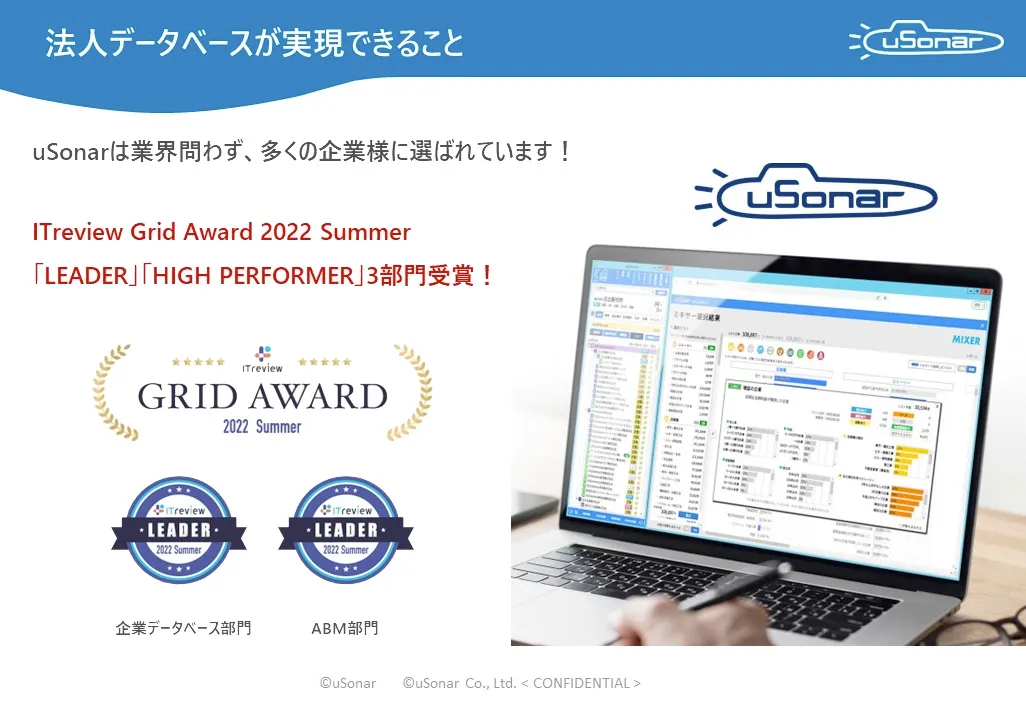
uSonar is utilized by various companies
across all industries and sectors.
ITreview Grid Award 2026 Summer
Leader in 6 Categories

With uSonar,
we can help solve your company's challenges!
Download Case Studies and Sample Reports