- Data Matching and Data Cleansing
2026 Edition: How to Perform Data Cleansing? Methods, Procedures, and Key Considerations

Updated: March 27, 2024

Click Here to Learn More About Data Consolidation and Data Cleansing ▶
Achieve High-Precision Data Maintenance
Through "Establishment-Level" Cleansing
To efficiently utilize vast amounts of accumulated data, performing data cleansing is essential. Using data that contains inconsistencies or errors can reduce the accuracy of data analysis and potentially have a significant impact on decision-making for marketing and sales initiatives. By performing data cleansing regularly, you can build a more reliable database.
In this article, we explain the objectives, concrete examples, benefits, and implementation steps of data cleansing.
We hope you find this information helpful.
Table of Contents
1-1Differences Between Data Cleaning and Data Consolidation
3Concrete Examples of Data Cleansing
4-11. Improvement in Productivity
4-22. Improvement in Data Analysis Accuracy
4-33. Improvement in Decision-Making Capabilities
5How to Proceed with Data Cleansing
5-11. Select and Collect Essential Data
5-44. Standardize Processes and Perform Regular Data Cleansing
Recommended Articles
Data cleansing is the process of organizing various data within a database and optimizing it to ensure it can be utilized effectively without issues. Specifically, it involves identifying and correcting inaccurate or irrelevant data, such as input errors, misplacements, or missing values.
Data that has not undergone data cleansing may not appear in search results or may contain inaccurate information, which can negatively impact a wide range of business operations, not just sales activities. Therefore, data cleansing is a critical process in data management and a measure that leads to the enhancement of data value.
There are terms similar to data cleansing, such as "data cleaning" and "deduplication." First, "data cleaning" is essentially a synonym for data cleansing, and it is safe to treat them as virtually identical.
On the other hand, "deduplication" refers to the process of removing duplicate entries from a list of data and consolidating them into a single record. While it is sometimes used interchangeably with data cleansing, in many cases, data cleansing focuses primarily on correcting data, whereas deduplication focuses on organizing or deleting duplicate data.

The purpose of data cleansing is to ensure the quality of a customer database, thereby improving the accuracy of data analysis and enhancing the precision of decision-making in marketing and sales initiatives. The goal is not merely to maintain a clean database, but to create a database that is "usable" for the analysis required to make strategic decisions.
However, in data utilization, challenges such as "inconsistent data types and formats" or "missing information due to incomplete data entry" are common. Such inaccurate and inconsistent data has low reliability and can negatively affect decision-making. Low-reliability data is also known as "dirty data," which can lead to increased labor and costs, or in the worst-case scenario, the loss of customer trust. Data cleansing is a vital measure to avoid these risks.
Let us look at examples of data that actually require cleansing.
The image below shows basic information in a customer database, such as company names, contact names, addresses, and phone numbers.
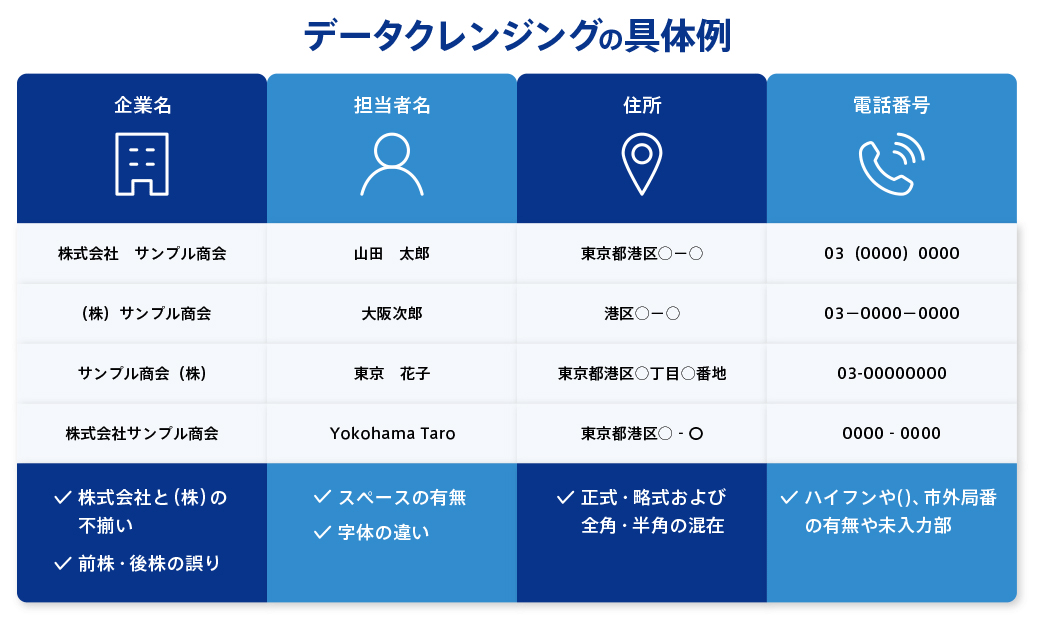
As shown here, differences in notation and formatting can cause the same information to be identified as separate data, resulting in a database that is difficult to use for analysis.
Notation discrepancies occur due to the following four causes:
1. Inconsistency between "Kabushiki Kaisha" and "(KK)" or errors in the placement of the company type (prefix vs. suffix).
2. Differences in the presence of spaces or character styles.
3. A mixture of formal and abbreviated forms, as well as full-width and half-width characters.
4. The presence or absence of hyphens, parentheses, area codes, or missing fields.
These types of data issues often arise when multiple sales or marketing staff enter data without unified input rules. The role of data cleansing is to correct these inconsistencies and errors to improve data integrity and accuracy.
What benefits can be gained from performing data cleansing? Here, we explain four representative benefits.
The first benefit is improved productivity.
By optimizing data through data cleansing, you can expect productivity gains not only within a specific department but across the entire company. Conversely, if data is flawed, it becomes difficult to extract necessary information, and corrections must be made every time an error is discovered.
By organizing data in advance through data cleansing, there is no need to make corrections on a case-by-case basis during business operations. Reducing unnecessary tasks allows employees to focus on core activities, increasing productivity within the same working hours. Additionally, employees can work more comfortably without the stress of redundant tasks, which also improves job satisfaction. Consequently, this leads to overall improvements in corporate productivity.
The second benefit is improved data analysis accuracy.
High-precision data analysis relies heavily on the consistency and accuracy of the underlying data. To conduct marketing using customer data, high-precision analysis is essential. By correcting missing or erroneous information and standardizing data formats through data cleansing, more accurate data analysis becomes possible. Performing this regularly enables highly effective marketing initiatives, such as identifying profitable customers.
Furthermore, data cleansing provides benefits when measuring the effectiveness of marketing results. If you wish to perform high-precision data analysis using your company's data, it is also important to foster a shared understanding within the company that data cleansing is a critical measure.
The third benefit is enhanced decision-making capability.
The quality of your company's data influences sound decision-making and the formulation of effective marketing strategies. For example, if referenced data contains errors, missing parts, or outdated information that has not been corrected, it may lead to incorrect decisions or strategies. If left unaddressed, you may realize the information was incorrect only after significant time and effort have been lost. Even without errors, data loses its freshness over time, and its quality declines.
Accurate information is essential for seamless data utilization. Perform data cleansing regularly to maintain the accuracy required for effective decision-making.
Finally, data cleansing is also effective for cost reduction.
First, by consolidating inconsistent data formats through data cleansing, data extraction becomes easier. As a result, there is no need to use expensive tools for data extraction.
Furthermore, you can avoid wasteful sales activities based on old or incorrect data, saving the costs that would have been incurred. Additionally, by deleting unnecessary data, you can reduce server maintenance costs. Moreover, by reducing redundant tasks and improving work efficiency through data cleansing, you can curb unnecessary labor costs, such as overtime pay, among many other benefits.
The process of data cleansing varies from company to company. Here, we briefly explain the general steps.
For more detailed information, please refer to the article below.
The first step in data cleansing is to select the data domain and collect important data from it. Collect only the necessary data from various file formats, such as CSV or XML, and consolidate them into a single database. By consolidating, you may discover relationships between data that were previously invisible.
The key to selecting and collecting important data is to define the scope of the data to be collected in advance. Collecting irrelevant or outdated data that has not been updated is meaningless. Conversely, it may lead to unnecessary work, so defining the scope allows for a smoother transition to data cleansing.
Before moving to the actual cleansing, organize the data and delete unnecessary parts. This process is sometimes called "deduplication" and is considered part of data cleansing. Unnecessary parts mainly refer to duplicate data.
Next is the correction and repair of data, which is a critical item in data cleansing. This involves correcting and standardizing erroneous data, full-width/half-width characters, adding missing data, and updating old information. It is also important to create a system that makes it easier to manage data collected in the future. It is advisable to review data entry methods and create a manual for data collection and entry so that consistency is maintained regardless of who enters the data.
Data that has been unified through cleansing can be utilized as lists for marketing activities and customer support. The task is to extract and list the data based on specific rules.
This task is a post-cleansing data processing step, and the method of organization changes depending on the purpose of data utilization and the type of data. Define rules with future use in mind and reorganize accordingly.
Data cleansing is not a one-time task. By performing regular cleansing when data increases or when launching new businesses, you can maintain high-precision data.
On the other hand, performing cleansing using different methods each time can negatively affect the data. To avoid this, it is important to standardize the process. Specifically, it is recommended to determine the timing of implementation and the person in charge, and to create a manual. By standardizing the process and sharing it across the company, you can perform data cleansing efficiently.
Data cleansing is an essential process for organizing, managing, and effectively utilizing corporate data. By implementing it, you enable high-precision data analysis, which further enhances the effectiveness of data utilization in business, such as in decision-making and the formulation of marketing strategies.
Furthermore, it offers benefits such as improved productivity, cost reduction, and an enhanced decision-making environment. If you are facing challenges regarding the accuracy of your internal data or operational efficiency, implementing data cleansing is highly effective.
While the approach to cleansing may vary depending on the industry and business model, the general workflow involves selecting the data domain, followed by collection, correction, and organization. By standardizing and regularly performing the data cleansing process, you can maintain greater data reliability and consistency.
About the Author

uSonar Editorial Department
MX Group, Editor-in-Chief
We are the uSonar Editorial Department.
We provide information on data utilization and digital technologies useful for considering future business operations, primarily for companies engaged in B2B business.
uSonar is utilized by
various companies across all industries and sectors.
ITreview Grid Award 2026 Summer
Leader in 6 Categories

With uSonar,
we can help solve your company's challenges!
Case Studies and Sample Reports
Download