





- Inside Sales
- Intent Data
- Seminar Report
- Digital Marketing
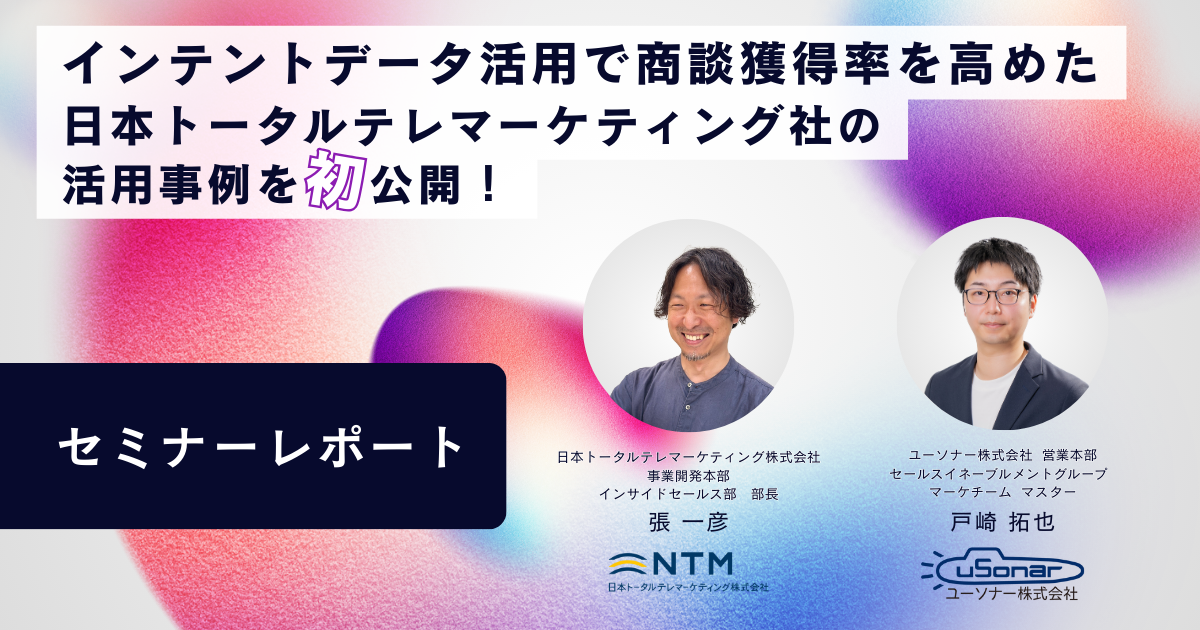
Increase Appointment Rates by Over 2.5x Using Intent Data!
Seminar Report: "The Latest Approaches to B2B Sales and Inside Sales"
Use Cases by Objective
New Approach Lists
Group Strategy

Digital
Marketing

Client Information Registration

Data Cleansing
Corporate Attribute Analysis

SFA/MA Activation

Business Card Data Integration

Credit and Client Screening

Use Cases by Department
Sales Department

Inside Sales
Department

Marketing &
Corporate Planning Department

IT Department

Administrative Department

Use Cases by Tool
Meeting Sonar
Last Updated: February 18, 2026

Hello. This is Inatomi from the Marketing Department at uSonar Co., Ltd.!
In this post, we are sharing a report from the seminar held on January 21, 2026.
During this seminar, uSonar Co., Ltd. and NEC VALWAY Ltd. presented their insights on how to utilize intent data in B2B sales and provided practical tips for its implementation.
We provide specific guidance for inside sales and marketing professionals on how to adapt to the rapidly changing customer purchasing behaviors seen in recent years.
Recommended Articles
Increase Appointment Rates by Over 2.5x Using Intent Data!
Seminar Report: "The Latest Approaches to B2B Sales and Inside Sales"
What Is Intent Marketing? Explaining Why B2B Companies Should Implement It and the Associated Challenges

NEC VALWAY, Ltd.
General Manager, Sales & Marketing Solutions Department 2, Second Business Operations Division
Shigehiro Uehara
Managed up to 11 simultaneous projects as a shared call center administrator, accumulating expertise in maintaining quality and productivity.
Since 2012, he has handled over 500 inside sales support projects. Currently, he is responsible for NEC Group's inside sales, SFA/MA implementation support, and operational consulting. He also serves as the head of digital marketing operations services.

uSonar Co., Ltd.
Executive Officer, DX Group, Sales Division
Masafumi Yuasa
Joined uSonar Co., Ltd. in 2005. For over 20 years, he has been engaged in solving various business challenges through corporate sales.
He also speaks at various seminars and events on the key points of building, maintaining, and utilizing customer databases, which serve as the foundation for B2B marketing. Appointed as Executive Officer of the DX Group, Sales Division, in October 2018.
The environment surrounding sales activities has changed significantly over the past few years.
Previously, the mainstream method for purchasing companies (consumers) to obtain product information was to inquire directly with vendor companies.
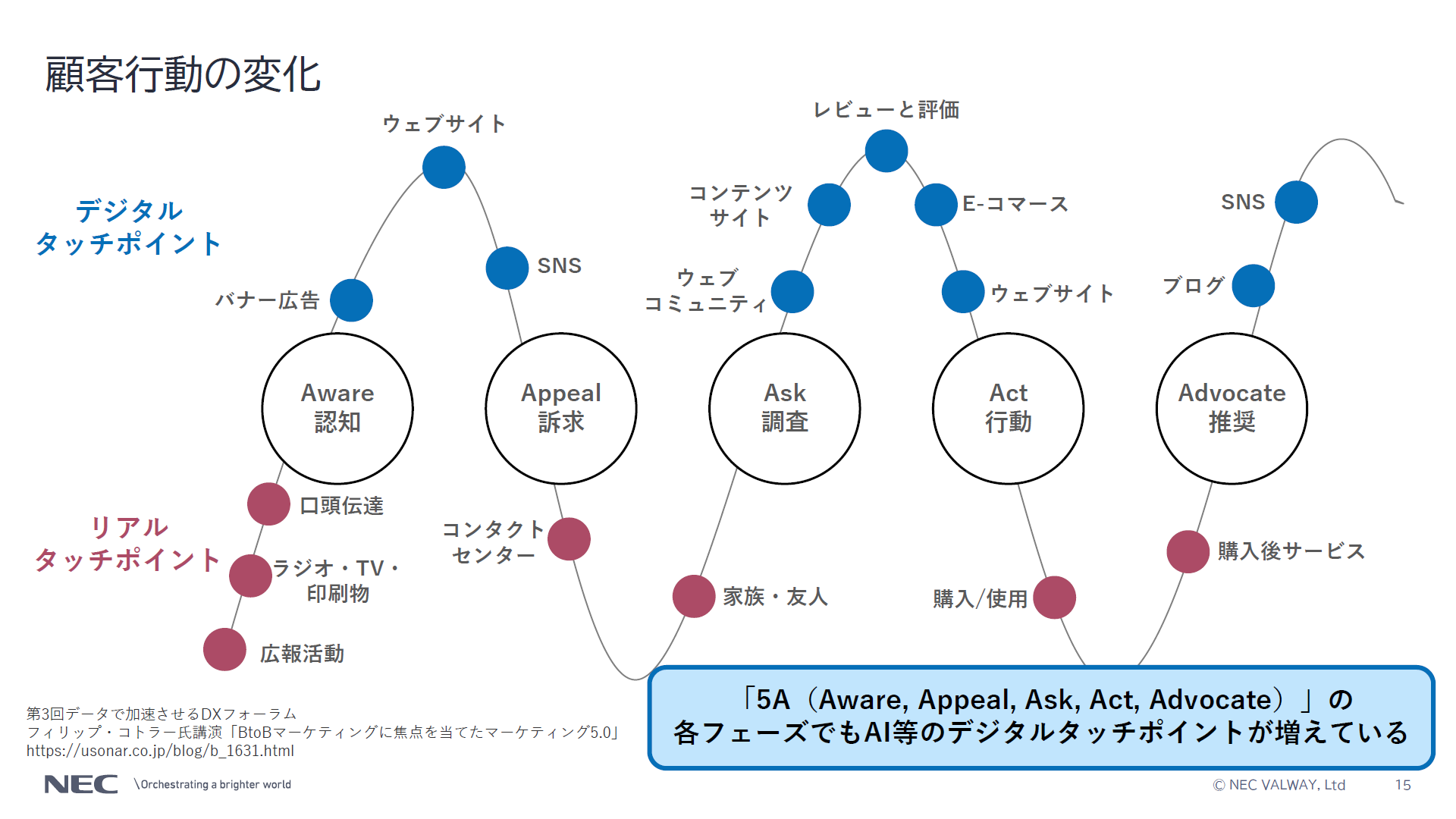
However, due to the penetration of AI and the increase in digital touchpoints, digital interactions now outweigh physical ones across various phases of the purchasing process.
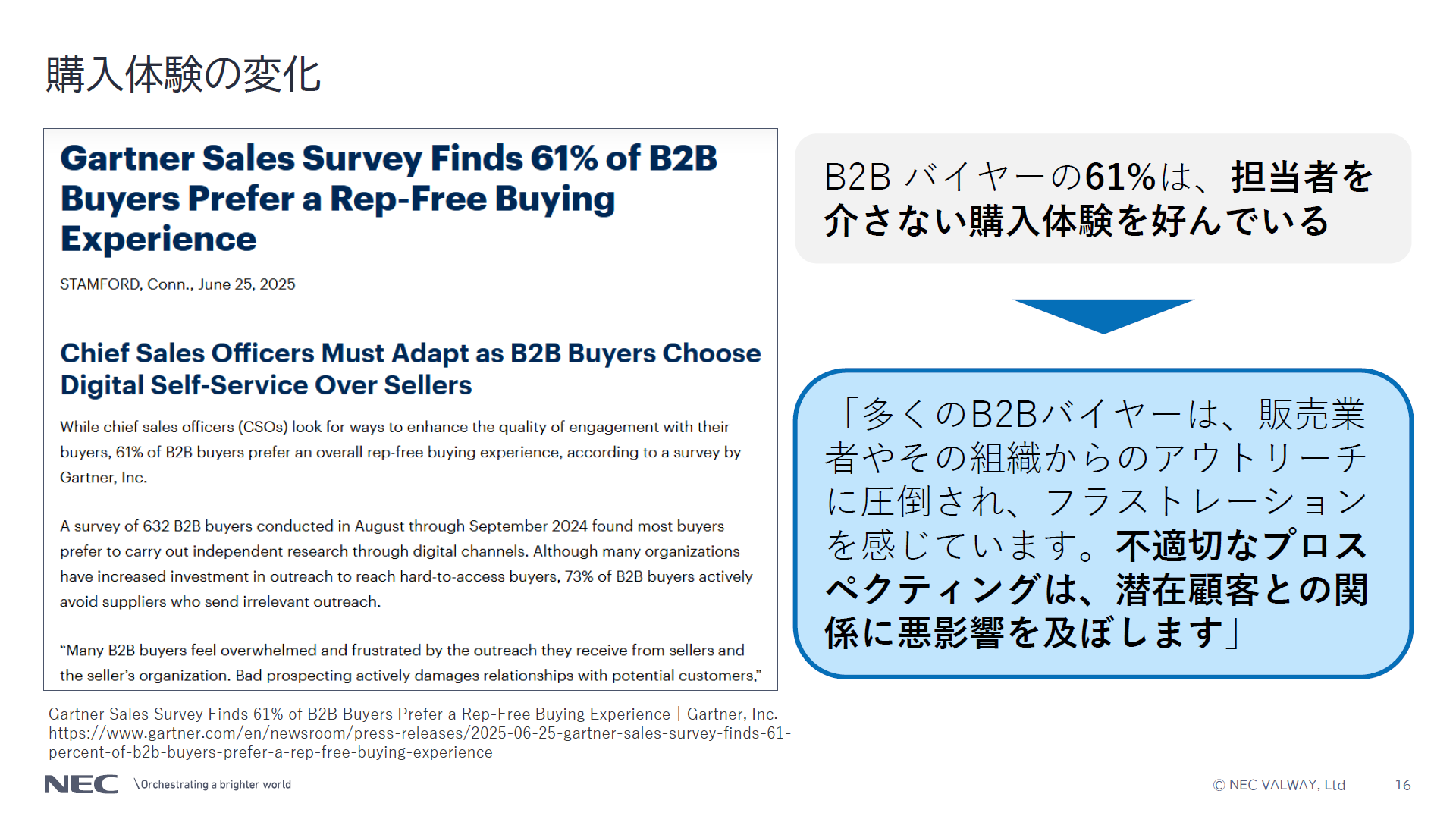
Furthermore, according to a Gartner research report, a high percentage of purchasing managers prefer a buying process that does not involve vendors during the information-gathering stage.
They show a tendency to avoid contact from vendors and have a strong need to obtain all necessary information online.
(Source: Gartner Sales Survey Finds 61% of B2B Buyers Prefer a Rep-Free Buying Experience|Gartner, Inc.)
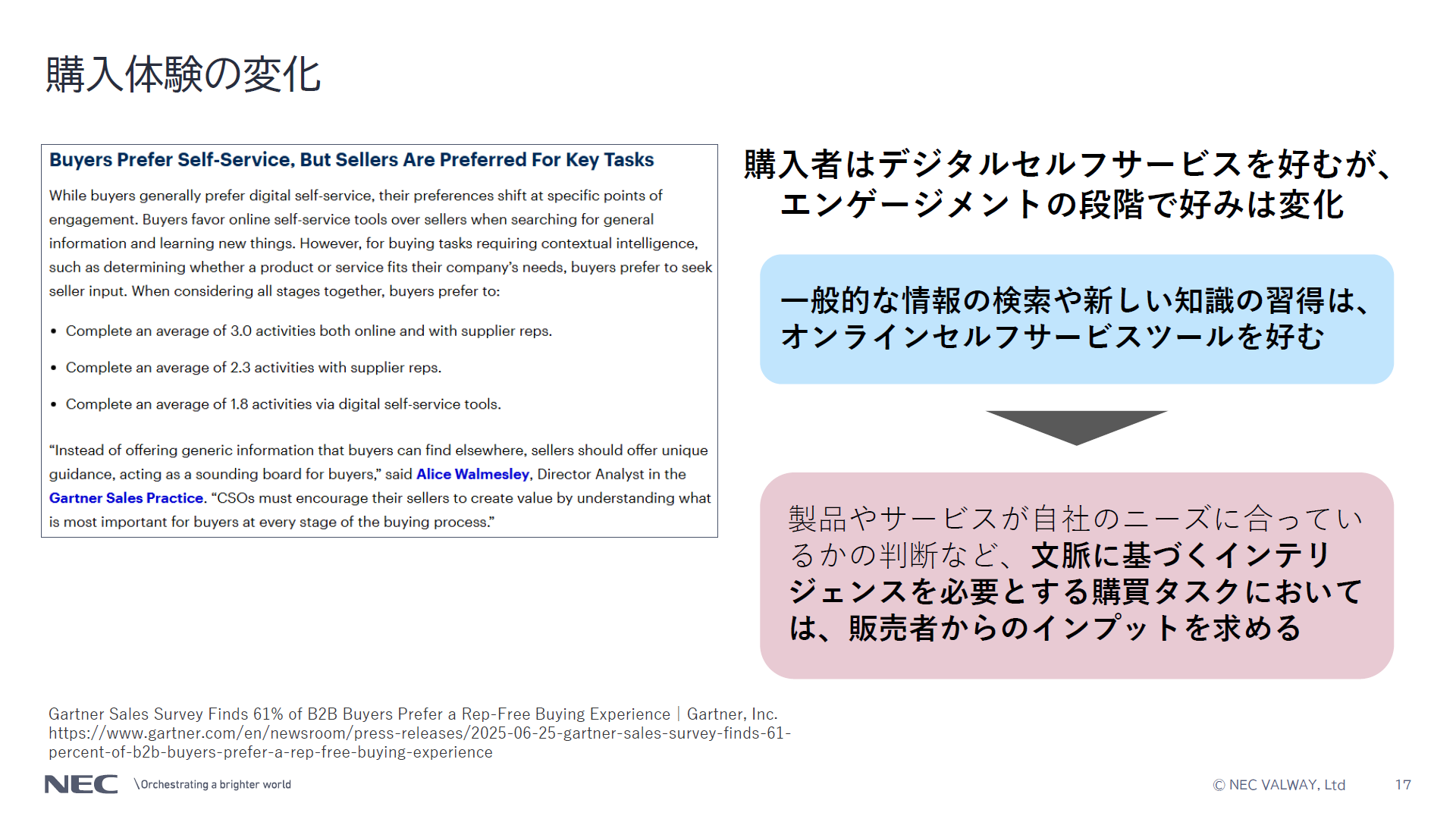
However, this trend does not apply to every phase of the purchasing process.
While customers believe that online information gathering is sufficient during the initial research stage, they begin to seek direct information and proposals from vendors during the evaluation phase when they have narrowed down their options to a few companies.
In other words, sales teams must accurately grasp which stage the customer is in and approach them at the appropriate time and through the appropriate method.
Additionally, data shows that within the purchasing process, 27% of the time is spent on online information gathering, while 17% is spent on meetings with vendors.
(Source: Win More B2B Sales Deals|Gartner, Inc.)
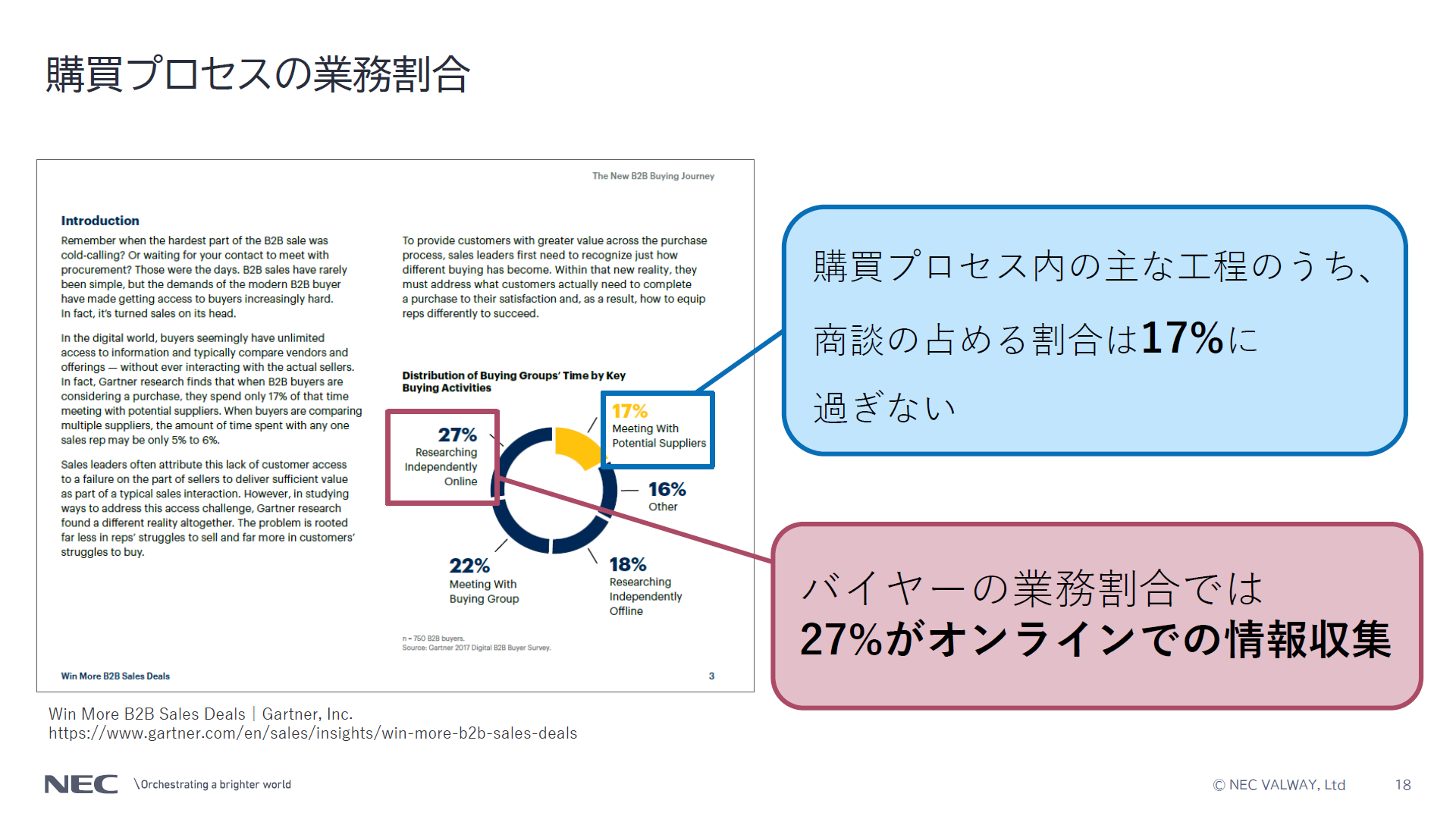
Considering inquiries made to multiple vendors, the contact time available per vendor becomes even more limited.
To adapt to these changes in the purchasing process, "Intent Data" is gaining significant attention.
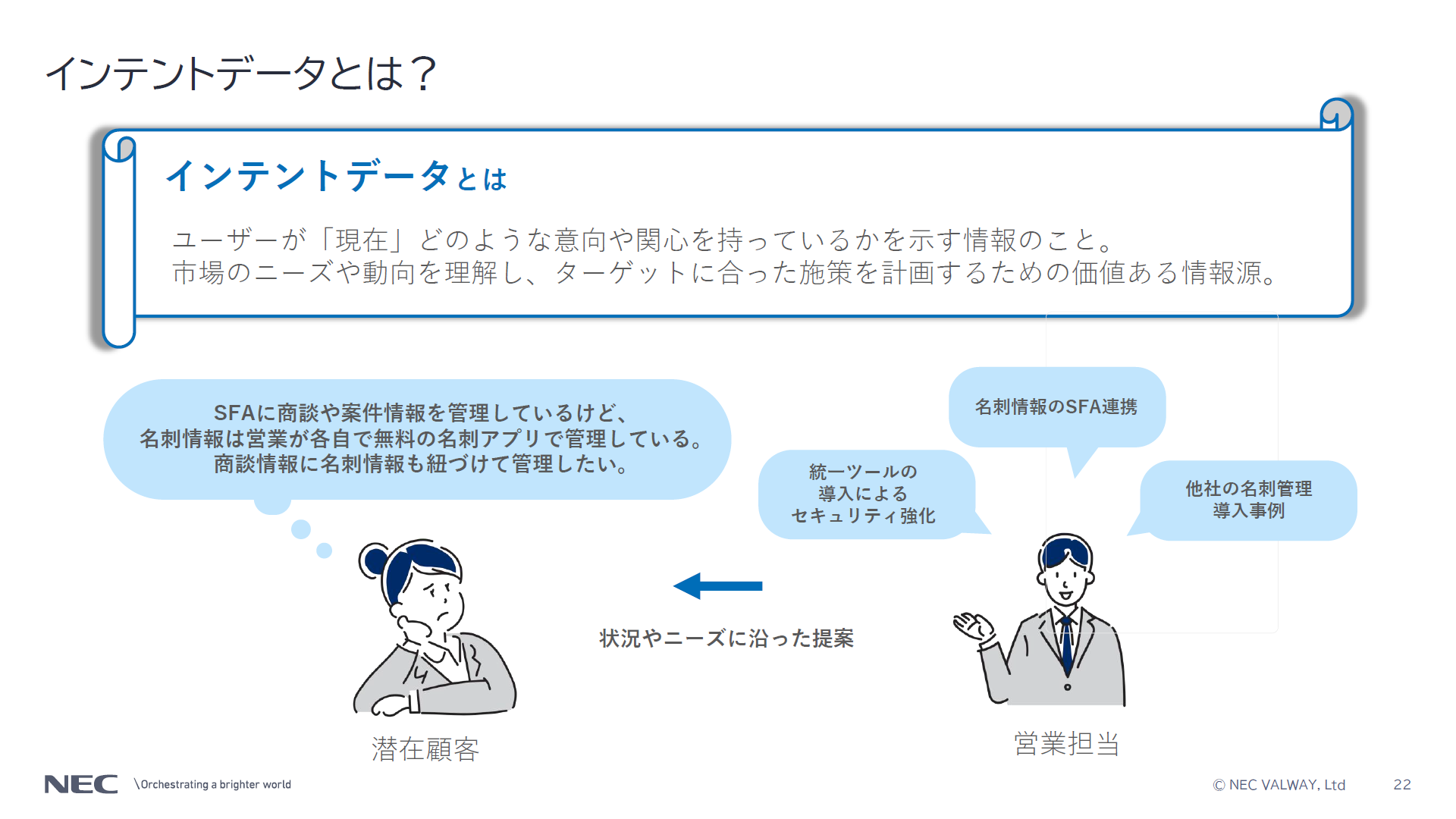
Intent Data refers to information that allows companies to infer a prospect's interests and consideration status based on their online behavioral history and search keywords.
Specifically, by analyzing which external media a customer company accesses and which pages they visit on your own website, you can determine what they are considering and where they are in the purchasing process.
Beyond understanding customer needs, Intent Data is also used to visualize "Dark Funnel" potential targets for outreach, as well as to detect churn risks and identify opportunities for upselling or cross-selling in customer success initiatives.
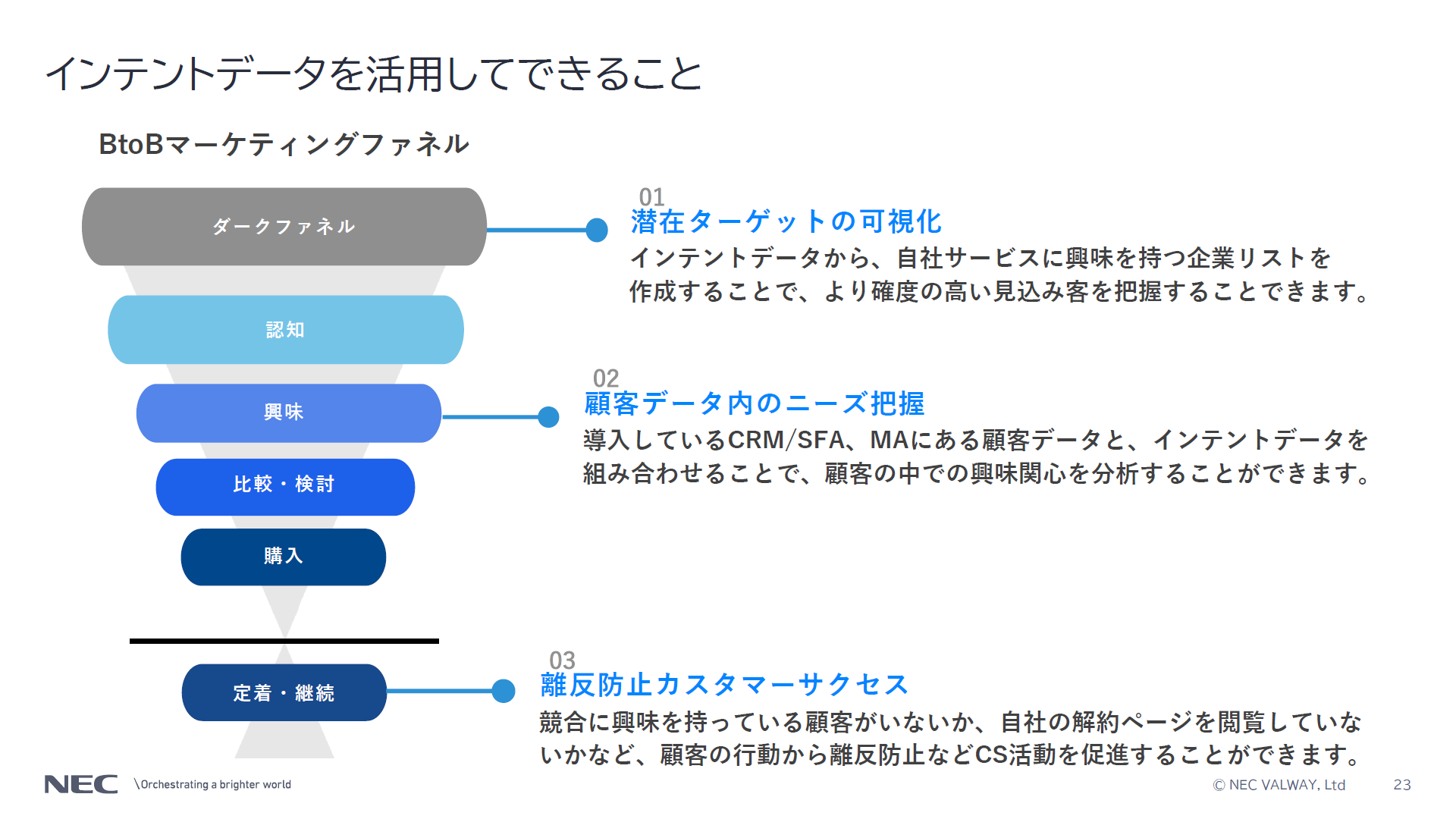
Intent data is broadly classified into two categories.
The first is known as "First-Party Data," which consists of data from companies that have accessed your own website. This provides specific behavioral information, such as "Company A viewed the pricing page on Month X, Day Y."
However, in the current era often referred to as the "Zero-Click Era," customers are increasingly satisfied with information obtained from AI-generated summaries and are not visiting vendor websites.
(Source: Site Visits via Google Drop by 30% in Japan Due to the Spread of AI Summaries | Nikkei)
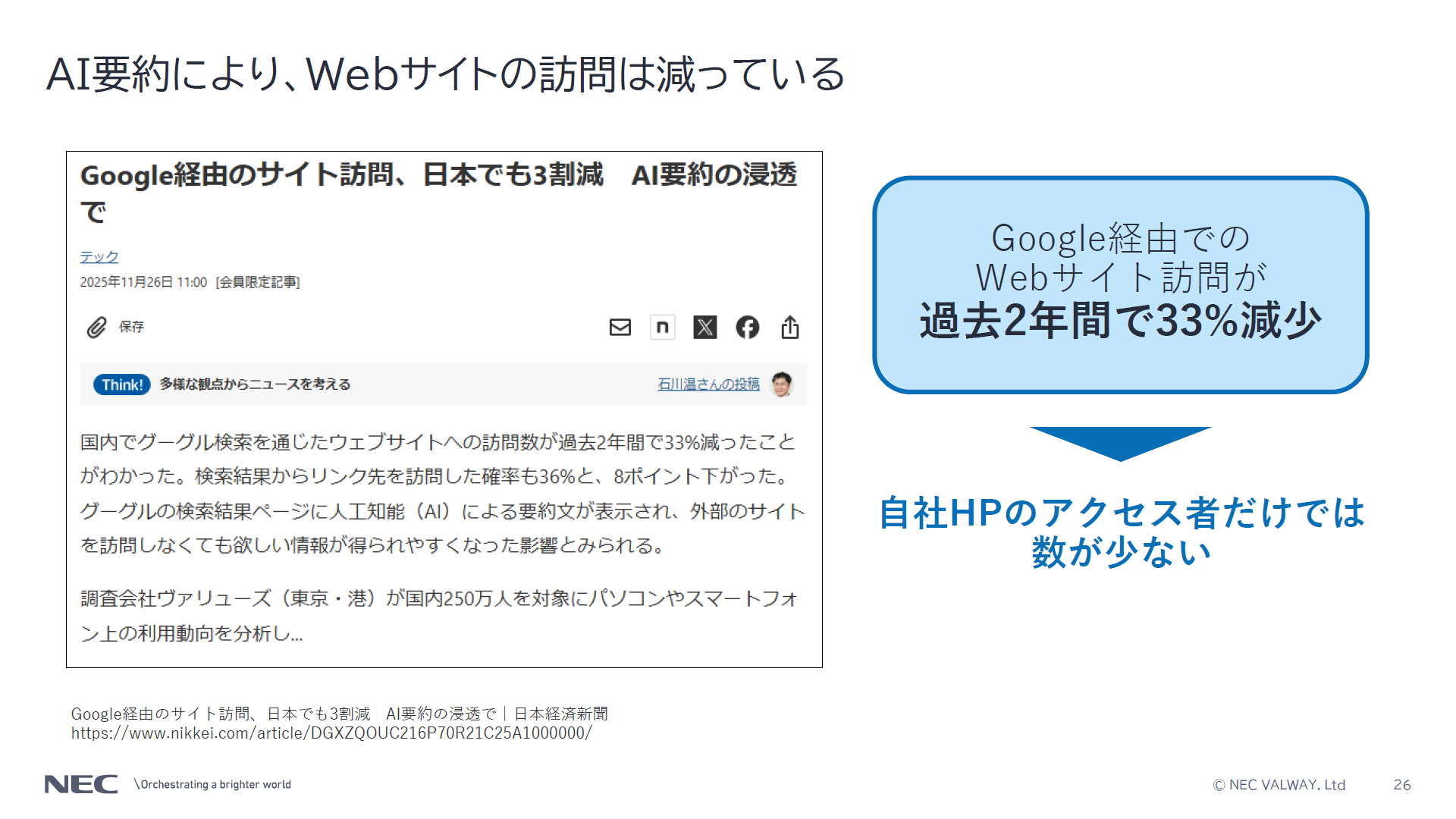
Therefore, it is necessary to capture not only first-party data but also companies that are gathering information on external websites.
The second category, "Third-Party Data," detects companies that are gathering information on external web media and news sites. For example, it is possible to identify companies that are researching keywords such as "Sales DX" or "SMB Market Development."
Furthermore, as a case study, a company selling cloud accounting systems detected companies researching keywords like "Cloud Accounting" or "Accounting Software Comparison." By identifying that these companies were also viewing their own pricing or case study pages, they were able to infer that the companies were in the consideration phase and initiated an approach accordingly.
By combining first-party data and third-party data in this way, more precise targeting becomes possible.
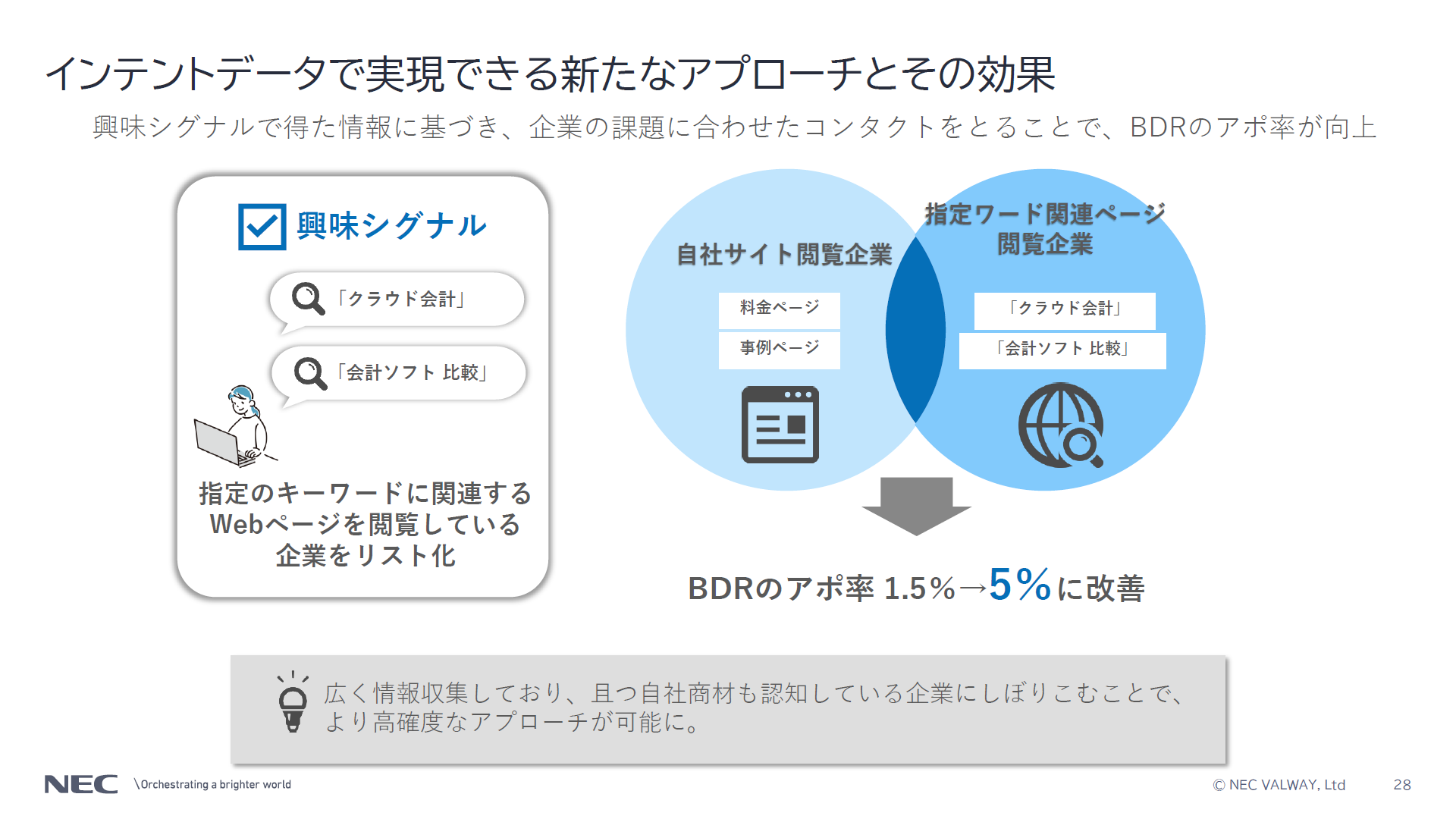
In this case study, while the appointment rate using only traditional corporate databases was 1.5%, it improved to 5% by combining information gathering on external sites with visits to their own website.
This demonstrates that accurately grasping the customer's consideration stage improves the accuracy of sales approaches.
It is important to note that simply approaching companies where intent has been detected does not guarantee results.
Intent data only indicates that "this company is currently considering something," but it does not tell you whether "that company is truly a target customer for your solution."
This is where the combination with corporate attribute information becomes critical.
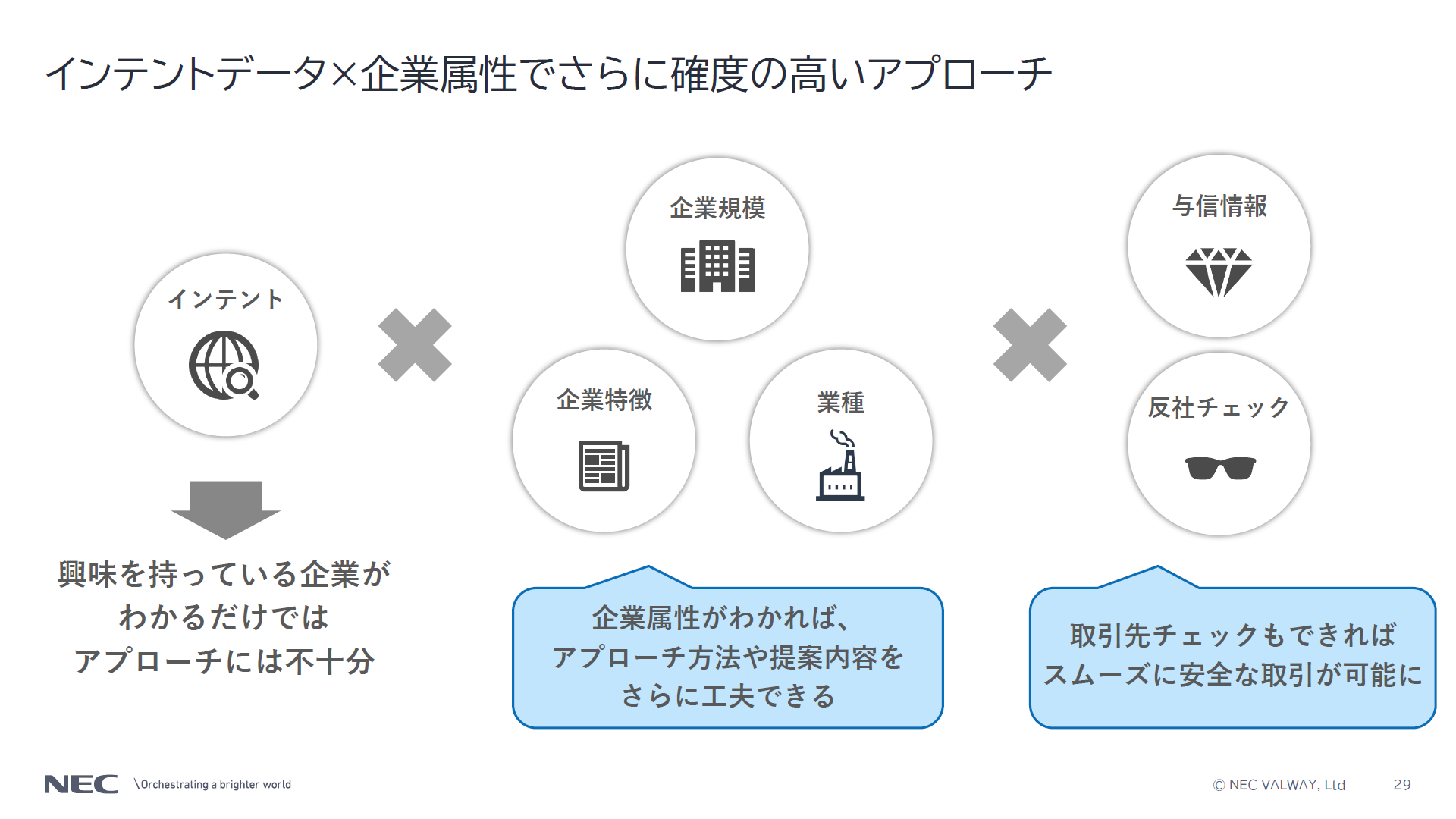
You can increase the precision of your approach by combining intent data with customer attributes that have a proven track record or high affinity with your services.
Furthermore, by incorporating data such as credit information and anti-social force checks, you can proactively avoid wasting sales costs.
Mr. Uehara from NEC VALWAY, who also provides support for sales activities utilizing intent data, pointed out a common pitfall that many companies fall into: operating by simply calling down a list of companies where intent has been detected in order.
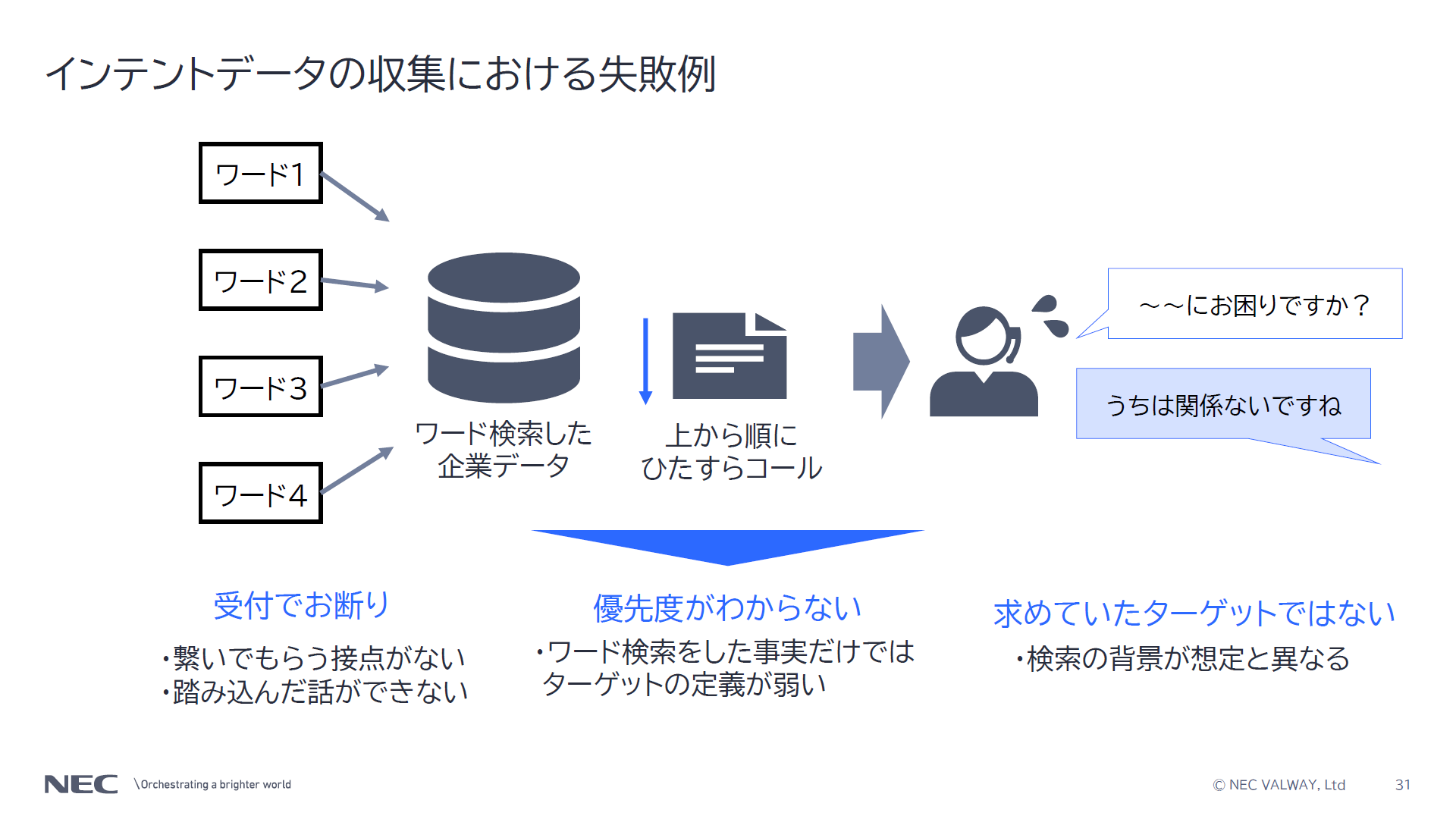
For example, even if you detect intent and make a call, the receptionist may not understand the context and refuse to connect you, or even if you reach the intended person, they may not be the target you were looking for, failing to lead to a business opportunity.
NEC VALWAY introduced a case study where they reviewed their approach to improve this situation.
First, they clearly defined a persona and selected targets by cross-referencing that persona with corporate data where intent was detected via keyword searches.
While this alone improved the progress of conversations, a new challenge emerged: even when proposals were made based on hypotheses derived from issues, they did not lead to business meetings because the companies stated they had no current needs.
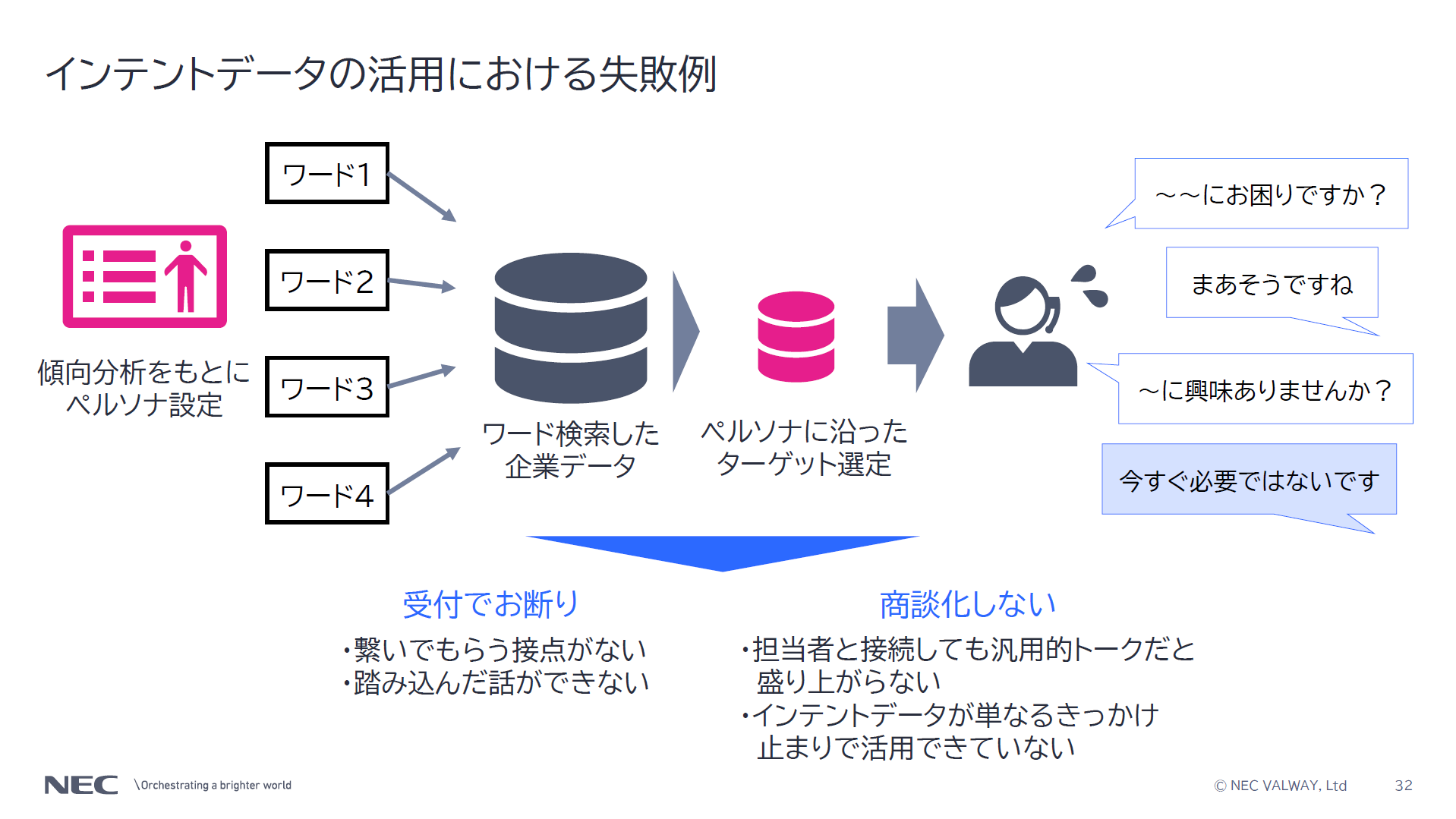
To solve this challenge, they introduced a combination with "Form Marketing."
In addition to target selection by cross-referencing personas and intent data, they prepared content that would interest the persona in advance and implemented an approach that combined form marketing, where that content was sent to the company's inquiry form before making a phone call.
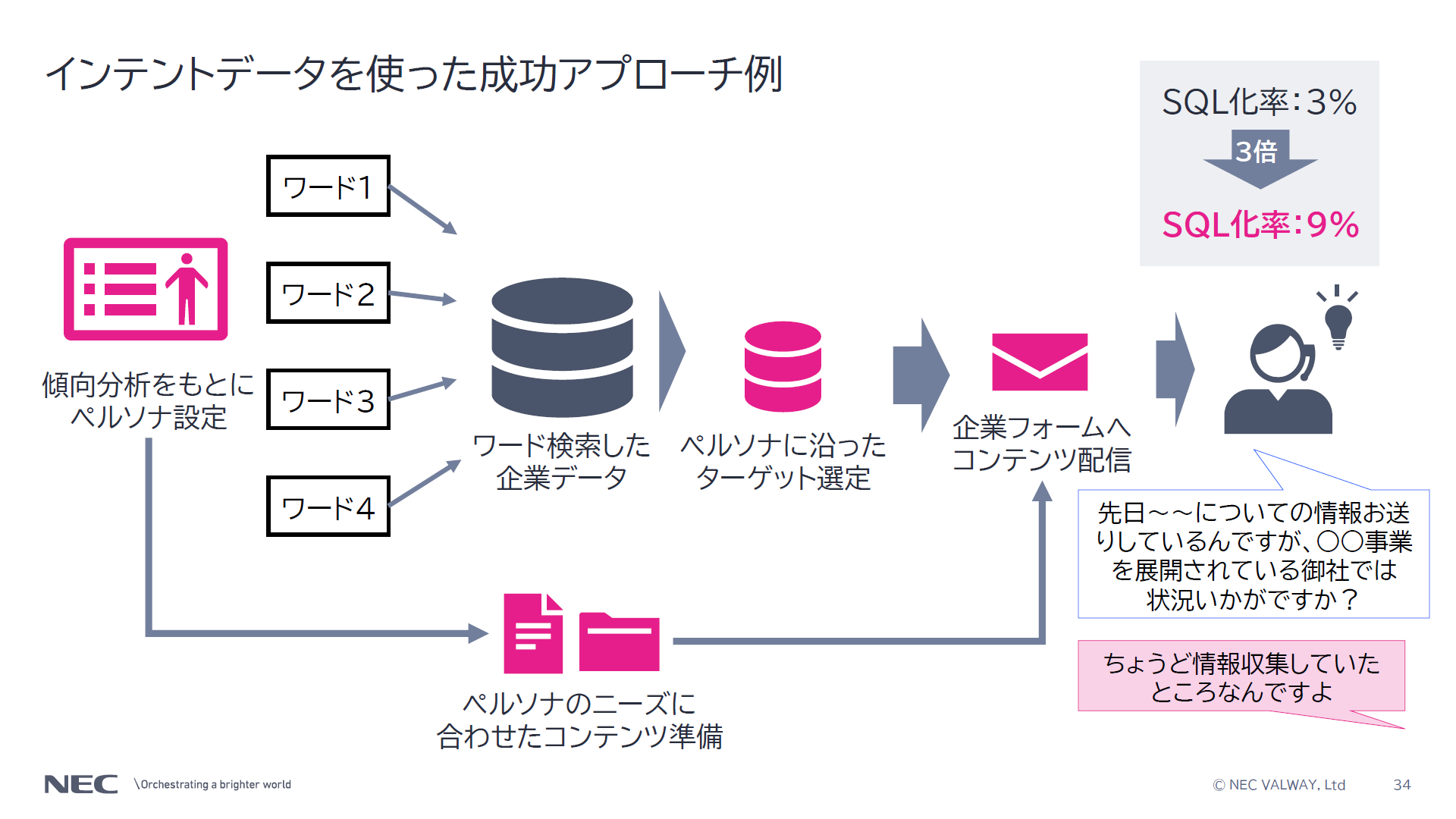
As a result, the entry point for conversations with customers has changed significantly.
By approaching them with a message like, "I noticed your company is involved in [Business A] and [Business B], so I wanted to share some relevant information—have you had a chance to review it?" customers are more likely to resonate with the message, leading to more engaging conversations and the creation of new business opportunities.
Regarding actual results, Mr. Uehara noted that the SQL rate improved from 3% to 9%, a threefold increase.
As this case study demonstrates, intent data is a tool that reveals a customer's "current" situation, but to utilize it effectively, it is essential to clarify your personas and prepare content tailored to those personas.
Furthermore, as a key point of their content strategy, in addition to providing standard content marketing materials, NEC VALWAY places particular emphasis on "Case Study Content."
Mr. Uehara explains that it is effective to identify a customer's business details, products handled, and target demographics through preliminary research, and then deliver case studies that align with those findings.
However, since implementing this content strategy requires a significant amount of time and effort, it is important to maintain a balance between "standardization" and "customization for each company" in your operations.
So far, we have discussed the definition of personas and the implementation of content strategies.
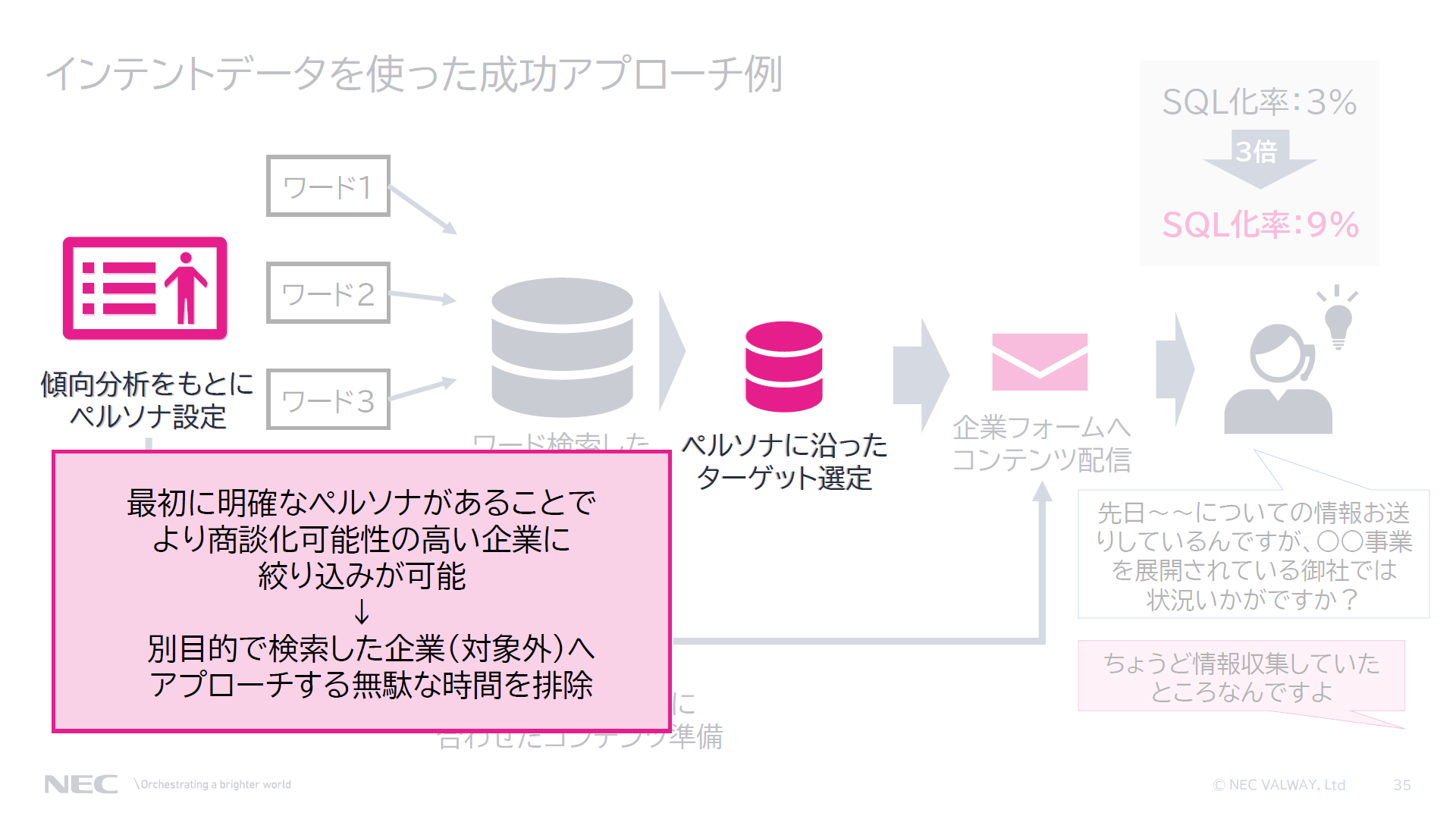
Summarizing the results generated by these operations, first, by implementing appropriate approaches based on personas, we were able to reduce wasted outreach.
By filtering for companies that match our own customer profile in addition to using intent data, we can narrow our focus to companies with a higher potential for business negotiations, thereby reducing inefficient sales activities.
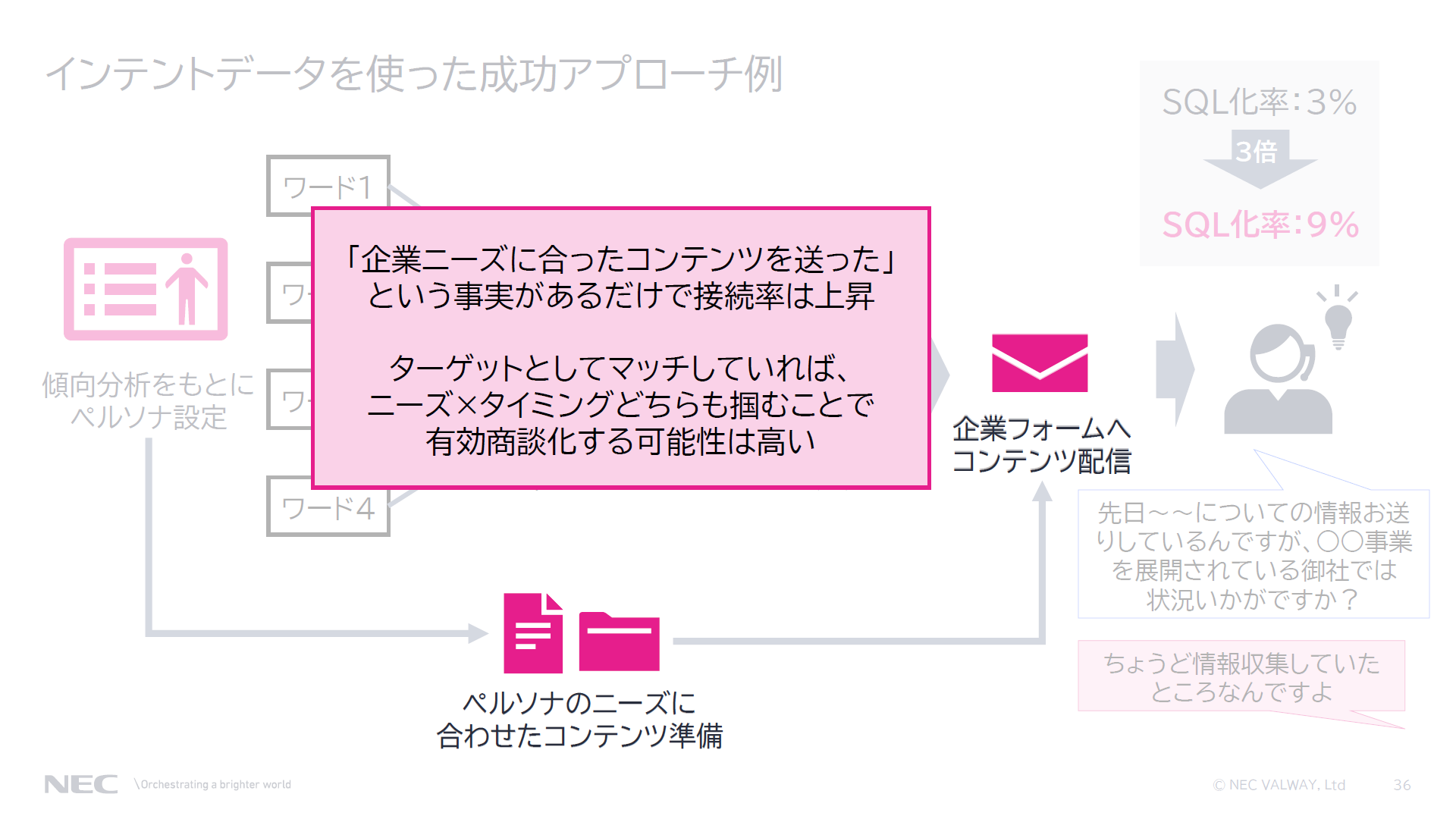
Next, by sending content tailored to the customer in advance, we improved the ease of transitioning into a conversation.
Additionally, by capturing both the needs and the timing, the probability of converting into a valid business opportunity increases.
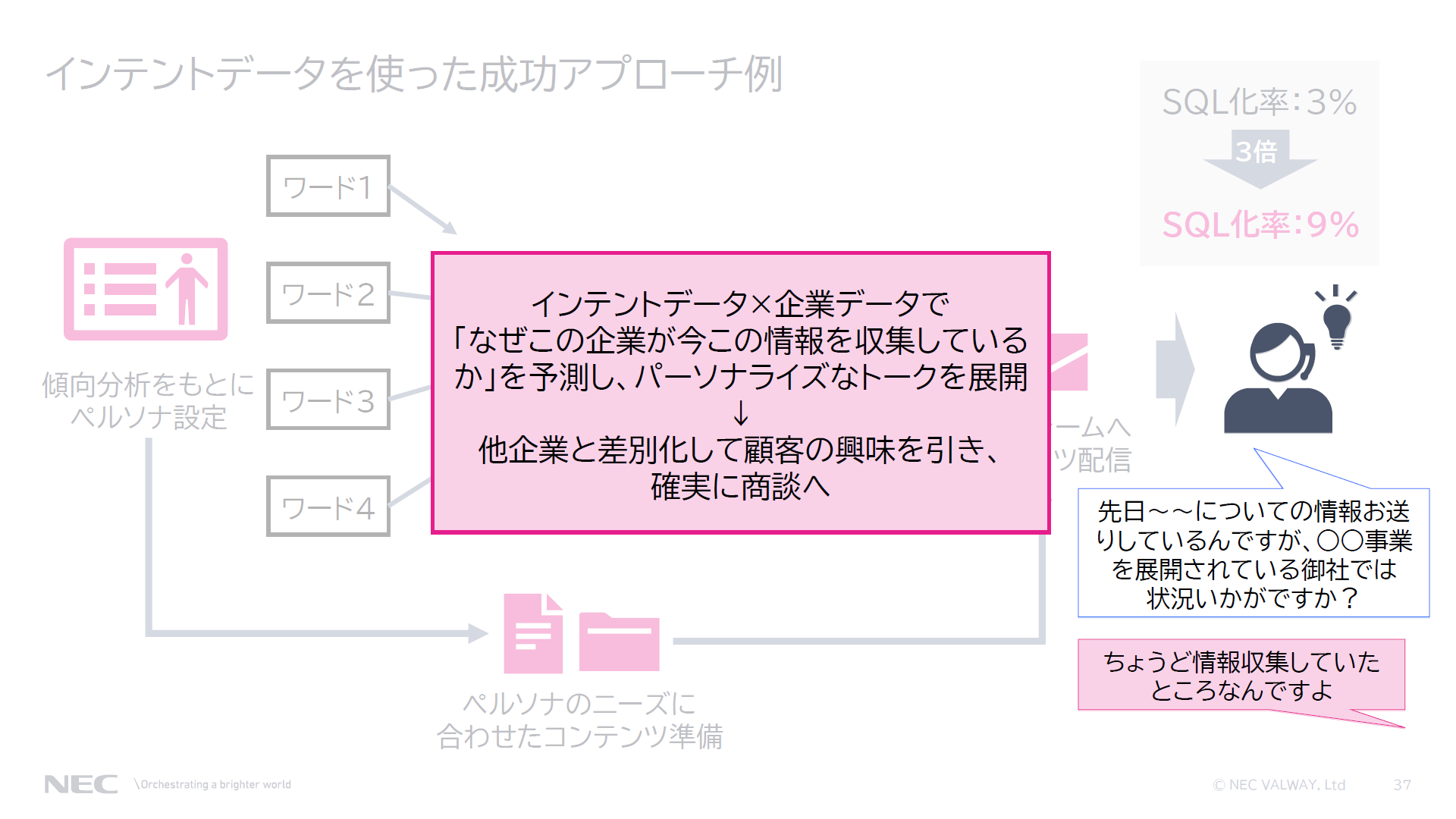
And most importantly, matching the timing of the approach to the target company is crucial.
By combining the customer's consideration status indicated by intent data with corporate data, personalized communication becomes possible, making it easier to lead to business negotiations.
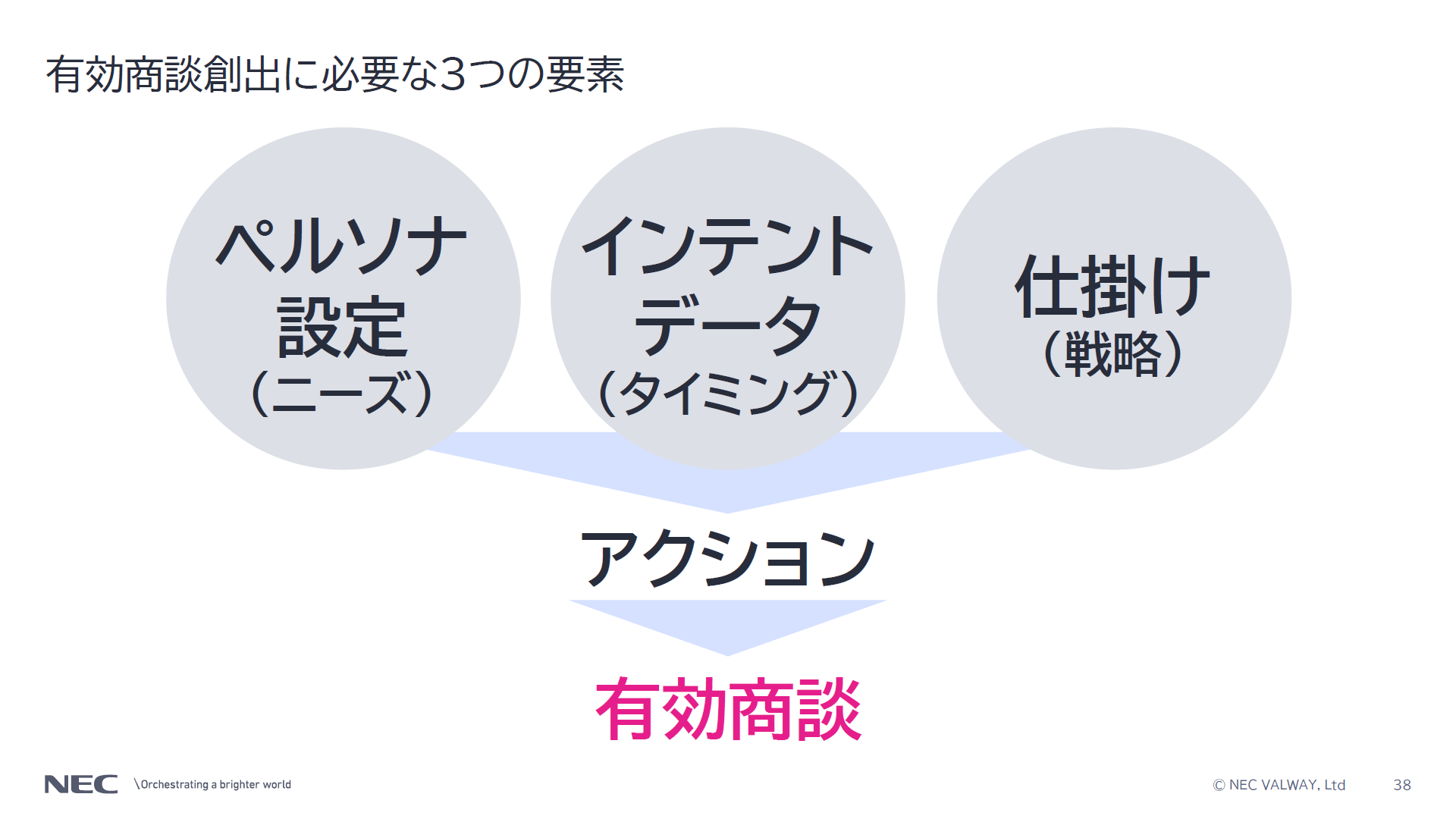
Intent data is "essential data for catching up on a customer's current situation."
However, simply calling companies where intent has been detected or performing generic sales activities is insufficient.
Mr. Uehara concluded that by carefully identifying the characteristics and challenges of the detected companies, and then developing a strategy before approaching them, you can generate high-quality "Valid Business Opportunities."
Thank you for reading until the end!
We received many questions from the participants of this seminar, which shows how high the demand for intent data utilization is in the field.
On the other hand, it was also emphasized that intent data is merely one source of information, and how strategically you operate it determines your results.
In today's world, where the purchasing process is constantly changing, sales activities also require daily improvement.
We hope this seminar report serves as a useful reference for your intent data utilization and new sales approaches.
▶︎ For more information on uSonar's intent data, please click here
▶︎ For consultations or inquiries regarding uSonar, please click here
▶︎ For more information on NEC VALWAY, please click here
Author

uSonar Editorial Department
MX Group Editor-in-Chief
We are the uSonar Editorial Department.
We provide information on data utilization and digital technologies useful for companies primarily engaged in B2B operations to consider the future of their business practices.
uSonar is utilized by various companies
across a wide range of industries and sectors.
ITreview Grid Award 2026 Summer
Leader in 6 Categories

With uSonar,
we will guide your company toward solving its challenges!
Case Studies and Sample Reports
Download