- Data Utilization
- Data Matching and Cleansing
- Customer Management and Analysis
What Are the Three Approaches to Eliminating Data Silos? An Explanation of Cleansing, Matching, and MDM!
Last Updated: August 7, 2026
In recent years, many B2B companies have begun accumulating customer data across multiple systems, such as CRM (Customer Relationship Management), MA (Marketing Automation), and SFA (Sales Force Automation) platforms.
However, it is said that this data is often siloed by department and system, leading to situations where the same client is registered as multiple, duplicate customer entries.
Data consolidation is the process of correctly linking this fragmented data to unify entries for the "same company" or "same individual." While data consolidation may appear to be a subtle and inconspicuous task, it is considered a critical process that fundamentally dictates the accuracy of data utilization.
This article explains the definition of data consolidation, its business benefits, implementation challenges, and practical processes, as well as specific use cases across various industries.
Table of Contents
1-1Variations in Company Name Notation
1-2Hierarchy of Business Locations and Branches
1-3Trade Name Changes, Mergers, and Acquisitions
1-4Existence of Duplicate Records
2Practical Data Consolidation Process
2-1Data Collection and Inventory
2-2Data Cleansing and Normalization
2-3Matching and Assignment of Consolidation Keys
2-4Integration and Finalization of Consolidation Results
2-5Continuous Updates and Monitoring
3Use Cases for Data Consolidation by Industry
3-3Construction
Recommended Articles
What Are the Three Approaches to Eliminating Data Silos? An Explanation of Cleansing, Matching, and MDM!

Clear Explanation: What Are Data Silos? How to Achieve Unified Management Through Data Matching
Data matching is the process of identifying and consolidating records that refer to the same company or individual from customer information dispersed across multiple databases and systems. In English, this concept is often referred to as Entity Resolution or Record Linkage.
In the B2B sector, the majority of business counterparts are corporations rather than individuals. Therefore, data cleansing primarily focuses on "Corporate Data Cleansing," which involves consolidating multiple records that refer to the same corporation or business location.
The fundamental reason data cleansing is necessary is that even for the same company, the notation often varies depending on the registration system or the person in charge.
Typical inconsistencies addressed by data cleansing include the following:
Countless notation patterns arise for the same company, such as whether "Inc." is placed at the beginning or end, the mixing of full-width and half-width characters, differences between English and Katakana notation, and the presence or absence of spaces and symbols.
Even if a human can recognize that these refer to the same company, systems treat them as separate entities.
Within the same corporate group, multiple locations exist, such as headquarters, branch offices, sales offices, and factories. Defining which unit is considered "identical" depends on the purpose of use, and it is essential to accurately capture the hierarchical structure.
Companies change their names or legal status due to rebranding, mergers, and acquisitions. To correctly link past data with current data, a mechanism capable of tracking these transitions is required.
When integrating business card management tools, exhibition lists, and past transaction histories, it frequently happens that information for the same company is registered multiple times. Conducting analysis or implementing strategies while duplicates remain leads to results that deviate significantly from reality.
Click Here for Past Articles on Data Cleansing
Data cleansing is generally considered to be executed through the following process.
Identify the location of customer data scattered throughout the company, such as in CRM, SFA, MA, core systems, and business card management tools. The starting point is to understand which items are held in which systems.
Perform "data cleansing" to standardize data notation, such as unifying full-width and half-width characters for company names, removing unnecessary symbols and spaces, and organizing corporate status notations. This preprocessing significantly changes the accuracy of subsequent matching.
For normalized data, identify the same company by combining attributes such as company name, address, and phone number. The basis for this determination is the "Data Cleansing Key (Corporate Code)" uniquely assigned to each company. By assigning a common key, it becomes possible to reconcile data across systems.
Records identified as duplicates are consolidated, and representative information is determined. By defining rules for integration levels—such as which branch units to consolidate and which data fields to prioritize—we ensure consistent integration results.
Data cleansing is not a one-time task. By reflecting changes in corporate information and continuously assigning cleansing keys to newly added data, you can maintain high data quality.
The demand for data cleansing varies by industry.
Here, we outline typical data cleansing use cases for five representative industries.
In the manufacturing industry, indirect sales through trading companies or distributors often coexist with direct transactions with end users, creating a structure where it is difficult to identify who is actually using the company's products.
By cleansing transaction data separated by sales channel, you can visualize the customer profile, including end users beyond the distributors. Furthermore, since headquarters, factories, research laboratories, and individual business offices are often registered as separate accounts, consolidating transactions at the corporate group level allows you to capture the total transaction scale and cross-selling opportunities across the entire group. Data cleansing also plays a vital role in accurately linking after-sales service and maintenance history by product and facility.
In the financial sector, accurately identifying corporate clients is essential for regulatory identity verification, anti-social force checks, and credit assessment. When systems are siloed by product—such as loans, deposits, payments, and insurance—the same client may be managed as separate entities, leading to challenges in assessing risks (such as credit concentration) across the entire corporate group. By using data cleansing to consolidate group companies and affiliates, you can enhance the accuracy of exposure management and gain a clearer understanding of the actual status of your clients.
Furthermore, identifying customers uniquely across multiple accounts and contracts is considered essential for proposing appropriate financial products and detecting fraudulent transactions.
In the construction industry, numerous companies—including prime contractors, subcontractors, partner companies, and material manufacturers—are involved in a single project. It is common for the same partner company to be registered with different names for each site or project, leading to fragmented transaction records. By correctly consolidating partner companies and business partners through data cleansing, you can centrally grasp order history and safety management records at the corporate level. Given the industry-specific complexities, such as information on licensed construction contractors and the handling of business partners formed as Joint Ventures (JV), this is an area where matching against a reliable corporate master database is highly significant. Data cleansing is also utilized for consolidating suppliers in material procurement and for credit management purposes.
Human resources services, such as recruitment, temporary staffing, and job advertising, handle both hiring companies (clients) and job seekers. On the client side, the same company is often registered as separate business partners by different departments or recruiters, making it difficult to see the overall transaction status of the entire enterprise. By consolidating departmental transactions into a single corporate entity through data cleansing, you can avoid redundant proposals and build relationships across the entire account. Additionally, by cleansing and normalizing the names of employers appearing in job seekers' work histories, it is possible to improve the accuracy of career matching and perform screening based on attributes such as industry and company size.
In administrative agencies, local governments, and government-affiliated financial institutions, business information is dispersed across multiple operational systems for subsidies, permits, bidding, and taxation. When the same business entity is managed differently under various systems, it hinders cross-sectional understanding of actual conditions and the streamlining of procedures. By uniquely identifying business entities through data cleansing, you can consolidate various applications, prevent duplicate benefits, and establish a data analysis foundation for policy formulation. In recent years, the development of Corporate Numbers has laid the groundwork for uniquely identifying businesses; however, a data cleansing mechanism capable of handling variations in notation and historical changes remains essential for integrating past data and businesses that do not possess Corporate Numbers.
Data cleansing is a foundational process that supports the accuracy of data utilization by correctly grouping dispersed customer data into units of the same company or the same individual. To overcome challenges such as variations in notation, data degradation, and the absence of a master database for judgment criteria, a mechanism for continuous data cleansing based on reliable corporate information is indispensable. Furthermore, as explored in this article, the challenges solved by data cleansing manifest differently across industries, making it essential to design utilization strategies tailored to your company's specific business structure.
Our customer data integration solution, uSonar, can address these data cleansing challenges with high precision. Through our proprietary code system, LBC (Linkage Business Code), we manage corporate information uniquely at the establishment level. This allows for data cleansing across systems by absorbing complex patterns such as variations in notation, hierarchical structures of locations, and changes in trade names.
By performing data cleansing based on one of Japan's largest corporate information databases, we can accurately identify companies with similar names that are distinct entities, as well as different names that refer to the same entity—tasks that are difficult to achieve with internal data alone. Furthermore, by continuously acquiring our independently collected corporate data, you can track changes such as relocations and name changes, ensuring your data cleansing results remain up-to-date.
For more details, please feel free to contact us via this page.
Author

uSonar Editorial Department
MX Group, Editor-in-Chief
We are the uSonar Editorial Department.
We provide information on data utilization and digital technologies useful for considering future business operations, primarily for companies engaged in B2B business.
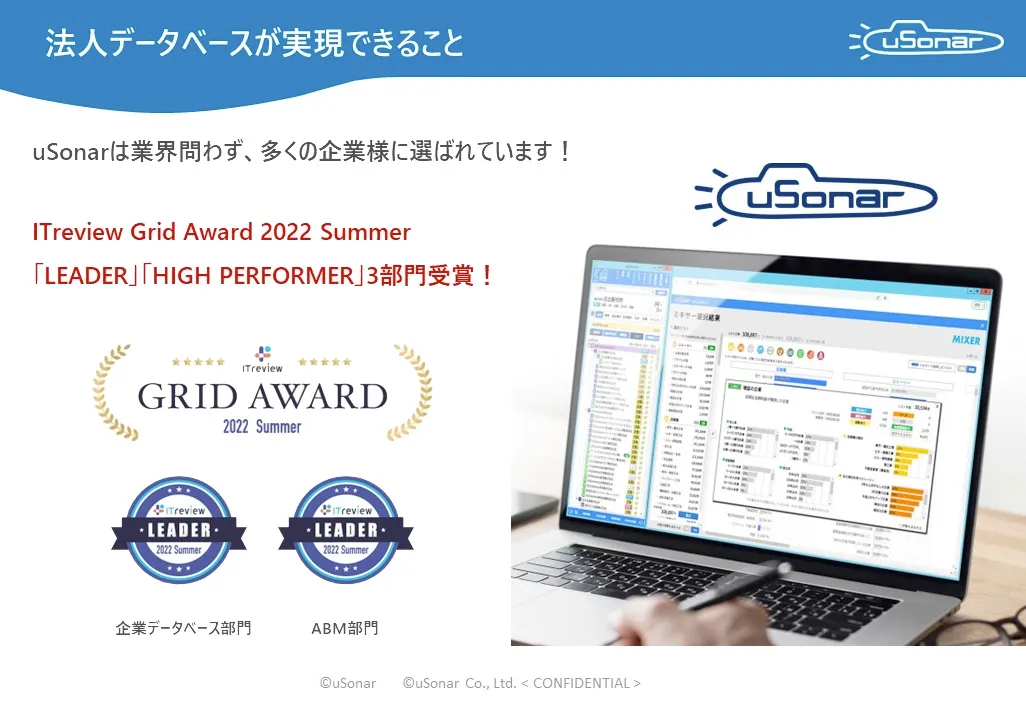
uSonar is utilized by a wide range of companies across various industries and sectors.
ITreview Grid Award 2026 Summer
Leader in 6 Categories
With uSonar,
we can guide your company toward solving its challenges!
Case Studies and Sample Reports
Download