Generated at: 2026-09-01 09:46:26
  • Credit and Anti-Social Forces Check
  • Sales Strategy
  • New Business Development and Sales Lists
  • Corporate Registry

Why the Corporate Registry Information Service Is Essential Now: Background, Demand, and Risks of Inaction

Last Updated: August 7, 2026

With the advancement of digital transformation (DX), the speed at which B2B companies can acquire accurate corporate and real estate information has become a critical factor in sales, credit management, and compliance operations. The foundation for this is the Corporate Registry Information Service, which allows users to verify registry information held by registry offices via the internet.
However, in many companies, the acquisition of registry information remains a manual process left to individual staff members, rather than being established as a company-wide data utilization framework.

This article provides an overview of the Corporate Registry Information Service, explains the background behind the current demand for utilizing registry information, the risks of failing to do so, and the first steps to take.

The Current Landscape of Utilizing Corporate Registry Information

Corporate registry information is a record of factual data essential for business transactions, such as a company's trade name, head office location, and officer composition, or the ownership and rights related to real estate, all based on national systems. While it was once common to request certificates of registered matters at Legal Affairs Bureau counters, online verification is now said to be becoming widely adopted.

The following three points are cited as the background for the growing attention toward corporate registry information.

  • Changes in the Market Environment
    Requirements for verifying the existence of business partners, conducting anti-social force checks, and managing credit risk are becoming stricter every year. To maintain the speed of initiating new business transactions while ensuring the quality of verification tasks, companies need a system that allows for the rapid reference of registry information, which serves as primary source data.
  • Evolution of Technology and Tools
    The online acquisition of registry information has been established as a formal system, and private services that connect to internal systems via APIs (system integration mechanisms) have emerged. Integrating information that was previously acquired manually into business systems and data platforms is becoming a practical option.
  • Changing Expectations of Customers and Business Partners
    Prolonged screening and contract procedures negatively impact the customer experience. Business partners also expect rapid decision-making, and the speed of verification processes is now considered a direct reflection of a company's reliability.

As these changes converge, the utilization of registry information is shifting from a routine task for specific administrative departments to an unavoidable management priority for many B2B companies.

What Is the Registry Information Provision Service?

The Registry Information Provision Service is a paid service based on a system under the jurisdiction of the Ministry of Justice, which allows users to view registry information held by registry offices on computer screens via the internet (*1). It is operated by the Civil Legal Affairs Association, a designated corporation, allowing users to check registry information from their homes or offices.

The main features are as follows:

  • Types of Information Available
    The service provides information such as full details and owner information for real estate, commercial and corporate registry information, summary files of movable property and claim assignments, as well as maps and drawing information. The usage fees per request are 330 yen for full details, 140 yen for owner information, and 360 yen for maps and drawings (fees effective after the April 1, 2026 revision, *2).
  • Extended Availability
    Full details and owner information can be accessed from 8:30 AM to 11:00 PM on weekdays, and from 8:30 AM to 6:00 PM on weekends and holidays. A key advantage is the ability to acquire information according to business hours without needing to visit a Legal Affairs Bureau office in person.
  • Inquiry Number System
    An "Inquiry Number" can be assigned to the acquired registry information, which may be used in place of a Certificate of Registered Matters when applying to government agencies. However, since the registry information displayed on the screen does not contain a certification statement or an official seal, it is necessary to distinguish when to use it versus when a formal Certificate of Registered Matters is required for situations demanding legal proof.

Risks and Opportunity Costs of Inaction

By postponing the development of a system for utilizing corporate registration data, companies may face the following risks and opportunity costs.

  • Credit and Compliance Risks
    Continuing business transactions without tracking changes such as trade name updates, head office relocations, or changes in corporate officers means that credit decisions are based on outdated information. Delays in verification can contribute to bad debt or contractual disputes.
  • Delayed Decision-Making
    When the acquisition of registration data relies on manual processes by specific personnel, wait times occur throughout the screening and contracting processes. The opportunity cost resulting from the inability to reference data immediately accumulates as the number of projects increases.
  • Human Resource and Organizational Strain
    Tasks such as visiting legal affairs bureaus, managing paper certificates, and transcribing acquisition results are typical examples of inefficient work that burdens staff. The accumulation of such tasks diverts limited human resources away from the core operations they should be focusing on.
  • Opportunity Costs in Sales and Marketing
    Registration data is said to be useful not only for credit management but also as a sales signal to capture corporate changes such as establishment, relocation, or capital increases. Lacking this information source may result in an information gap compared to competitors.

While these risks may not be immediately apparent in the short term, they are expected to impact a company's revenue structure and credibility in the medium term.

How Leading Companies Are Responding

The following trends are observed among companies that have been proactive in utilizing registration data. These are presented as types of initiatives, omitting specific company names.

  • Integration into Business Processes
    This involves incorporating the verification of registration data as a standard step within credit screening and new business initiation workflows. It marks a shift from subjective operations—where verification is performed only as needed—to a standardized approach where every project undergoes the same quality of verification.
  • Integration into Data Infrastructure
    This involves linking acquired corporate registration information with customer master data in CRM (Customer Relationship Management) or SFA (Sales Force Automation) systems. By enabling sales, credit, and administrative departments to reference the same information, it contributes to reducing verification costs across departments.
  • Continuous Monitoring of Changes
    This is a system for regularly checking registration changes for key business partners, such as head office relocations, trade name changes, and changes in corporate officers. By detecting these changes early, companies can utilize the information as a trigger for credit reviews or sales approaches.

What these initiatives have in common is the recognition that "the utilization of corporate registration information is not merely a task for administrative departments, but a part of data utilization that supports management decision-making."

Where to Start

Utilizing corporate registration information does not require starting with a large-scale investment. A small-start approach, as described below, is considered effective.

  • Step 1: Visualization of the Current State
    Conduct an inventory within your company to identify who is acquiring corporate registration information or certificates of registered matters, for which tasks, and with what frequency. Simply understanding the number of acquisitions and the time spent on these tasks will reveal the significant potential for improvement.
  • Step 2: Prioritization of Use Cases
    Prioritize tasks where the impact is easily visible, such as credit screening, sales list maintenance, or real estate-related verification. Starting with themes that are easy for stakeholders to agree on will lead to greater internal buy-in.
  • Step 3: Execution of Small Trials
    The "Corporate Registration Information Provision Service" includes a mechanism for temporary use, allowing you to test with a small volume of acquisitions. By narrowing the scope to specific tasks, you can quantitatively verify changes in work time and costs.
  • Step 4: Institutionalization and Tool Utilization
    Based on the results of the trials, establish acquisition rules and management methods to formalize the process. If the number of acquisitions is high or integration with internal systems is required, utilizing private corporate registration acquisition services becomes a viable option.

The key is "not to wait for a perfect plan." The utilization of corporate registration information is an area that can be started on a small scale and expanded while learning; it is said that delays in getting started directly lead to an information gap.

Conclusion

We summarize the key points of this article in three areas: 1) The Registry Information Provision Service is an official paid service that allows you to check registry information from the registry office online; 2) A lack of an established utilization framework leads to opportunity losses, such as credit risks and delayed decision-making; and 3) It is effective to start by auditing the current situation and conducting small trials before progressing to full-scale organizational implementation and tool utilization.

The utilization of registry information is not merely a matter of administrative efficiency; it is a management issue that supports the quality of credit management, compliance, and sales activities for B2B companies. We recommend using the current awareness, risks, and initial actions outlined in this article as a starting point for internal discussions.

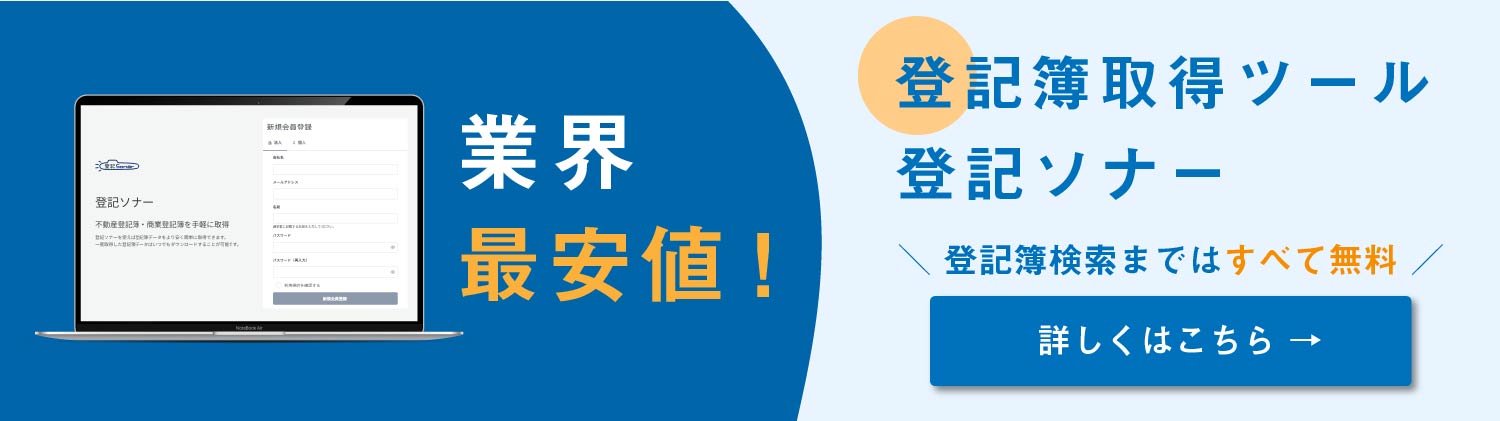
Our registry acquisition service, Touki Sonar, allows you to obtain commercial and real estate registry records online. It features a completely pay-as-you-go model with no initial or monthly fees, free searches, and the ability to acquire necessary registry records in anywhere from a few seconds to a few minutes. We also support system integration via API for commercial registration, providing speedy support from the very first step of registry information utilization to full-scale organizational implementation.

For more details, please feel free to contact us via this page.


*1: Ministry of Justice, "Overview of the Registry Information Provision System"
https://www.moj.go.jp/MINJI/minji25.html
*2: Ministry of Justice, "List of Usage Fees for the Registry Information Provision Service"
https://www.moj.go.jp/MINJI/minji25-1.html

About the Author

uSonar

uSonar Editorial Department

MX Group, Editor-in-Chief

This is the uSonar Editorial Department.
We provide information on data utilization and digital technologies useful for rethinking future business operations, primarily for companies engaged in B2B business.

uSonar is utilized by various companies
across all industries and sectors.

  • Ministry of Economy, Trade and Industry.
  • Asahi
  • BIZ REACH
  • NITORI BUSINESS
  • FUSO
  • MIZUHO
  • PayPay
  • Ministry of Economy, Trade and Industry.
  • Asahi
  • BIZ REACH
  • NITORI BUSINESS
  • FUSO
  • MIZUHO
  • PayPay
  • Ministry of Economy, Trade and Industry.
  • Asahi
  • BIZ REACH
  • NITORI BUSINESS
  • FUSO
  • MIZUHO
  • PayPay
  • Ministry of Economy, Trade and Industry.
  • Asahi
  • BIZ REACH
  • NITORI BUSINESS
  • FUSO
  • MIZUHO
  • PayPay
  • RICOH
  • Bengo4.com, Inc.
  • Resona Bank, Limited
  • SAKURA internet
  • SATO
  • Sozon Information Systems Co., Ltd.
  • Suzuyo
  • RICOH
  • Bengo4.com, Inc.
  • Resona Bank, Limited
  • SAKURA internet
  • SATO
  • Sozon Information Systems Co., Ltd.
  • Suzuyo
  • RICOH
  • Bengo4.com, Inc.
  • Resona Bank, Ltd.
  • SAKURA internet
  • SATO
  • Sozon Information Systems Co., Ltd.
  • Suzuyo
  • RICOH
  • Bengo4.com, Inc.
  • Resona Bank, Ltd.
  • SAKURA internet
  • SATO
  • Sozon Information Systems Co., Ltd.
  • Suzuyo

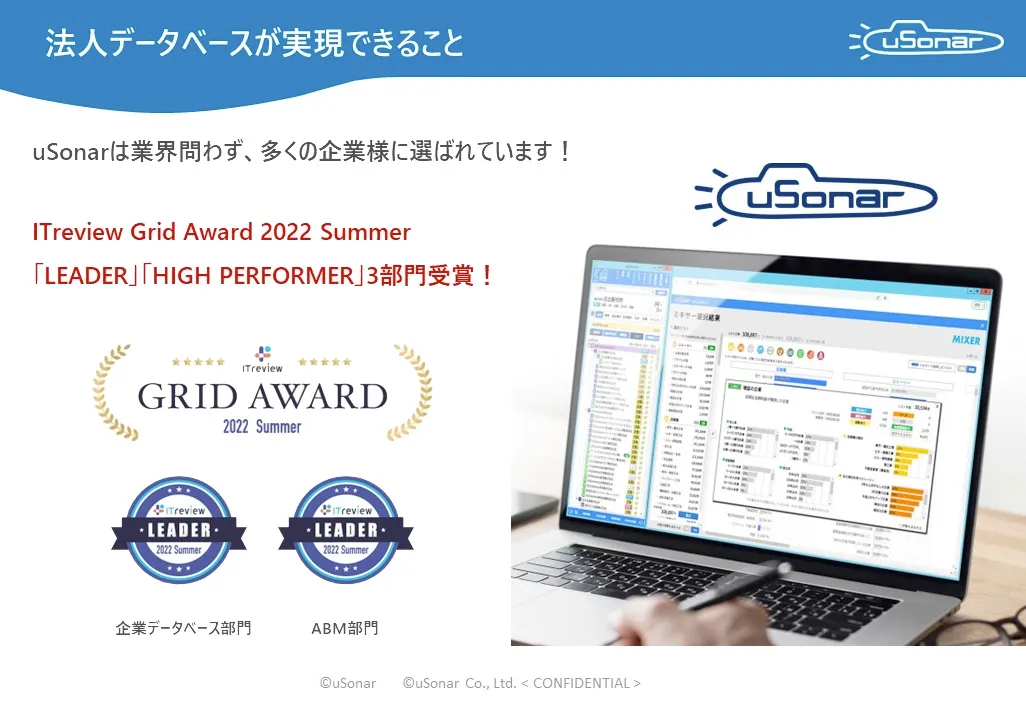
ITreview Grid Award 2026 Summer
Leader in 6 Categories

  • ITreview Grid Award 2026 Summer
  • Corporate Database
    ABM Tool
    Sales List Creation Tool
    Sales Enablement Tool
    Anti-Social Forces Check Tool
    Business Card Management Software

With uSonar,
we can help solve your company's challenges!

Case Studies and Sample Reports
Download
View All Materials
Download Case Studies and Sample Reports

For Urgent Inquiries, Please Call Us03-5388-7000Reception Hours: 10:00 AM - 5:00 PM (Closed on Weekends and Holidays)

The Definitive Solution for Sales DX Through Data Utilization

Service Materials

uSonar in 5 Minutes

Understand uSonar in 5 Minutes

Download Materials