- Data Matching and Data Cleansing
[2026 Latest Edition] How to Perform Data Cleansing: Methods, Procedures, and Key Considerations

Last Updated: March 15, 2024

Scientific Sales:
Learn About uSonar in 5 Minutes
In recent years, the trend of data utilization in business has evolved rapidly. To respond more quickly to customer needs and demands, companies are leveraging data to understand customer preferences and provide products and services accordingly. Furthermore, the use of AI and machine learning technologies is becoming essential for businesses, with data being utilized in various fields such as strengthening the ability to predict customer behavior, optimizing marketing campaigns and sales activities, and improving products and services.
In this article, we will introduce the importance of customer analysis in corporate activities, categorized into "Corporate Data," "Behavioral Data," and "Product Data."
Recommended Articles
Customer analysis is considered essential for understanding customer needs and behavioral patterns, but what specific benefits does it provide? Based on feedback from clients of uSonar Co., Ltd., we introduce several advantages of conducting customer analysis below.
A value proposition refers to the unique value a company offers that addresses high-priority customer needs and cannot be provided by competitors. Analyzing customers and aggregating common requests is the first step toward clarifying your company's points of differentiation. Furthermore, highlighting latent customer demand leads to strengthening your company's uniqueness.
By conducting analysis focused on customer information, companies can make faster decisions in customer interactions. By combining internal and external data and gaining insights into customer behavior through statistical processing, it is possible to strategically improve policies.
Monitoring trends and developments regarding customers, markets, and competitors helps improve business processes and efficiency. By visualizing common industry challenges, you can formulate versatile and effective actions. Additionally, you can respond appropriately to customer churn risks.
Corporate data can be categorized into "information publicly disclosed by companies" and "segment information (attribute information) assigned based on public information."
By utilizing information publicly disclosed by companies, you can narrow down your target markets and customers based on criteria such as industry, revenue, and employee size.
By further cross-referencing segment information, you can clarify your ideal customer profile—such as the specific departments or regions likely to adopt your products—and gain insights into the challenges your customers are facing.
Behavioral data can be categorized into "trends and interests inferred from online behavioral history" and "offline information exchange."
Online behavioral history can be divided into "actions taken on your company's website" and "actions taken outside of your company's website," which can then be processed and matched against corporate information.
Offline behavioral history includes records such as business card exchanges, conversation logs, and sales negotiation status, which are often stored in internal systems like CRM or SFA. By integrating this with online behavioral data, you can visualize the level of interest and the depth of the relationship with your company on a per-customer basis.
Product data can be categorized into "information regarding your own products" and "information regarding competitors' products."
By analyzing information regarding your own products, you can identify trends in features and services that customers prefer, as well as discover key selling points and use cases that provide a competitive advantage.
By analyzing information regarding third-party products, you can gain insights into the strategies customers use to adopt tools and technologies. This allows you to infer the engagement status of competitors and refine your own approach strategy.
Integrating this information organically contributes to a more robust value proposition.
Specific use cases for conducting analysis based on customer data include the following:
By utilizing corporate and product data for market research and competitive analysis, you can obtain information on products and services that are trending in the market. Furthermore, by understanding the approach strategies of competitors, you can evaluate your company's market positioning and develop appropriate strategies.
By leveraging corporate and behavioral data to assign segments to customers and cross-referencing these segments, you can narrow down your target audience and provide marketing messages and services tailored to each specific group.
You can evaluate lead quality and prioritize responses by analyzing customer behavioral data. Furthermore, it is possible to assign sales representatives based on customer behavioral characteristics and their specific stage in the consideration process. This enables sales teams to approach acquired leads with the most appropriate representative and develop customized account plans for each prospective customer.
While the above examples focus on marketing and sales, there are numerous other cases where customer analysis is utilized for customer success and consulting as well.
Through customer analysis, such as customer segmentation and lifecycle analysis, companies can provide more suitable services and products to their customers. Additionally, the results of customer analysis play a vital role in optimizing the cycle and direction of product development, production, and feature enhancement.
In the future B2B market, further integration and utilization of data are expected, leading to the adoption of more sophisticated analytical technologies. Data-driven, rapid decision-making and action will become a Key Success Factor (KSF). By recognizing the importance of customer-related data and grasping customer behavior and market trends in real time, rapid decision-making and customer responsiveness become possible.
The customer data integration solution we provide, uSonar, includes a vast corporate information database that allows for the visualization of all corporate, behavioral, and product data.
Many of our clients use uSonar to build the environment necessary for customer analysis by integrating its data with tools in the CRM and SFA domains.
Furthermore, uSonar provides various visualization functions to efficiently grasp rising market needs and the approaches of competitors.
It is possible to realize the construction of a customer-centric analysis environment and the streamlining of sales and marketing strategy development based on a single integrated database.
For more details, please feel free to contact us via this page.
Author

uSonar Editorial Department
MX Group, Editor-in-Chief
We are the uSonar Editorial Department.
We provide information on data utilization and digital technologies useful for B2B companies to rethink their future business operations.
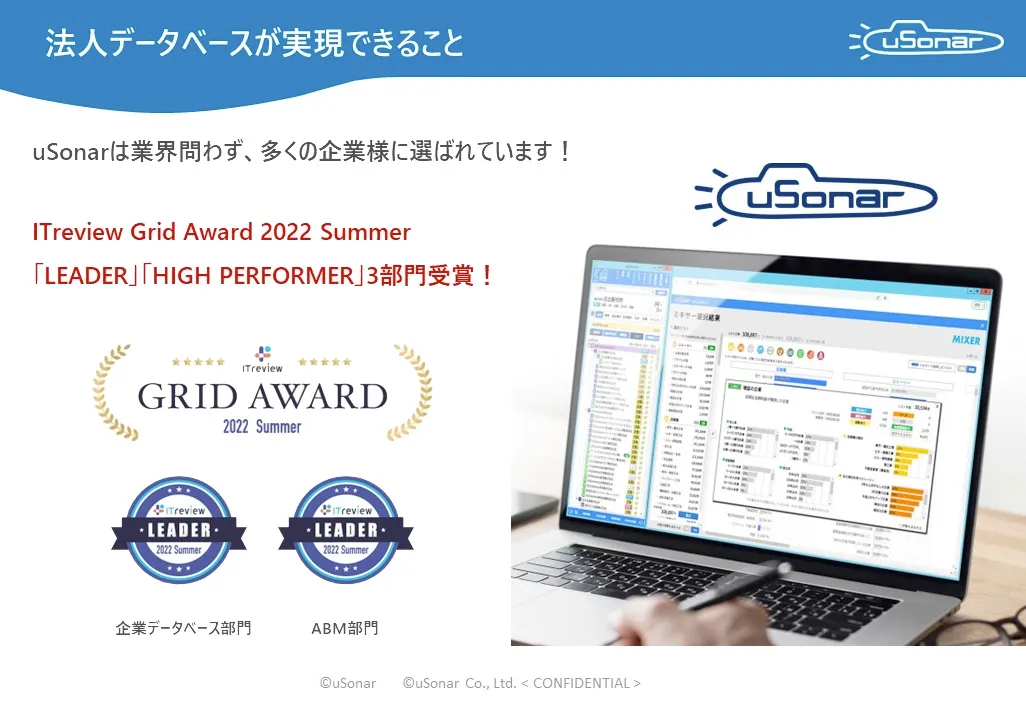
uSonar is utilized by various companies
across all industries and sectors.
ITreview Grid Award 2026 Summer
Leader in 6 Categories

With uSonar,
we will guide your company to solve its challenges!
Case Studies and Sample Reports
Download