






- Inside Sales
What Is the Difference Between Inside Sales and Telemarketing? Key Points for Inside Sales Operations Explained

Use Cases by Objective
New Approach List
Group Strategy

Digital
Marketing

Client Information Registration

Data Deduplication
Corporate Attribute Analysis

SFA/MA Activation

Business Card Data Integration

Credit & Client Check

Use Cases by Department
Sales Department

Inside Sales
Department

Marketing &
Corporate Planning Department

Information Systems Department

Management Department

Use Cases by Tool
Meeting Sonar
Last Updated:
March 27, 2026

Click Here to Learn More About Inside Sales ▶
[Supervised by Akihiko Shigeno]
How to Build an Inside Sales Organization
In recent years, "Inside Sales" has gained significant attention as a key sales strategy.
However, many professionals may still lack a clear understanding of its precise definition and how to effectively implement it.
This article provides a detailed explanation of the definition, characteristics, strategies, and methodologies of inside sales. We also explore which types of companies are best suited for this approach, effective implementation methods, common challenges and their solutions, and future prospects.
If you are looking to introduce inside sales to enhance your sales performance, we invite you to read this article to the end.
Table of Contents
1-1Definition and Characteristics
2Inside Sales Methodologies and Differences from Field Sales
2-2Differences from Field Sales
33 Characteristics of Companies Suited for Inside Sales
3-11. Long Lead Time Until Product Sale
3-22. Broad Target Market Scale
3-33. Need for Data-Driven Sales Strategies
4Effective Implementation Methods for Inside Sales
4-1Team Building and Role Allocation
4-2Collaboration with Sales and Marketing
4-3KPIs and Evaluation Metrics
5Challenges and Solutions in Inside Sales
5-2Approaches to Problem Solving
6Future Outlook for Inside Sales
6-1Future Trends and Forecasts
Recommended Articles

Inside sales is a sales methodology that promotes the sale of products and services by communicating with customers through remote channels such as phone, email, and online meetings.
Unlike cold calling, inside sales is characterized by not necessarily seeking direct appointments with leads (potential customers). Instead, it focuses on providing information to generate interest and build trust, thereby increasing the customer's purchase intent.
Additionally, collecting and analyzing customer needs and behavioral data is a critical component.
The growing importance of inside sales can be attributed to the drive for more efficient sales activities. By completing sales processes online, sales representatives can reduce travel time and expenses, allowing them to engage with a larger number of customers.
Furthermore, because inside sales allows for the collection and analysis of customer needs and behavioral data, it enables the development of more effective sales strategies and customer engagement. Additionally, inside sales serves as an effective means for building long-term customer relationships.
Various methods and tools for inside sales are available. While it is important to select them according to your specific objectives, we will introduce some representative examples here.
[Reference Article] Introducing MA Tools for Inside Sales! 6 Tools Categorized by Purpose ▶
Field sales involve conducting sales activities through direct, face-to-face interaction with customers. This role is responsible for tasks such as detailed needs assessment, business negotiations, product or service explanations, and final contract execution.
On the other hand, inside sales conduct sales activities primarily through remote communication methods such as phone and email, rather than face-to-face meetings. This role is responsible for identifying customer needs, providing basic product explanations and demonstrations, and connecting interested customers to field sales.

The first characteristic is having a long lead time from initial contact to order closure for products or services.
For products that require a lengthy consideration process, inside sales are well-suited for uncovering latent needs and nurturing prospective customers.
Furthermore, inside sales are an optimal choice for products that require continuous transactions or those with potential for upselling and cross-selling.
The second characteristic is handling products with a broad target market.
By utilizing inside sales, even a small sales team can maintain contact with a large number of customers, enabling efficient sales activities. Even when the market scale is large, you can effectively advance your approach.
Additionally, there are cases where the marketing department acquires a large volume of prospective customer information through web pages, seminars, and exhibitions. In such cases, rather than passing leads directly to field sales, conducting needs assessments through inside sales before scheduling meetings increases the likelihood of making more optimal proposals.
The third characteristic is the need for data-driven sales strategies.
Inside sales allow for the collection and analysis of customer needs and behaviors as data.
By understanding customer needs and behaviors, it becomes possible to formulate more effective sales strategies and improve customer engagement. If collecting and analyzing customer needs and behaviors as data is a priority, utilizing inside sales is highly effective.

The five representative roles in inside sales are Team Leader, BDR, SDR, Sales Support, and Marketing Support.
The responsibilities for each role are as follows:
To implement inside sales effectively, collaboration between sales and marketing is essential.
Providing marketing-generated lead information and data on customer needs and behaviors to the sales team enables effective sales activities. Additionally, providing feedback from the sales team to the marketing team allows for the formulation of more effective marketing strategies.
Reference Article: Explaining 3 Key Points for Collaboration Between Inside Sales and Marketing! ▶
To measure the effectiveness of inside sales, it is important to set KPIs (Key Performance Indicators) and evaluation metrics.
KPIs include sales performance, the number of customers acquired, and customer satisfaction. Evaluation metrics include the efficiency of sales activities and the quality of customer service. By setting KPIs and evaluation metrics and conducting regular assessments, you can grasp the effectiveness of your inside sales and formulate improvement measures.
Even after launching an inside sales department, it is possible that you may not achieve the desired results.
Below, we have listed common challenges encountered after introducing inside sales. Compare these with your company's structure to identify your specific challenges.
For each of the challenges mentioned above, the following approaches are effective for resolution.
Several key points are predicted as future trends for inside sales.
As inside sales evolve, various changes are anticipated.
In this article, we have provided a detailed explanation of inside sales.
Inside sales is a sales methodology well-suited for building efficient sales activities and data-driven strategies.
It is particularly effective for companies with products that have long lead times or those targeting broad markets. By collecting and analyzing customer needs and behaviors as data, more effective sales strategies become possible. As inside sales continues to evolve through the use of AI and the strengthening of omnichannel strategies, companies must prepare to adapt to these trends.
Through the practice of inside sales, companies can build longer-term relationships with their clients. If you are considering implementing inside sales, please use this article as a guide to develop the optimal strategy for your organization.
About the Author

uSonar Editorial Department
MX Group, Editor-in-Chief
This is the uSonar Editorial Department.
We provide information on data utilization and digital technologies useful for B2B companies to rethink their future business operations.
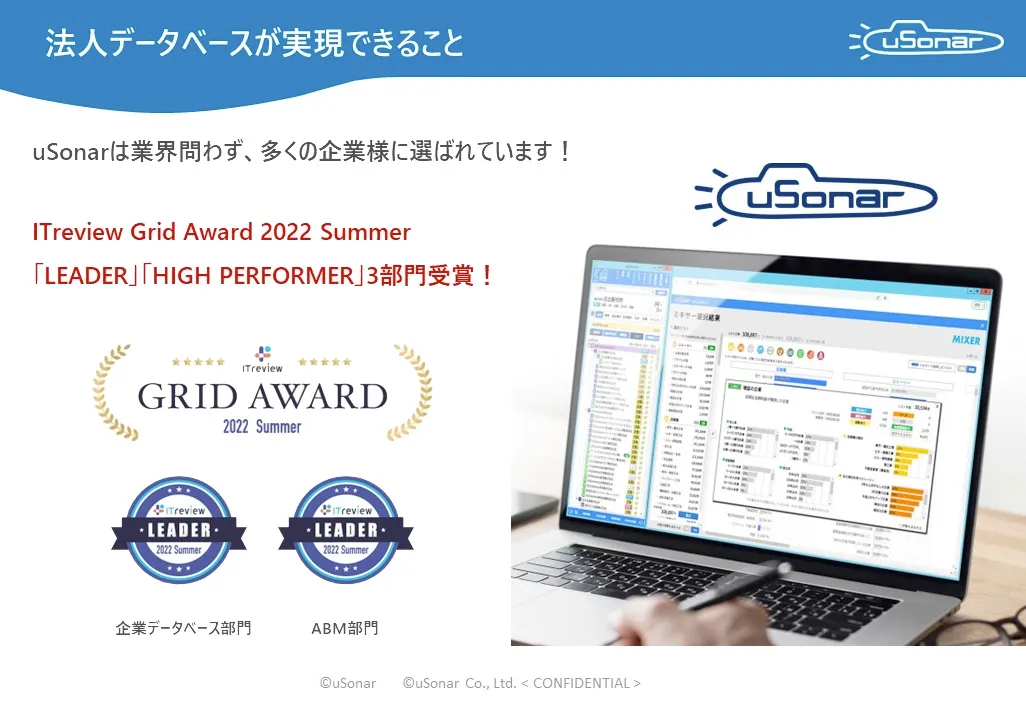
uSonar is utilized by various companies
across all industries and sectors.
ITreview Grid Award 2026 Summer
Leader in 6 Categories

With uSonar,
we can help solve your company's challenges!
Case Studies and Sample Reports
Available for Download