- Data Utilization
Data Utilization in Business: What Are the Necessary Processes and Challenges to Solve?

Update Date: May 12, 2023

Click Here to Learn More About Data Utilization ▶
"Scientizing Sales"
The Definitive Guide to Sales DX Through Data Utilization
In most sales organizations, performance is evaluated based on quarterly or annual revenue targets.
These evaluation methods are typically divided into "Team/Department Performance Evaluation" and "Individual Performance Evaluation."
Naturally, evaluators place higher expectations on sales teams and representatives who demonstrate strong performance.
Unfortunately, teams with lower evaluations are often forced to exert significant effort to recover their standing.
So, what specific efforts or transformations can lead to improved performance?
In this article, we will explain "Data-Driven Lead Analysis," a practice employed by top-performing sales representatives, as a reference.
Recommended Articles

Evaluators in the sales department assess representatives based on the likelihood of converting leads into closed deals.
Rather than relying on a single numerical metric like the number of closed deals, they define a "top-performing" sales representative by analyzing the representative's performance distribution over a specific period.
Leads are then assigned to sales representatives in order of their likelihood to convert.
Based on the perspectives above, the most suitable representative is assigned.
Specifically, the distribution process is streamlined using the following criteria:
We evaluate whether a lead matches our target market or customer profile to determine if we should pursue sales activities. This evaluation is based on factors such as industry, company size, region, and similarity in needs or challenges. We also use metrics like budget and purchase intent to assess the potential for future high-value sales or long-term relationship building.
By evaluating the lead's level of interest, we determine the likelihood of them engaging with our information or content and moving forward with a deal. Specifically, we consider factors such as the number and frequency of website visits, whether they have downloaded specific content, or their participation in marketing campaigns.
We evaluate the frequency of responses and communication regarding sales activities to determine the necessity of follow-up or information provision. For leads with high response rates, we can allocate more resources to provide in-depth information, thereby increasing the potential for business negotiations. For leads with low response rates, we must conduct regular follow-ups to nurture their interest.
This system is built on a commitment to prioritizing the customer.
Furthermore, the foundation of this system is the collection and analysis of data.

Leads (prospective customers) face various business challenges.
An excellent sales representative is defined by their ability to derive a context in which the company's products or services can solve the lead's specific challenges.
So, how do top-performing sales representatives derive this context?
The answer lies in "thorough preparation." By preparing efficiently, they can demonstrate to the customer that they have a wide range of "drawers" (knowledge/solutions) to provide accurate answers to various questions.
One method for efficient preparation is data utilization.
By using data to comprehensively anticipate a lead's needs, representatives can expand their "drawers," which in turn leads to higher conversion rates.
Specifically, using the following types of data is said to improve efficiency:
1. Industry Data
Research which industry the lead belongs to and investigate what solutions our company has provided to solve specific challenges in that segment.
2. Sales/Profit-Related Data
Understand the sales and profit trends of the last few years to evaluate whether the company is in a financial position to invest.
Additionally, investigate whether the company is investing in our product or service areas based on information such as "investment status by sector" found in public documents.
3. Company Size Data
By analyzing the distribution of personnel (executives and employees) by department or region, we can predict the lead's focus areas and determine if they align with our product or service offerings.
4. Intent Data
Visualize the areas in which the lead has a particular interest based on online behavioral data.
At the same time, collect information on whether their interest in competitor services is increasing, and determine whether to include competitive advantages as part of the sales pitch.
5. Corporate Group Data
Clearly define and classify relationships between companies, branches, and organizations based on capital and other criteria.
This allows us to identify group companies that likely face similar challenges and consider horizontal expansion of our sales approach.
Collecting information about leads using a unified standard helps in determining lead quality and increases the productivity of sales representatives.
By prioritizing leads with specific needs and a high probability of continuous payment, and by dedicating time to detailed proposal activities, we can maximize the use of limited resources.
Furthermore, for leads with lower potential, knowing in advance which approaches are effective through data allows for more efficient regular follow-ups.
One challenge faced by sales representatives across all industries is the lengthening of the sales cycle.
In particular, purchasing decisions for services related to overall corporate activities, such as new systems, tend to involve more stakeholders than in the past. Consequently, there is a need for more in-depth discussions with more decision-makers over a longer period, creating a dilemma where it is difficult to achieve immediate sales results.
However, for many advanced companies, investment in the efficiency of corporate activities remains a priority management issue, and for highly competitive companies, it is an area where growth can be expected.
Many purchasing managers at client companies are open to receiving insightful proposals from sales representatives.
This is because they want to build sustainable relationships with trusted partners rather than purchasing from vendors they are not interested in.
Understanding these customer perspectives and utilizing information revealed through data to propose solutions to prospective customers' challenges is likely the most essential element for successful business negotiations.
Author of This Article

uSonar Editorial Department
MX Group, Editor-in-Chief
We are the uSonar Editorial Department.
We provide information on data utilization and digital technologies useful for rethinking future business operations, primarily for companies engaged in B2B business.
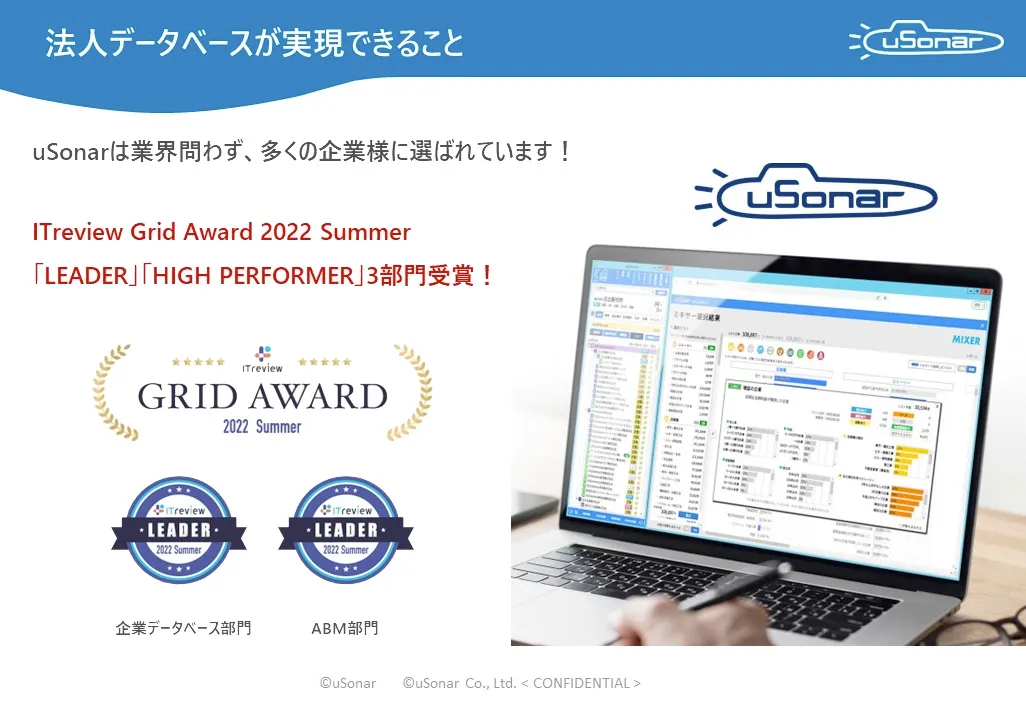
uSonar is utilized by various companies
across all industries and sectors.
ITreview Grid Award 2026 Summer
Leader in 6 Categories

With uSonar,
we can help solve your business challenges!
Case Studies and Sample Reports
Available for Download