- Data Utilization
- Sales Strategy
What Is Sales DX? A Thorough Explanation of Its 5 Key Benefits, Importance, and Success Factors!

Update Date: May 12, 2023
The Definitive Guide to Sales DX Through Data Utilization
Learn About uSonar in 5 Minutes
Low productivity is frequently cited as a challenge in Japanese corporate sales, making operational efficiency a major priority. How can companies approach improving sales efficiency? Data utilization is considered one of the keys to achieving this.
This article explains the key points for improving sales efficiency through data utilization.
• You feel there is waste in your sales operations.
• You want to streamline sales activities to achieve results in less time.
• You want to improve sales efficiency across your entire team and company.
• You are already utilizing data but have not yet achieved improved efficiency.
If any of these apply to you, please read on.
Table of Contents
1Is Wasted Time in Japanese Sales Activities Increasing?
2Factors Contributing to Low Sales Efficiency
2-1Pattern 1: Wasted Efforts Due to Visiting Low-Probability Prospects Without Closing Deals
2-2Pattern 2: Repeated Rejection from Cold Calling Through Customer Lists
2-3Pattern 3: Sales Methods Are Individualized, Leading to Disjointed Team Efforts
3Improving Efficiency Through Data Utilization
3-2Pattern 1: Identifying High-Probability Prospects Using Data to Increase Conversion Rates
3-3Pattern 2: Prioritizing Outreach Targets Based on Data-Driven Insights
3-4Pattern 3: Standardizing Sales Methods Through Data for Scalable Implementation
4Getting Started with Data Utilization
4-22. Organizing Collected Data
4-33. Communicating to Relevant Personnel
4-44. Refining Through Operational Use
5Beware of Data Utilization Pitfalls
5-1Effectively Using Collected Data for Sales Activities
6Conclusion: Reallocating Saved Time and Costs to Building Customer Trust
Recommended Articles
What Is Sales DX? A Thorough Explanation of Its 5 Key Benefits, Importance, and Success Factors!
Expert Insights from Corporate Database Professionals | A Guide to Developing Sales Strategies: Explaining Key Success Factors!

How Does Data Usage Transform Sales? Explaining the Importance of DX in B2B Sales
In recent years, companies across various sectors have been working on DX in the sales field. Through these initiatives, many companies have introduced various digital tools such as SFA and CRM to improve sales efficiency and achieve better results...
However, survey results that overturn this impression have been published.
In the 4th "Survey on Awareness and Reality of Sales in Japan 2023" released by HubSpot Japan K.K. in February 2023, it was found that "wasted time in Japanese sales activities" has increased by approximately 150 billion yen to reach about 1 trillion yen compared to the same survey conducted one year prior.
Although the number of companies working on DX promotion is increasing, it is clear that they have not yet realized the efficiency improvements that are one of the primary objectives of these efforts.
☆-☆-☆ Body End ☆-☆-☆What are the factors that lead to poor sales efficiency? Let's look at two patterns of waste and inefficiency that occur during sales activities.
When customer data lacks useful information, sales representatives may rely on intuition to visit prospects, resulting in wasted time. This makes both travel time and meeting time inefficient and unproductive.
In traditional sales styles where priorities and statuses are not managed, representatives may cold call through customer lists and face constant rejection. Beyond the waste of time, this also takes a toll on the mental well-being of the staff.
Information on which approaches to specific customers led to successful deals is not shared among representatives or teams, leaving results to individual intuition. Because everyone is working independently, similar mistakes are repeated everywhere. This means valuable successful experiences are wasted.
Do any of these sound familiar to you?
There is one common factor shared by these examples: the failure to effectively utilize data within sales activities.
 ☆-☆-☆ Body Start ☆-☆-☆
Many companies might say, "We have customer data and we use it for sales." However, that alone does not constitute proper data utilization. So, what exactly is data utilization?
"Data utilization in sales" literally means conducting sales activities by leveraging collected data. It refers to making decisions or taking actions based on numerical data.
Instead of relying on intuition, sense, and experience as in the past, sales methods are determined by collecting and analyzing data to identify patterns.
While "customer data" is the primary focus, "data related to sales activities," such as sales performance and timing of results, is also important.
Let's look at how the three patterns mentioned above change when data is utilized.
If information that can determine probability is accumulated in customer data, you can follow those patterns to extract high-probability prospects and improve the closing rate for each visit. For example, if closing rates differ based on industry or company size, you can develop strategies such as focusing your approach on segments with higher closing rates.
☆-☆-☆ Internal Link Button Start ☆-☆-☆ ☆-☆-☆ Internal Link Button End ☆-☆-☆If customer data attributes and current statuses are managed as information, you can narrow down targets and determine priorities based on data. Instead of blindly contacting prospects without a set order, you can prioritize and contact those most likely to convert.
☆-☆-☆ Internal Link Button Start ☆-☆-☆ ☆-☆-☆ Internal Link Button End ☆-☆-☆By visualizing the methods of top-performing sales representatives through data accumulation, standardizing them, and permeating them throughout the team, you can break away from individual reliance and raise the performance of the entire team. Instead of leaving the timing of visits or the use of talk scripts to individual intuition, these are converted into data, accumulated, and shared.
☆-☆-☆ Internal Link Button Start ☆-☆-☆ ☆-☆-☆ Internal Link Button End ☆-☆-☆As shown, promoting data utilization makes it possible to conduct sales activities efficiently.
Although the concept of data utilization has permeated marketing first, the reality is that many companies have yet to implement it in their sales activities.
By seriously engaging in data utilization for sales activities now, you will be able to stay one step ahead of your competitors.
When working on improving sales efficiency through data utilization, proceed with the following steps:
1. Collect data
2. Organize collected data
3. Inform and train staff
4. Refine through operation
Start by gathering and centralizing customer data and sales activity data scattered across various locations. Deciding which items to manage as information is also important.
While collected data can be organized using Excel or spreadsheets, if you are aiming for broad efficiency across the entire company or department, consider utilizing tools such as SFA.
Inform staff on how to use the collected data and what tasks are required to continuously accumulate data (such as inputting into tools) to integrate data-driven sales operations.
Once data is collected and tools are introduced, run the PDCA cycle by repeating analysis and improvements while operating the system.
Introducing data utilization has specialized and difficult aspects, such as data collection methods, tool implementation, and thorough staff training. Considering consultation with experts will likely increase the success rate of your implementation.
☆-☆-☆ Body End ☆-☆-☆Many companies introduce DX tools like SFA, collect and digitize data, and input it into the tools, only to encounter the following failures:
It is essential to design in advance how to extract (filter) the collected data and how to approach prospects.
Otherwise, you may revert to inefficient sales activities, such as "cold calling all accumulated customer data."
In data utilization, how you segment the data is very important.
Decide firmly how to extract information from the vast amount of data. Designing this process also leads to the standardization of sales processes that tend to be individualized.
Customer information is updated daily as sales activities progress. Information regarding "what the current status is" is particularly important; if this information is not updated and is missed, correct information will not reach the staff, leading to wasted sales activities.
Furthermore, if data quality declines due to issues like duplicate entries or missing items, trust in the data will decrease, and the effectiveness of tool implementation will be diminished.
Maintaining the quality of customer data is a very important element for sales efficiency.
By keeping these points in mind, you can avoid the failure of "introducing a new tool but failing to utilize it effectively."
In this article, we explained the key points of data utilization to improve sales efficiency, the implementation steps, common pitfalls, and how to prevent them.
It is often said that in today's market, purchasing decisions are driven not only by price, product, or service quality, but by corporate trust. The HubSpot study mentioned at the beginning also highlights that being a trustworthy company is the most critical factor in purchasing decision-making.
The significance of improving sales efficiency lies in the ability to reallocate the saved time and costs toward building trust with high-probability prospects. Furthermore, this reclaimed time can be invested in initiatives for further operational optimization.
Of course, this also contributes to healthier working hours and improved mental well-being for sales representatives.
We encourage you to leverage data to enhance your sales efficiency and build a more advanced sales style.
About the Author

uSonar Editorial Department
MX Group Editor-in-Chief
We are the uSonar Editorial Department.
We provide information on data utilization and digital technologies useful for considering future business operations, primarily for companies engaged in B2B business.
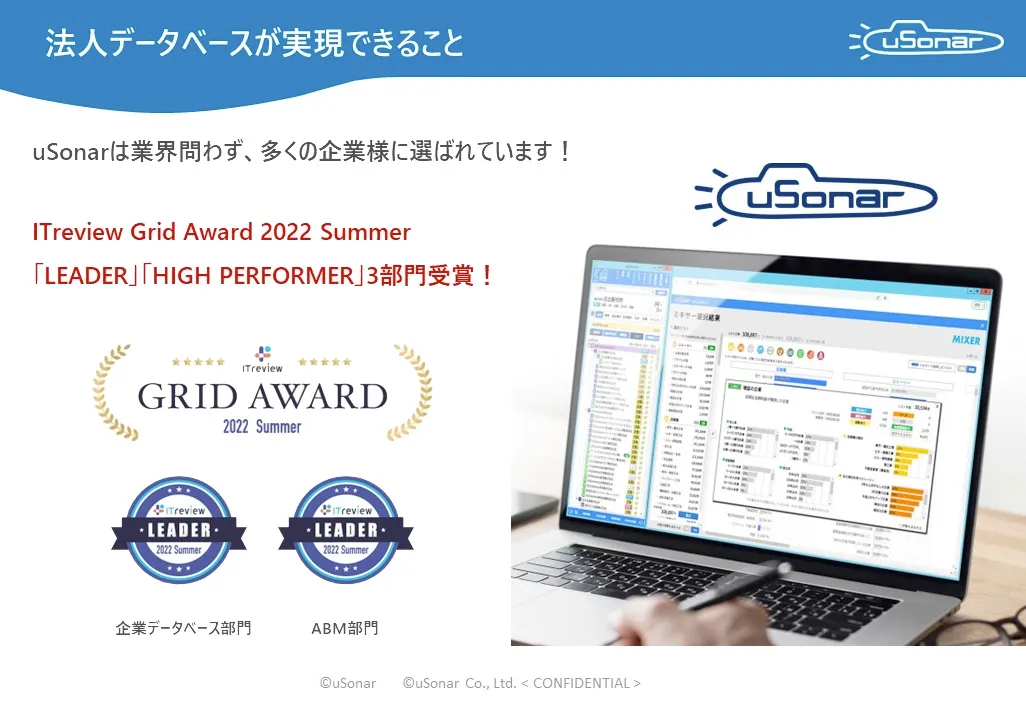
uSonar is utilized by various companies
across all industries and sectors.
ITreview Grid Award 2026 Summer
Leader in 6 Categories

With uSonar,
we can help solve your company's challenges!
Case Studies and Sample Reports
Available for Download