- Credit & Anti-Social Force Check
- Sales Strategy
- New Business Development & Sales Lists
- Corporate Registry
How to Choose a Corporate Registry Acquisition Service: 6 Criteria and the Selection Process Explained!

Last Updated: August 22, 2023

Click Here to Learn More About Creating Sales Lists ▶
Scientizing Sales:
Understanding uSonar in 5 Minutes
To conduct efficient sales activities, it is essential to create high-quality sales lists that consolidate customer information. Regularly reviewing and updating your sales lists can improve sales performance and drive corporate growth.
This article introduces the specific benefits of building sales lists and the characteristics of lists that lead to results. We also explain the procedures for building sales lists and key points for achieving better outcomes.
Table of Contents
1Characteristics of High-Performing Sales Lists
1-1Always Updated with the Latest Information
2Why Is Sales Prospecting Necessary?
2-1Enables Efficient Sales Activities
2-2Useful for Upselling and Cross-Selling
2-3Leads to Improved Customer Satisfaction
3Procedures for Creating Sales Lists
4Key Points for Achieving Results with Sales Prospecting
4-1Formulate Hypotheses Regarding Customer Needs
4-2Continuously Expand Your Prospect List
4-3Continue Updating and Managing Your List
Recommended Articles
How to Choose a Corporate Registry Acquisition Service: 6 Criteria and the Selection Process Explained!

Why a Corporate Registry Provision Service Is Essential Now: Background and Risks of Neglect Explained!
Methods for creating and managing sales lists vary by company. However, effective sales lists share common characteristics. When creating or improving your company's sales lists, keep the following features in mind.
To ensure sales lists deliver results, the content must be constantly updated. Updating your sales list is an essential task to avoid unnecessary trouble and complaints, and to conduct sales activities efficiently. In the business world, customer information is constantly changing due to factors such as office relocations, personnel changes, and shifts in business operations. If you leave a sales list unupdated in such an environment, you may experience increased issues such as documents being returned from old addresses or calls failing to connect, which reduces sales efficiency. If you are unable to maintain proper contact with clients, it can lead to various troubles and complaints, potentially hindering your daily sales activities.
A high-quality sales list contains no duplicate data, such as the same company being registered under multiple names. Data duplication leads to inefficiencies, such as approaching the same company multiple times with the same content or method, which can damage your company's reputation. As data grows, identifying duplicates becomes more difficult, making organization challenging. Therefore, companies with high-quality sales lists check for duplicates daily and correct them immediately upon discovery. An effective way to prevent data duplication is to establish naming conventions for companies. It is necessary to foster a culture within your company of registering both formal and abbreviated names, and ensuring the list is updated whenever a client company merges.
Listing promising companies as sales targets leads to further efficiency in sales activities. Specifically, there are three main benefits.
By gathering detailed information on promising companies, managing it centrally with IT tools, and sharing it across the sales department, each sales representative can search and view this data. This makes it easier to determine which companies to approach, when, and how. Naturally, the more accurate and fresh the information on the listed companies, the greater the improvement in sales efficiency. By establishing such a list-building environment, you can prevent issues like not knowing who to approach or how to initiate contact.
Building a sales list is also useful for upselling and cross-selling. Both methods aim to increase the average customer transaction value.
In upselling, you propose higher-tier products to customers considering a purchase or those already under contract. In cross-selling, you recommend additional products to be used alongside the primary product. These are typically products that are convenient when used in combination with the product the customer is currently considering, or other items the customer has shown interest in.
By documenting the purchase history and anticipated needs of promising customers on your sales list, you can easily implement upselling and cross-selling tailored to each company's situation. Consistently providing beneficial upsell and cross-sell opportunities can also be expected to increase repeat business.
It is important to keep customer needs updated and detailed within your sales list. This allows you to propose the products and services customers want at the right time, leading to both direct sales growth and improved customer satisfaction. Furthermore, by sharing the listed customer information centrally across the sales department, you create an environment where everyone can efficiently collect sales-related information. This provides the time to approach each customer more carefully. Naturally, this also prevents troubles such as duplicate approaches to the same company. Overall, these benefits lead to higher customer satisfaction.
Here, we explain the basic steps for building a list, divided into four parts.
Step 1 is data analysis. Analyze existing customer information in detail to understand the current situation: what kind of customers use your products or services, and in what situations.
Step 2 is segmenting the customer list. Create groups based on attributes such as industry or location, and categorize customers accordingly. Then, analyze how much of each product is purchased or used by each group. This allows you to predict common needs and the future market potential of each group.
Step 3 is target setting. Based on Step 2, pick the groups that are most suitable as your main targets, such as groups with high purchase rates or high average order values.
Step 4 is customer scoring. Assign scores based on attributes and behaviors for each company or individual. For example, set scores such as "Company size of 1,000+ employees: +20" or "Spontaneous inquiry: +10." Calculate the total score for each customer within the target group, and list those who exceed a certain threshold as "promising customers."

To practice list building that leads to steady results and to realize those effects in actual sales, please keep the following three points in mind.
When building a list, it is important to formulate hypotheses regarding customer needs and budget settings.
For example, suppose your company provides "basic training services for new graduates." In this case, investigate whether the client company is hiring new graduates. You can check their official website for new graduate job postings or search for the company on job sites. If the listed company is hiring new graduates, you can anticipate that they have the needs and budget for your service.
Do not stop after building the list once. Continue to increase the number of customers on your sales list daily. Seek out companies that have contact with your firm or those whose needs match your products. For example, by analyzing access to your website, you can identify companies that have visited. Adding these company names to your sales list helps expand it.
Continuing to update and manage the list is also a key point. In addition to segmentation and scoring, keep dynamic information updated to maintain a sufficient volume of data. For example, after approaching a prospect, record the results in the company's entry to track the current relationship and their interest in specific products. This leads to smoother improvements in the timing and method of future approaches, enhancing the quality of your sales.
Using IT tools is also effective for streamlining sales list building. uSonar is a solution that optimizes and integrates customer data, supporting effective list building.
By implementing uSonar, your company's customer database is integrated with LBC, one of Japan's largest corporate databases. This makes it easy to create optimal sales lists and automatically handles changes such as company relocations or name changes. By deriving trends common to existing customers, it identifies potential new customers, allowing you to efficiently list new targets that should be prioritized.
It is also important that using LBC makes it easier to exclude companies that should not be approached. For example, companies associated with anti-social forces can be identified through capital relationships or locations, reducing the risk of accidentally listing targets that should be avoided for social or compliance reasons.
An application called "Side Sonar" is also attractive. It integrates seamlessly with existing CRM, SFA, and Marketing Automation (MA) tools to manage customer data centrally. While using these tools, Side Sonar operates constantly to display accurate corporate information.
*Side Sonar will cease new provision as of February 2025. Analysis and list creation functions have been transferred to PLANSonar, and CRM/SFA enhancement functions have been transferred to GuideSonar.
Additionally, "mSonar" is useful. By linking your existing business card data with LBC, you can enrich the data. For example, you can manage business card data on mobile devices with added information such as company size, industry, and number of employees. This type of business card management appropriately connects physical sales sites with digital sales activities, making overall sales activities more efficient.
To translate sales list building into efficient sales activities, it is important to put the points introduced in this article into practice. Additionally, utilizing IT tools can lead to even greater results. Especially with an IT tool like uSonar, which allows you to reference one of the largest corporate databases in Japan, you can keep your company's customer data in an optimal state at all times. If you want to maximize the effectiveness of your sales lists, consider implementing it.
About the Author

uSonar Editorial Department
MX Group, Editor-in-Chief
We are the uSonar Editorial Department.
We provide information on data utilization and digital technologies useful for considering future business operations, primarily for companies engaged in B2B business.
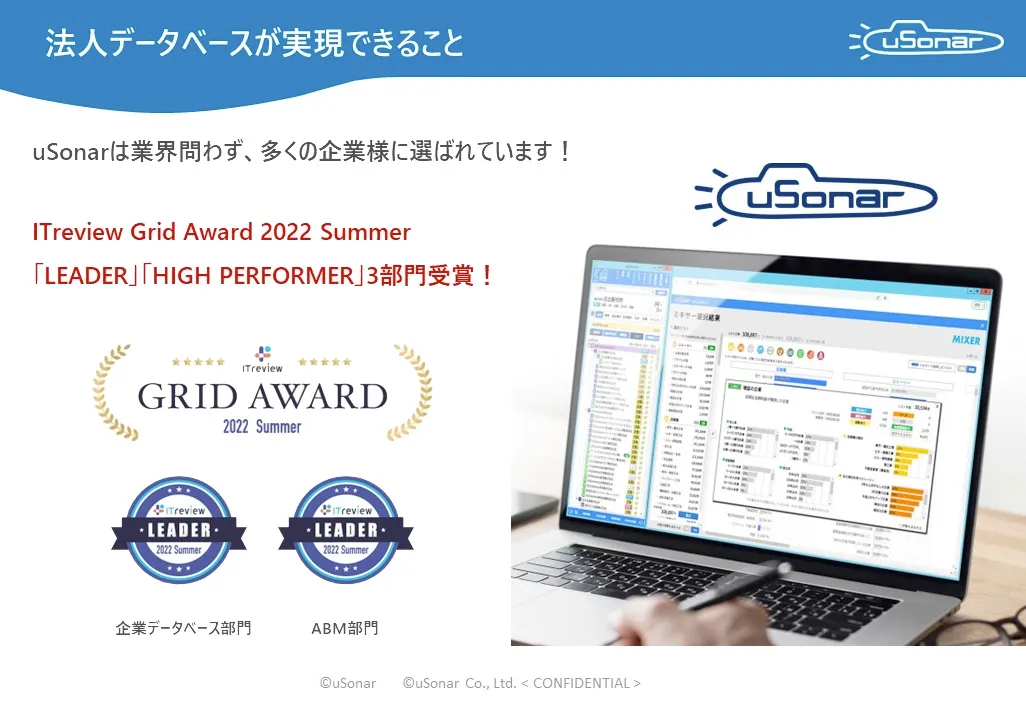
uSonar is utilized by various companies
across a wide range of industries and sectors.
ITreview Grid Award 2026 Summer
Leader in 6 Categories

uSonar Can Help Solve Your Business Challenges!
Case Studies and Sample Reports Available for Download
View All Materials