- Sales Strategy
- New Business Development & Sales Lists
A Detailed Guide to the Fundamentals of New Business Development and 20 Sales Techniques.

Last Updated: September 25, 2023
Click Here to Learn More About New Business Development ▶
Scientizing Sales:
Understanding uSonar in 5 Minutes
To achieve success in corporate sales, consistent effort in new business development is essential. However, new business development is not easy. Amidst intensifying competition and market volatility, acquiring new customers and clients always presents certain challenges. This article focuses on common challenges in the new business development process and summarizes key insights to overcome them. Let us examine the following points to drive success in your new business development efforts.
Table of Contents
1Common Challenges in New Business Development
1-11.1. Insufficient Number of Leads
1-21.2. Insufficient Segmentation
1-31.3. Difficulty in Identifying BANT
2High-Quality Sales Lists Are Essential for Successful New Business Development
2-42.4. Leveraging External Data
3The Impact of List Quality Improvement on Success Rates
3-12.6. Improving Conversion Rates
3-32.8. Preventing Sales Representative Burnout
4Common Challenges in Sales Approaches
4-13.1. One-Sided Sales Messaging
4-23.2. Lack of Appropriate Questioning
4-43.4. Inappropriate Timing of Proposals
5Common Methods for Understanding Customer Needs and Selecting Appropriate Approaches
6Do Not Give Up After Being Rejected: Perform Follow-Ups
6-14.1. Standard Number of Lost Opportunities Before Closing a Sale
6-24.2. The Significance of the Number of Rejections
6-34.3. However, Do Not Use the Number of Rejections as a Performance Metric
Recommended Articles
A Detailed Guide to the Fundamentals of New Business Development and 20 Sales Techniques.

How to Choose a Corporate Registry Information Acquisition Service: 6 Criteria and Selection Processes Explained!
There are various factors involved in successfully developing new business. Here, we focus on and explain three key areas: Lead Volume, Segmentation Depth, and BANT Qualification.
Lead volume is a critical factor when acquiring new customers. If the number of leads is insufficient, the sales team is constrained from the outset in pursuing appropriate opportunities. Naturally, a higher volume of leads expands options and increases the probability of success.
Common methods to resolve a shortage of leads are outlined below. Explore the methods that best suit your company.
Segmentation, the process of categorizing customers along various axes, is an essential element for success in new business development. Segmentation creates the foundation for deploying specific strategies for different customer groups. By performing segmentation, you can execute the optimal approach for the most suitable potential customers, which also leads to resource optimization.
BANT is a well-known acronym in B2B sales, standing for Budget, Authority, Need, and Timing. Grasping these four elements helps in evaluating a customer's purchasing intent. Accurately understanding BANT information improves lead quality and reduces wasted resources. However, because building a relationship of trust with the customer is essential, grasping BANT takes time.
To acquire new business, high-quality sales lists are indispensable. These lists contain information on potential customers and clients, which can be used to narrow down targets and maximize results. This section explains in detail how to build high-quality sales lists and the key points to consider.
The quality of a sales list is directly linked to its utility. It is necessary to ensure data accuracy and eliminate outdated or duplicate information. Implement a quality management process and perform regular data updates.
For an accurate understanding of the current situation, "data cleansing" (merging identical information within the database) is also essential. Please check the following for information on customer data cleansing.
When building a list, consider target segmentation. Decide which industries, regions, and company sizes to focus on, and organize the list accordingly. Different approaches are required for each segment.
By developing new business in segments that your company has not yet approached, despite them being your target, you can effectively compensate for a shortage of leads.
You may be able to create sales lists by utilizing your company's core systems, CRM (Customer Relationship Management), or SFA (Sales Force Automation) systems. These systems are useful for organizing data and segmentation.
However, note that the primary role of CRM and SFA is pipeline management for customers with whom you already have contact. By analyzing targets based on customer information in the system and conducting actual approaches to groups of companies with whom you have not yet established contact, efficient new business development becomes possible.
For effective approaches to companies with no prior contact, utilizing external data should be considered an option. By obtaining data from reliable data providers and adding it to your list, you expand your chances of finding new potential customers. Representative companies in Japan that can provide corporate lists include Teikoku Databank, Tokyo Shoko Research, and our company, uSonar.
The uSonar database is characterized by its comprehensive coverage of data not only for large corporations but also for small and medium-sized enterprises, government agencies, and other non-private sector entities at the "business establishment" level. Please check here for details on uSonar, which applies science to sales.
The importance of high-quality sales lists goes without saying, but how exactly does improving their quality influence your success rates?
By using high-quality sales lists, you can approach potential customers who closely match your target profile. This increases conversion rates and enhances business profitability.
High-quality lists reduce wasted time and resources. Sales activities based on lists that do not match your target result in a waste of time, whereas using high-quality lists enables efficient time management.
The most typical method for new business development is often simply cold calling. In such sales organizations, representatives frequently face blunt rejections and struggle to close deals, which increases the mental burden on the sales staff.
With high-quality lists, you are selecting potential customers who are a good fit for your services from the start, allowing you to approach them with the primary goal of solving their business challenges. Compared to random outreach, the quality of each lead is higher, making it more likely that investing time in thorough preparation will yield significant results. Consequently, this will also alleviate the mental burden on your sales representatives.
Success in new business development depends heavily on your sales approach. Once you have selected your target list, the strategy for how you approach those prospects becomes critical. This section explains common mistakes and key considerations in sales outreach.
A common mistake is sending one-sided sales messages to prospects. Customers are focused on their own needs and pain points and are looking for proposals that align with them. Sales representatives must understand the customer's perspective and demonstrate value through meaningful dialogue.
Failing to ask the right questions during a sales approach can lead to a lack of information and misunderstandings. It is often said that sales representatives who simply ask, "What are your company's challenges?" are second-rate. This implies that instead of asking about challenges or needs directly, you should approach the meeting with a hypothesis. By preparing thoroughly before the outreach so that you can ask, "Is your challenge related to X?", you can more easily build a relationship of trust with the customer.
Applying excessive pressure can alienate potential customers. Prioritize building a relationship of trust by proceeding at a pace that suits the customer.
Presenting proposals or product explanations at the wrong time can cause you to lose the customer's interest. In B2B sales, in particular, timing is a crucial factor in closing a deal. It is essential to identify the right moment to present your proposal.
Furthermore, it is important to follow up consistently, even after an initial rejection. A lost lead may not mean the customer does not need your product; it may simply mean the timing was not right.
The key to a successful sales approach is to accurately understand customer needs and select the appropriate strategy. While the following are examples of solutions, the ideal approach varies by company. It is essential to explore the methods that best suit your organization.
To understand customer needs, conduct thorough research in advance. Grasp their industry, challenges, and goals, and tailor your proposals accordingly.
Adopt a customized approach tailored to the customer rather than a generic one. It is crucial to provide value that resonates with the customer.
The sales process is also a forum for dialogue. By listening carefully to the customer and showing empathy, you can more easily build a relationship of trust.
In your sales approach, it is important to consider long-term relationships rather than just short-term success. By ensuring customer satisfaction and building trust, you generate repeat business and positive word-of-mouth.
In B2B sales, rejection is an unavoidable reality. However, there are statistical trends regarding the number of rejections, and it is important to understand their significance.
In B2B sales, the probability of success on the first approach is generally low. In many cases, sales representatives only win a contract after several approaches.
According to the "2023 Survey on Sales Awareness and Reality in Japan" by HubSpot Japan, 60% of customers reject an offer four times before closing, yet 48% of sales representatives never attempt a follow-up.
- Building Trust: Customers expect sales representatives to be committed and demonstrate reliability. Multiple approaches provide opportunities to build trust.
- Clarifying Customer Needs: Multiple interactions are necessary to accurately understand customer needs and requirements. Rejections serve as opportunities to gather more detailed information.
- The Importance of Timing: Customer situations and priorities can fluctuate. Follow-ups after a rejection can lead to engagement at the right time.
While there are statistical trends in rejection rates that highlight the importance of continuous follow-up, be careful not to use the number of rejections as a performance metric. Doing so can lead to persistent, unproductive approaches to customers with no potential for closing, which may contribute to the aforementioned sales representative burnout.
Remember that the ultimate goal is to increase sales, and that lost opportunities are simply a part of that process.
In this article, we summarized the key points for B2B new business development, focusing on the importance of high-quality target lists and continuous follow-up.
In business, the causes of failure (challenges) are often common, but the factors for success vary from company to company. Once you have grasped the challenges and potential solutions from this article, it is important to actually reach out and explore the methods that work best for your company.
If you wish to conduct new business development efficiently, please check the details of uSonar below.
About the Author

uSonar Editorial Department
MX Group, Editor-in-Chief
This is the uSonar Editorial Department.
We provide information on data utilization and digital technology useful for considering future business operations, primarily for companies engaged in B2B business.
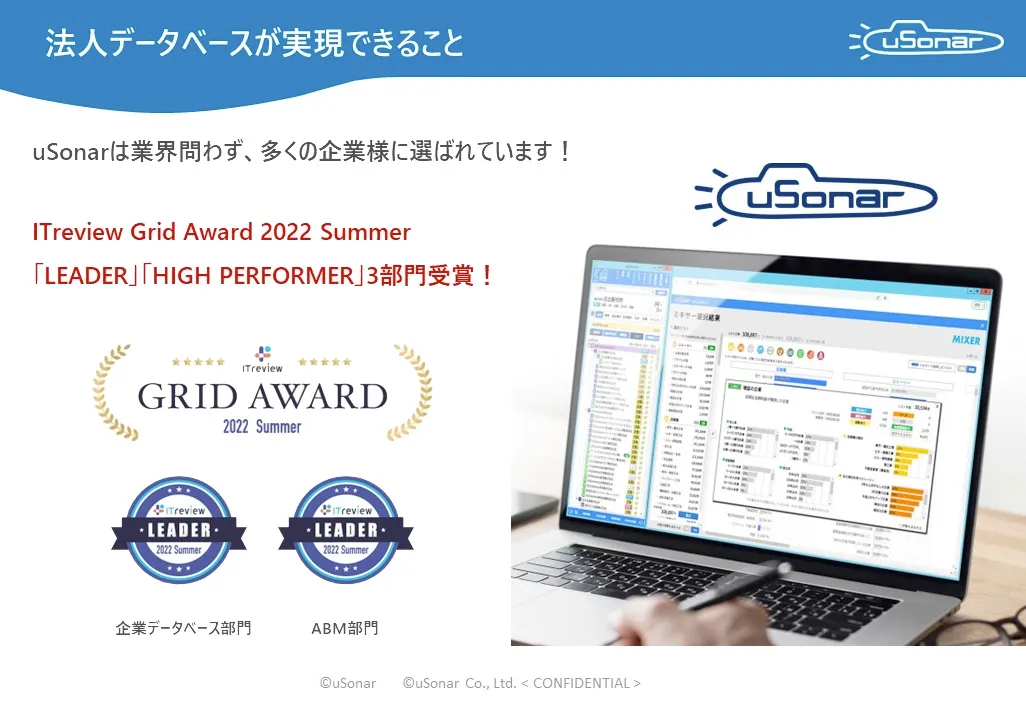
uSonar is utilized by a wide range of companies
across various industries and sectors.
ITreview Grid Award 2026 Summer
Leader in 6 Categories

uSonar Can Help Solve Your Business Challenges!
Case Studies and Sample Reports Available for
Download