- Customer Management and Analysis
What Is Customer Analysis? A Thorough Guide to 16 Frameworks and Tools That Directly Impact Sales!
Last Updated: April 22, 2024
Table of Contents
1Deriving Strategy from Existing Customer Analysis
2Are You Feeling the Limitations of RFM Analysis?
3Essential Data Preparation for Customer and Purchasing Potential Analysis
4Customer Analysis and Purchasing Potential Analysis to Identify Potential High-Value Customers
5Use Cases for Customer Analysis and Purchasing Potential Analysis
Recommended Articles
It is no exaggeration to say that analyzing existing customers is the most critical task when determining a company's direction. To develop superior strategies, it is essential to understand the environmental factors relevant to your company, including the market and competitors. Since comparing your company to the market and competitors is fundamental, visualizing your company's situation through existing customer analysis serves as the axis for all business activities.
While there are various methods for customer analysis, such as Decile Analysis, Segmentation Analysis, and Behavioral Analysis, we will focus on RFM Analysis, which is the most fundamental and important method.
Recommended Articles:
What Is Customer Analysis? A Thorough Guide to 16 Frameworks and Tools That Directly Impact Sales!
RFM Analysis is a method of classifying customers based on three metrics: Recency, Frequency, and Monetary value. Generally, RFM Analysis is a type of customer analysis method that covers the elements necessary to improve LTV (Life Time Value).
However, we often hear the following concerns from many companies:
"With customer analysis based solely on RFM items, we end up approaching the same people every time and cannot find potential prospects..."
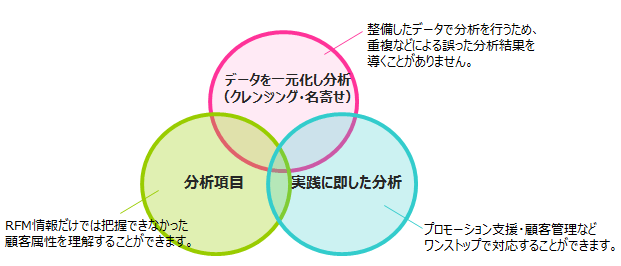
By using the attribute information held by uSonar, it becomes possible to visualize the profiles of existing customers from perspectives other than basic information and RFM items. Therefore, uSonar's customer analysis allows for One-to-One marketing based on an individual understanding of each customer, realizing an approach to potential high-value customers that could not be captured by RFM Analysis alone.
We can help resolve the following issues. Please feel free to consult with us.
For many B2C companies, data preparation is the first challenge in conducting customer analysis. Many companies possess duplicate data due to input errors or missing information, and customer data that is fragmented across various channels such as physical stores and e-commerce sites. Even if you can manage customers by "Customer ID," it requires significant man-hours to match customers across IDs and achieve a unique state ("Unique Customers").
However, by organizing customer data into a unique state, cases can arise where a customer previously recognized as A-rank is actually S-rank. The distribution of customer ranks differs between "Customer ID" and "Unique Customers," and you may be overlooking true high-value customers. Therefore, building accurate customer data is essential for conducting accurate customer analysis.
At uSonar, we also support the construction of "Unique Customer" data as a preparatory step for accurate customer analysis. We perform data processing by utilizing various knowledge, such as name masters, address masters, and map checks. For data organized into "Unique Customers," we append attribute information associated with uSonar's consumer database to conduct customer analysis from multifaceted perspectives beyond RFM items.
In uSonar's customer analysis, we append attribute information associated with uSonar's consumer database in addition to RFM items, allowing you to identify potential high-value customers who are expected to contribute to profits, as well as customers with a high probability of churn. As a result, it is possible to realize an increase in the LTV of existing customers.
In other words, we conduct "Predictive Customer Analysis" to grasp whether a customer should be followed up in the future, rather than RFM Analysis based on current purchase history.
In uSonar's customer analysis, we utilize not only general attribute information but also the following attribute information to delve into the inner aspects of existing customers:
[General Attribute Information] Demographic and geographic information such as gender, age, and residential area, as well as RFM-related information.
[uSonar Attribute Information] Attribute information such as wealth and occupation, and corporate attribute information.
By utilizing this attribute information, we visualize "Potential High-Value Customers" who could become high-value customers in the future.
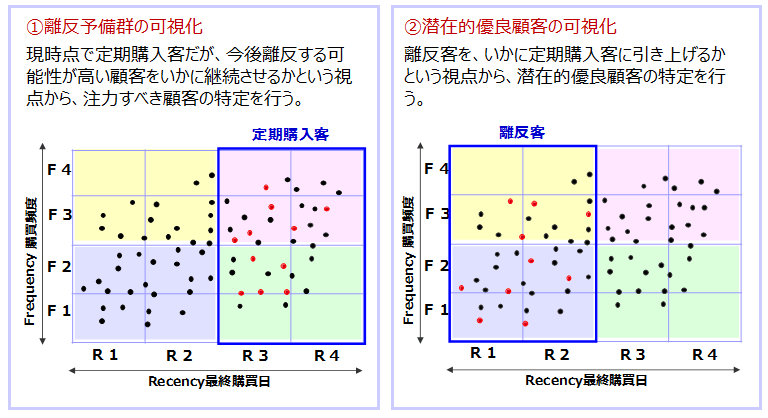
It can be used to solve the following issues:
Author

uSonar Editorial Department
MX Group, Editor-in-Chief
This is the uSonar Editorial Department.
We provide information on data utilization and digital technologies useful for rethinking future business operations, primarily for companies engaged in B2B business.
uSonar is utilized by various companies
across all industries and sectors.
ITreview Grid Award 2026 Summer
Leader in 6 Categories

With uSonar,
we can help resolve your company's challenges!
Case Studies and Sample Reports
Download