- Business Card Management
2026 Definitive Guide: Business Card Management Service Comparison and Features

Last Updated: October 2, 2025
Business card management is an essential challenge that cannot be avoided when streamlining sales activities. However, many companies still manage business cards using analog methods, which often leads to missed business opportunities.
In today's increasingly digital world, the implementation of a business card management tool holds strategic significance that goes beyond simple efficiency. By selecting the right tool, companies can not only improve the productivity of their entire sales organization but also deepen customer understanding and create new business opportunities.
This article systematically explains the key points B2B companies should consider when selecting a business card management tool and introduces the importance of data utilization that extends beyond mere card management. Please use this as a reference to select the optimal tool for your company.
Table of Contents
1The Importance of Business Card Management Tools
2Basic Functions and Selection Criteria for Business Card Management Tools
3Data Accuracy: The Importance of OCR Technology and Manual Correction
3-1Evolution of OCR Technology
4Security Measures: Protecting Corporate Data Safely
5Cost Comparison: Strategies for Maximizing Return on Investment
5-1Key Cost Factors 1: Initial Costs and Monthly Fees
5-2Key Cost Factors 2: Data Conversion Costs
5-4Estimation of Cost Reduction Effects
6Integration Features: Improving Sales Efficiency Through CRM and SFA Integration
6-1Major Integrated Systems: 1. CRM (Customer Relationship Management) Systems
6-2Major Integrated Systems: 2. SFA (Sales Force Automation) Systems
6-3The Importance of API Integration
7The Importance of Data Utilization Beyond Business Card Management
7-1Limitations of Conventional Business Card Management
7-2Strengthening Sales Capabilities Through Data Utilization
Recommended Articles
In modern B2B sales, business card management has evolved beyond simple contact organization into a strategic asset. Traditional analog management methods risk missing valuable business opportunities.
By implementing digital business card management tools, sales representatives can share customer information immediately after an exchange, enabling the entire team to develop cohesive sales strategies. Furthermore, by analyzing the corporate information provided on business cards, teams can assess company scale and industry trends to determine more effective engagement approaches.
The following are the essential features to verify when selecting a business card management tool.
Selecting a tool that meets these criteria ensures smooth post-implementation operations and leads to improved employee productivity.
The core of a business card management tool is the accuracy with which paper business cards are converted into digital data. This accuracy is primarily determined by OCR (Optical Character Recognition) technology.
With current high-precision OCR technology, some services have emerged that achieve a recognition accuracy of 99.9%. Advanced AI technology is particularly necessary for Japanese business cards, as they contain a mix of Kanji, Hiragana, Katakana, and alphanumeric characters.
Since OCR technology alone has its limitations, many high-quality services incorporate manual correction by human operators. This manual correction provides the following benefits:
While manual correction requires time and cost, it can be considered an investment that leads to a significant improvement in sales efficiency over the long term.
Properly protecting personal and corporate information contained in business cards is one of the most critical factors when selecting a business card management tool.
Encryption during the transmission and storage of business card information is essential. SSL/TLS encryption prevents data eavesdropping and tampering.
It is also necessary to verify compliance with legal requirements such as the Act on the Protection of Personal Information and GDPR. Services that have acquired the Privacy Mark guarantee a certain level of security.
The cost of business card management tools should be evaluated not only by simple monthly fees but also by the comprehensive TCO (Total Cost of Ownership).
The market price for corporate business card management software varies widely, ranging from 6,000 yen to over 30,000 yen per month. Pricing models include both pay-as-you-go based on the number of users and flat-rate plans.
As a reference, the standard cost for digitizing a single business card is 50 yen or more. Please calculate your costs by considering the number of business cards acquired monthly.
We calculate the expected benefits of implementing a business card management tool.
When these benefits are converted into monetary value, it is often expected that the ROI will significantly exceed the cost of the tool.
The true value of a business card management tool is realized through its integration with other sales tools.
By integrating with these systems, business card information is automatically registered into the customer database and linked to the history of sales activities.
You can leverage business card information at each stage of the sales process to optimize your approach.
If integration with your company's proprietary systems is required, ensure that an API (Application Programming Interface) is provided. This allows for flexible integration.
There is an important perspective that many companies overlook when selecting a business card management tool: whether the goal is simply managing business cards or utilizing the data beyond that point.
Traditional business card management was limited to organizing contact information. However, the corporate data contained on business cards includes critical information that can influence your sales strategy.
By integrating business card information with a corporate database, you can enable the following advanced sales activities:
For instance, if you could instantly grasp the following information about a company you have exchanged business cards with, your sales strategy would change significantly.
By utilizing such comprehensive corporate information, it becomes possible to build Sales Intelligence that goes beyond simple business card management.
Selecting a business card management tool cannot be based solely on simple feature or cost comparisons. What is important is to clarify what you want to achieve through business card management.
If your goal is merely simple contact management, basic business card management features should suffice. However, if you aim to strengthen sales capabilities and deepen customer understanding, you need a solution that integrates business card information with a corporate database.
mSonar goes beyond traditional business card management by integrating with LBC, one of Japan's largest corporate databases, to support strategic sales activities from the moment business cards are exchanged. With 12.5 million corporate records, you can instantly grasp detailed information about prospective companies and achieve more effective outreach.
If you are considering implementing a business card management tool, please take a moment to review the features of mSonar. We also welcome requests for demonstrations and consultations, so please feel free to contact us.
About the Author

uSonar Editorial Department
MX Group, Editor-in-Chief
We are the uSonar Editorial Department.
We primarily provide information on data utilization and digital technologies to B2B companies, helping them rethink their future business operations.
uSonar is utilized by
various companies across all industries and sectors.
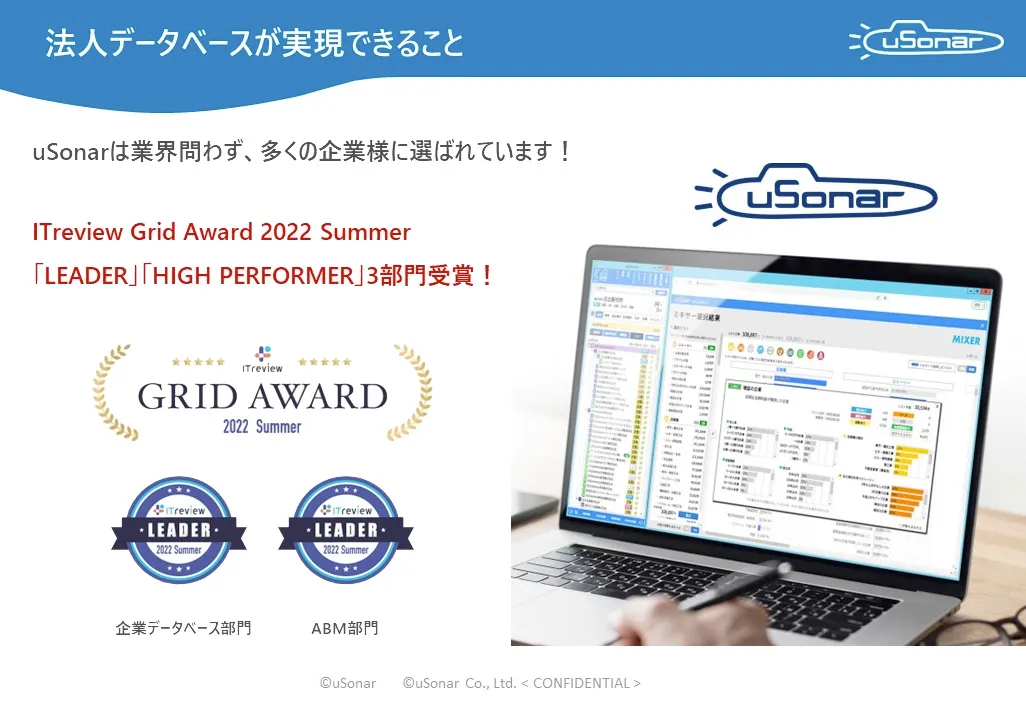
ITreview Grid Award 2026 Summer
Leader in 6 Categories

With uSonar,
we can help solve your company's challenges!
Case Studies and Sample Reports
Download